
400-867-1999
Signage and display manufacturers face growing demand for customized graphics, promotional boards, retail displays, and short-run advertising products. Customers expect accurate cutting, clean edges, and fast delivery, often with frequent changes to artwork and dimensions.
Traditional manual cutting can be time-consuming, while die cutting may require additional tooling for each new design.
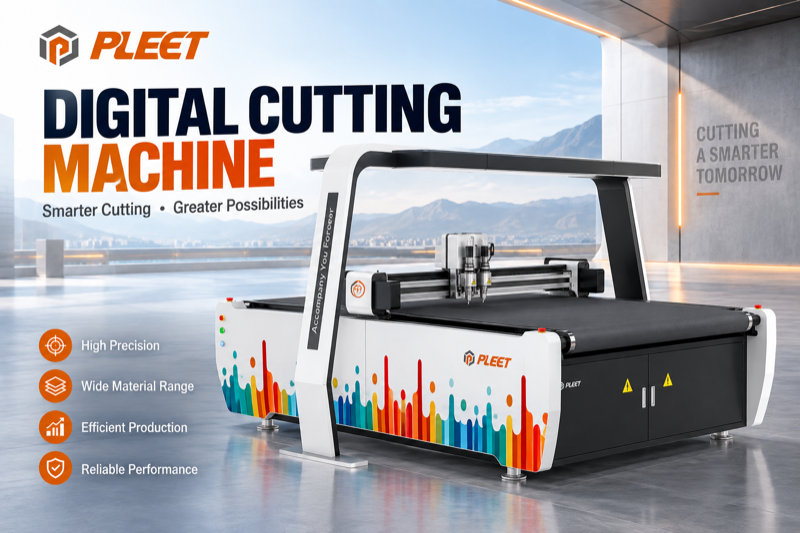
A CNC cutting machine for signage and display production offers a flexible alternative. Combining digital cutting technology, configurable tools, automatic nesting, and optional camera registration, it helps manufacturers process various compatible materials efficiently.
But which features matter most when selecting a digital cutting machine for advertising applications?
A CNC signage cutting machine is a computer-controlled system that cuts advertising and display materials according to digital design files.
Many multifunctional flatbed cutters use oscillating knives, drag knives, and other specialized tools.
The typical workflow includes:
Digital Artwork → CAD File Preparation → Material Positioning → CNC Cutting → Finished Display
For printed materials, optional CCD vision systems can recognize registration marks and adjust cutting paths.
Unlike traditional die cutting, digital cutting allows manufacturers to change product designs without producing dedicated cutting dies.
Different advertising materials require different cutting technologies.
| Material | Typical Application | Recommended Processing |
|---|---|---|
| Paper-faced foam board | Promotional displays | Knife cutting |
| Corrugated cardboard | POP displays and stands | Cutting and creasing |
| Corrugated plastic | Temporary signage | Suitable knife cutting |
| PVC foam board | Advertising panels | Knife or routing, depending on thickness |
| Adhesive vinyl | Stickers and decals | Drag knife or kiss cutting |
| Printed film | Promotional graphics | Camera-assisted contour cutting |
| Polyester fabric | Banners and soft signage | Suitable knife cutting |
| Honeycomb board | Display structures | Specialized knife cutting |
| Acrylic sheet | Rigid signs | CNC routing or suitable laser cutting |
| Aluminum composite panel | Architectural signage | CNC routing |
Material compatibility depends on thickness, density, structure, and cutting-tool configuration.
A conventional oscillating knife cutter should not be considered a universal solution for rigid boards.
Manufacturers can process new designs directly from digital files.
This is especially useful for customized signs, prototypes, and small production batches.
CNC motion control enables cutting of curves, irregular outlines, internal openings, and other suitable shapes.
Operators can modify dimensions or cutting patterns through software without manufacturing new physical tooling.
Automatic nesting software arranges patterns within available sheets to reduce unnecessary offcuts.
A multifunctional machine may support cutting, creasing, kiss cutting, and selected V-cutting operations.
These functions help manufacturers produce different advertising products using one configurable platform.
Printed signage often requires accurate alignment between artwork and cutting contours.
During printing, laminating, or handling, materials may shift, rotate, or experience dimensional changes.
A conventional CNC cutter following the original coordinates may produce visible border misalignment.
A CCD vision system detects printed registration marks or supported visual features.
The software calculates positional differences and adjusts the cutting path.
Printed Material → Camera Recognition → Position Correction → CNC Cutting
Printed promotional signs
Stickers and decals
Branded display graphics
Printed foam boards
Customized advertising textiles
Camera registration can improve print-to-cut alignment, but it cannot physically eliminate wrinkles or unpredictable material deformation.
Point-of-purchase displays frequently require both cutting and folding operations.
Common products include:
Countertop displays
Product presentation stands
Promotional cardboard structures
Retail display boxes
Exhibition decorations
A multifunctional CNC cutter equipped with suitable creasing tools can create fold lines and cut structural contours.
Incorrect creasing may cause cracked coatings, uneven folds, or poor assembly.
Manufacturers should evaluate the complete finished display rather than only the cut sheet.
For load-bearing displays, structural stability must also be verified.
| Factor | CNC Flatbed Cutter | Laser Cutter | CNC Router |
|---|---|---|---|
| Cutting method | Mechanical knife | Thermal energy | Rotating tool |
| Foam board | Suitable for selected types | Material-dependent | Suitable for selected boards |
| Printed graphics | Suitable with vision | Material-dependent | Limited for thin films |
| Corrugated cardboard | Suitable | Possible thermal damage | Generally less practical |
| Acrylic | Usually requires specialized tooling | Suitable for selected acrylics | Suitable |
| Aluminum composite panel | Limited | Generally unsuitable for common configurations | Suitable |
| Main advantage | Multi-material flexibility | Fine details in compatible materials | Rigid-material machining |
For businesses processing flexible graphics and semi-rigid display materials, a digital flatbed cutter is often a practical choice.
For thick acrylic and aluminum composite panels, CNC routing is generally more appropriate.
Safety note: PVC-containing materials should not be processed using unsuitable laser cutting methods because thermal decomposition can release hazardous and corrosive emissions.
Accurate cutting depends on more than machine positioning specifications.
Important factors include:
CAD accuracy: Verify dimensions and cutting paths.
Blade selection: Match tools to material thickness and density.
Material holding: Prevent movement during cutting.
Camera calibration: Maintain reliable print registration.
Cutting parameters: Optimize speed and depth.
Machine maintenance: Inspect blades and motion components regularly.
For printed signage, measure alignment between the finished cutting contour and the printed artwork.
For structural displays, verify dimensions after folding and assembly.
Before purchasing, manufacturers should evaluate:
Material compatibility: Test actual advertising materials.
Working area: Match the table size to the largest signs.
Cutting tools: Confirm required knife, creasing, and kiss-cutting functions.
CCD vision: Evaluate registration performance for printed graphics.
Automatic nesting: Check material utilization.
Vacuum holding: Verify stable sheet positioning.
Production capacity: Measure actual output, including loading and unloading.
Technical support: Confirm installation, training, maintenance, and spare-parts availability.
Request cutting demonstrations using representative production materials and artwork.
Shandong PLEET Intelligent Technology Group Co., Ltd. develops and manufactures CNC digital cutting equipment for flexible materials.
Its configurable systems include:
Oscillating knife cutting
Automatic nesting
Vacuum material holding
Optional CCD vision positioning
Creasing and kiss-cutting tools
Customized working areas
Depending on configuration, PLEET equipment can be evaluated for suitable foam boards, corrugated cardboard, printed graphics, advertising textiles, and promotional display materials.
PLEET also provides material testing, equipment configuration guidance, installation, operator training, and 7×24 remote technical support.
Specific material compatibility and cutting performance should be verified through actual production trials.
A multifunctional digital flatbed cutter is often suitable for flexible graphics and compatible semi-rigid display materials. Rigid materials may require CNC routing.
Yes. Suitable CCD vision systems can improve alignment between printed artwork and cutting contours.
A configurable flatbed cutter may process both using different tools, provided the materials are compatible.
Yes. Digital cutting supports complex shapes, frequent design changes, and small-batch production without dedicated dies.
It can improve material utilization by arranging compatible cutting patterns efficiently.
A CNC cutting machine for signage and display production helps advertising manufacturers handle customized orders, complex contours, and frequent design changes.
Digital flatbed cutting offers advantages including flexible pattern management, automatic nesting, multifunctional tools, and optional camera registration.
For suitable signage materials, PLEET provides configurable CNC cutting solutions supported by material testing and technical services.
The right machine should match your materials, cutting requirements, production volume, and finished-product quality standards—not simply offer the highest advertised cutting speed.