
400-867-1999
Manufacturers processing fabric, leather, foam, rubber, and other flexible materials often face challenges such as inaccurate cutting, material waste, and high labor costs. Traditional cutting methods
may struggle with complex shapes and frequent design changes.
An oscillating knife cutter for flexible materials provides an efficient solution. Combining CNC technology, automatic nesting, and precision cutting tools, it helps manufacturers improve production flexibility, cutting consistency, and material utilization.
An oscillating knife cutter is a CNC-controlled machine that uses a rapidly reciprocating blade to cut materials along programmed paths.
Unlike laser cutting, it separates materials mechanically without intentional thermal processing, helping avoid burning, melting, and thermal discoloration.
The typical workflow includes CAD file preparation, automatic nesting, material positioning, CNC cutting, and finished-part inspection.
Traditional die cutting requires physical tooling for different product designs. An oscillating knife cutter processes digital patterns directly, eliminating dedicated dies for ordinary design changes.
This makes it particularly suitable for customized products, prototypes, and small-batch manufacturing.
With suitable blades and machine configurations, oscillating knife cutters can process various flexible materials.
| Material | Typical Applications |
|---|---|
| Fabric | Upholstery, apparel, technical textiles |
| Genuine and synthetic leather | Footwear, furniture, automotive interiors |
| EVA and EPE foam | Protective packaging, cushioning |
| Rubber sheets | Industrial gaskets and sealing components |
| Carpets | Floor mats and customized rugs |
| Acoustic felt | Soundproofing and insulation |
| Corrugated cardboard | Packaging and displays |
| Dry composite fabrics | Carbon fiber and fiberglass reinforcement |
Material compatibility depends on thickness, density, structure, and cutting-tool selection.
CNC motion control enables the cutting head to follow programmed curves, irregular outlines, and internal openings.
This improves consistency compared with manual cutting, provided the material remains stable.
However, finished-part accuracy also depends on blade geometry, material deformation, and machine calibration.
Automatic nesting software arranges cutting patterns within the available material area.
By optimizing layouts while respecting grain direction and other restrictions, manufacturers can improve material utilization and reduce unnecessary offcuts.
Operators can switch between approved digital cutting files without manufacturing new dies.
This is especially valuable for factories producing multiple product sizes, customized components, and frequently updated designs.
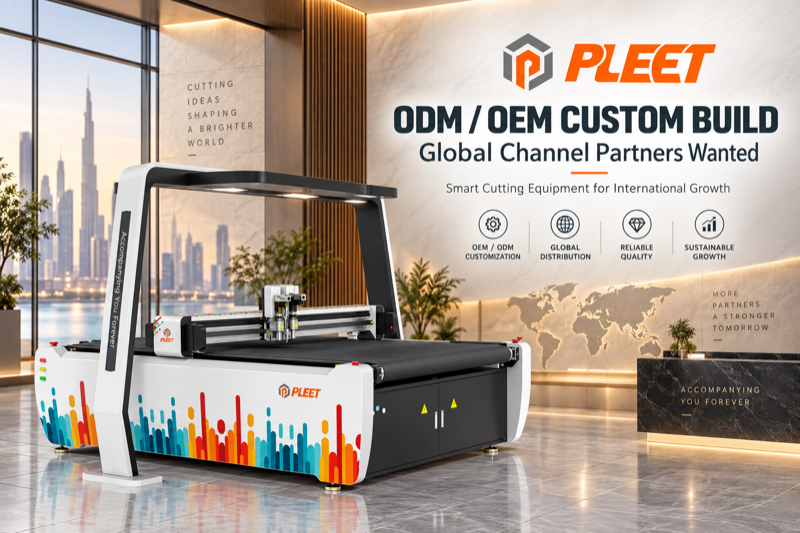
Automated cutting reduces repetitive measuring, marking, and hand-cutting operations.
Optional conveyor feeding can further improve handling efficiency for compatible roll materials.
However, loading, unloading, inspection, and maintenance may still require operators.
Automotive interiors: Cutting seat upholstery, leather coverings, carpets, floor mats, and acoustic insulation.
Furniture manufacturing: Producing sofa fabrics, leather panels, and compatible cushioning components.
Packaging: Creating customized foam inserts, corrugated cardboard packaging, and protective components.
Footwear: Cutting shoe uppers, synthetic leather, and suitable foam materials.
Industrial manufacturing: Producing rubber gaskets, filtration textiles, insulation, and flexible reinforcement fabrics.
The appropriate equipment configuration should be selected according to actual production materials.
| Factor | Oscillating Knife | Die Cutting | Laser Cutting |
|---|---|---|---|
| Dedicated dies | Not required | Usually required | Not required |
| Design flexibility | High | Limited by tooling | High |
| Cutting mechanism | Mechanical blade | Physical die | Thermal energy |
| Thermal edge damage | No intentional heating | No intentional heating | Possible |
| Small-batch production | Often suitable | Tooling costs may be high | Material-dependent |
| High-volume identical parts | Depends on throughput | Often economical | Depends on application |
Oscillating knife cutting is particularly attractive for manufacturers requiring flexible production and frequent pattern changes.
Die cutting may remain more economical for high-volume identical components, while laser cutting requires careful evaluation of material compatibility and emissions.
Before purchasing, manufacturers should evaluate:
Material compatibility: Verify cutting performance using actual materials.
Cutting thickness: Confirm the machine can process the required thickness.
Blade configuration: Select tools suitable for different material structures.
Working area: Ensure the table accommodates production components.
Automatic nesting: Evaluate material utilization and software compatibility.
Material holding: Check vacuum stability and deformation control.
Automation: Consider feeding and CCD vision when necessary.
Technical support: Confirm installation, training, maintenance, and spare-parts availability.
Buyers should request cutting samples and measure finished-part accuracy, edge quality, repeatability, and actual production output.
Shandong PLEET Intelligent Technology Group Co., Ltd. develops and manufactures CNC digital cutting equipment for flexible materials.
Its configurable solutions include oscillating knife technology, automatic nesting, vacuum holding, optional automatic feeding, and CCD vision positioning.
PLEET provides equipment solutions for suitable fabrics, leather, foam, rubber, carpets, packaging, and technical textiles.
The company also offers material testing, customized equipment configurations, installation, operator training, and 7×24 remote technical support.
Specific material compatibility and cutting performance should be verified through actual production trials.
Suitable configurations can process fabrics, leather, foam, rubber, carpets, packaging materials, and selected flexible composite fabrics.
Mechanical cutting is often preferable for heat-sensitive materials because it avoids intentional thermal processing. The best choice depends on material properties and production requirements.
It can reduce dedicated tooling requirements, improve nesting efficiency, and automate repetitive cutting tasks. Actual savings depend on the production process.
Yes. Digital pattern flexibility makes it particularly useful for customized products, prototypes, and frequent design changes.
An oscillating knife cutter for flexible materials combines digital flexibility, mechanical cutting, automatic nesting, and repeatable production.
Its main advantages include eliminating dedicated dies for frequent design changes, processing compatible materials, reducing repetitive manual work, and improving material utilization.
For manufacturers seeking reliable CNC cutting equipment, PLEET offers configurable solutions supported by material testing and technical services.
Selecting the right machine requires evaluating actual materials, finished-part quality, production capacity, and long-term operating costs.