
400-867-1999
Manufacturers working with fabric, leather, foam, rubber, carpets, and technical textiles face a common challenge: flexible materials are not always easy to cut accurately.
Unlike rigid materials, they can stretch, compress, wrinkle, or move under cutting forces. Different materials also require different blade geometries, cutting speeds, and holding methods.
For factories producing customized components or handling frequent design changes, traditional manual cutting can be labor-intensive, while die cutting may require additional tooling costs.
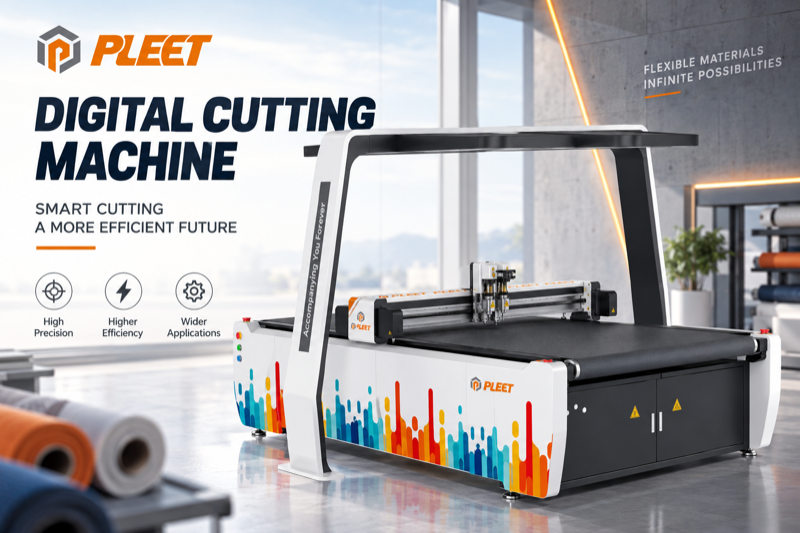
An oscillating knife cutter for flexible materials offers a practical alternative.
Using a computer-controlled cutting head equipped with a rapidly reciprocating blade, this technology can process many compatible soft and semi-rigid materials directly from digital cutting files.
Its advantages include flexible pattern changes, complex contour cutting, automatic nesting, and the ability to process suitable materials without intentional thermal cutting.
However, the benefits depend on selecting the correct equipment configuration and understanding the limitations of mechanical cutting.
This guide explains how oscillating knife cutting works, its key advantages, common industrial applications, and what manufacturers should consider before investing.
An oscillating knife cutter is a CNC-controlled machine that uses a blade moving rapidly back and forth along its cutting axis to separate material.
The cutting head follows a programmed path while the blade performs a reciprocating cutting motion.
Unlike a laser, which uses concentrated thermal energy, an oscillating knife separates the material mechanically.
A typical industrial oscillating knife cutting system includes:
CNC cutting table
Oscillating knife cutting head
Servo motion-control system
Digital cutting software
Automatic nesting functions
Vacuum material-holding system
Configurable blades
Optional automatic feeding
Optional CCD vision positioning
Additional tools for selected applications
The operator imports a digital cutting file into the machine software.
The software prepares the cutting paths and may arrange components through automatic nesting.
The material is positioned on the cutting table and stabilized.
The cutting head then follows the programmed contours.
The process can be summarized as:
CAD Design → Automatic Nesting → Material Positioning → Oscillating Knife Cutting → Component Collection → Inspection
For compatible roll-fed materials, automatic feeding may reduce repeated manual positioning.
One of the most important advantages of oscillating knife cutting is the ability to produce components directly from digital files.
Traditional die cutting requires a physical cutting die shaped according to the component.
For high-volume production of identical parts, this can be economical.
However, when designs change frequently, dedicated tooling can increase preparation costs.
With a CNC oscillating knife cutter, manufacturers can modify cutting patterns through software.
This is particularly useful for:
Product prototypes
Customized components
Small production batches
Frequent engineering revisions
Multiple product sizes
Short-run manufacturing
A packaging manufacturer produces protective foam inserts for different electronic products.
Each product requires a different internal contour.
With digital knife cutting, the manufacturer can update the CAD file and cut the new design without manufacturing a dedicated die.
Digital cutting does not automatically replace die cutting in every application.
For extremely high volumes of identical components, die cutting may still provide lower unit costs.
The main advantage of oscillating knife technology is flexibility.
A configurable oscillating knife cutter can process a wide range of compatible flexible materials.
However, the correct blade and cutting parameters depend on material properties.
| Material | Common Applications | Main Cutting Consideration |
|---|---|---|
| Woven fabric | Upholstery, home textiles | Fraying and grain direction |
| Synthetic leather | Furniture, footwear, automotive interiors | Coatings and backing layers |
| Genuine leather | Handbags, shoes, premium upholstery | Hide defects and thickness variation |
| EVA foam | Protective packaging, footwear | Density and cutting resistance |
| EPE foam | Cushioning and packaging | Compression and tearing |
| Flexible PU foam | Furniture and insulation | Elastic recovery |
| Rubber sheets | Gaskets and industrial pads | Hardness and deformation |
| Carpet | Floor mats and custom rugs | Pile and backing structure |
| PET acoustic felt | Soundproofing panels | Fiber density and edge quality |
| Nonwoven textiles | Filtration and insulation | Porosity and fiber movement |
| Dry carbon fiber fabric | Composite reinforcement | Fiber orientation and fraying |
| Fiberglass fabric | Industrial composites | Blade wear and fiber release |
| Corrugated cardboard | Packaging and displays | Cutting and creasing |
These applications require material-specific configurations.
A machine suitable for thin fabric may need a different cutting head or blade to process dense rubber.
Similarly, rigid cured composite panels generally require routing or waterjet cutting rather than conventional oscillating knife cutting.
Factories processing several compatible materials may be able to use one configurable platform for different production tasks.
However, this should be confirmed through actual cutting tests.
Material versatility is valuable only when the machine produces acceptable finished components across the intended material range.
Oscillating knife cutting mechanically separates materials.
It does not rely on concentrated thermal energy.
This can be beneficial for heat-sensitive materials.
Depending on the material, laser cutting may cause:
Burning
Melting
Charring
Edge discoloration
Smoke and fumes
Thermal degradation
For compatible materials, oscillating knife cutting avoids intentional thermal damage.
This is useful for selected:
Foam materials
Leather
Rubber sheets
Coated textiles
Composite reinforcement fabrics
Acoustic insulation materials
Mechanical cutting is not entirely free from heat or material damage.
Blade friction can generate localized heating.
The cutting process may also cause fraying, compression, tearing, or blade marks.
Some materials, particularly PVC-containing products, can generate hazardous and corrosive emissions during unsuitable thermal processing.
Mechanical cutting may be a more appropriate option for compatible PVC-containing flexible materials.
However, machine safety, blade hazards, and particle generation must still be controlled.
Many industrial components contain irregular shapes.
Examples include:
Automotive floor mats
Leather shoe uppers
Rubber gaskets
Foam packaging inserts
Acoustic insulation panels
Furniture upholstery components
Manual cutting of complex contours can be time-consuming and operator-dependent.
A CNC oscillating knife cutter follows programmed paths.
Depending on material and tooling, the machine may process:
Curved contours
Irregular outlines
Internal openings
Alignment notches
Complex component shapes
Repeated patterns
Digital cutting reduces dependence on manual tracing and cutting.
Approved patterns can be reused for repeated orders.
The machine cannot necessarily reproduce every small radius or intricate feature.
Blade geometry, cutting resistance, and material deformation affect achievable detail.
Buyers should test the smallest required openings and tightest curves.
Consistent cutting is essential for downstream manufacturing.
A component that varies in size may create problems during sewing, bonding, or assembly.
Manual cutting performance can vary because of:
Operator technique
Measuring errors
Pattern positioning
Cutting pressure
Fatigue
Material movement
A digital cutter follows the same programmed path for repeated components.
When the machine is properly calibrated and the material remains stable, this can improve consistency.
Flexible materials can stretch, compress, or shift during cutting.
Therefore, accurate CNC movement does not automatically guarantee accurate finished parts.
Positioning accuracy describes how closely the cutting head follows programmed coordinates.
Finished-part accuracy describes how closely the actual component matches its required dimensions.
These measurements are different.
According to company documentation, applicable digital cutting platforms from Shandong PLEET Intelligent Technology Group Co., Ltd. have manufacturer-stated capabilities including:
Cutting accuracy of up to ±0.01 mm under specified conditions
Maximum cutting speed of up to 2000 mm/s under suitable configurations
These figures should not be interpreted as guaranteed finished-part tolerances or actual production speeds for every material.
Manufacturers should measure finished components across repeated cutting cycles.
Consistency should be evaluated using actual production materials.
Material costs are a major concern in flexible-material manufacturing.
Leather, rubber, technical textiles, and composite reinforcement materials can be expensive.
Automatic nesting software arranges cutting patterns within the available material area.
The software evaluates component shapes and material dimensions.
It then generates a cutting layout intended to improve material utilization.
Fabric grain direction
Leather defects
Carpet pile direction
Printed-pattern orientation
Composite fiber orientation
Cutting margins
Required quantities
Suppose a manufacturer requires acceptable components occupying 900 m².
At 75% material utilization:
900 ÷ 0.75 = 1,200 m² of material
If improved nesting increases utilization to 80%:
900 ÷ 0.80 = 1,125 m²
The potential reduction is 75 m², equivalent to 6.25% of the original material consumption.
This is an illustrative calculation rather than a guaranteed result.
Actual savings depend on component geometry, material restrictions, and existing production efficiency.
The highest theoretical nesting percentage is not always the best result.
For example, rotating composite reinforcement plies incorrectly may violate fiber-orientation requirements.
The correct objective is to maximize acceptable component yield.
Manufacturers increasingly handle customized products and frequent engineering revisions.
Traditional tooling-based processes may require additional preparation when designs change.
With digital cutting, operators can select a different cutting file.
Customized automotive mats
Small-batch leather products
Packaging prototypes
Furniture upholstery
Industrial gaskets
Decorative acoustic panels
Approved cutting files can be stored and reused.
This reduces repeated manual pattern preparation.
A supplier produces carpet components for several vehicle models.
Different models require different contours.
A digital cutter can switch between approved patterns through software.
Although digital file changes are fast, material changes may still require blade adjustments, feeding changes, or new cutting parameters.
Setup time should be measured across the complete production process.
Manual cutting can involve repetitive measuring, marking, and cutting.
CNC cutting automates the programmed cutting path.
Manual contour tracing
Repeated measuring
Hand cutting
Manual pattern positioning
Repetitive cutting operations
Material loading
Material inspection
Finished-part collection
Quality inspection
Blade replacement
Machine maintenance
A basic CNC cutter may automate cutting while retaining manual loading and unloading.
A more integrated system may include automatic feeding and other material-handling functions.
An oscillating knife cutting machine is not necessarily a fully unattended production system.
Buyers should evaluate actual operator requirements rather than assuming complete labor elimination.
Many flexible materials are supplied in rolls.
Examples include:
Fabrics
Synthetic leather
Carpets
Nonwoven insulation
Advertising textiles
Technical textiles
For compatible materials, automatic feeding can reduce repetitive repositioning.
Roll Loading → Controlled Feeding → Material Positioning → Vacuum Holding → CNC Cutting → Collection
Reduced manual handling
More consistent cutting cycles
Improved processing of long rolls
Reduced repositioning time
Better production continuity
Automatic feeding must control:
Material tension
Lateral alignment
Wrinkles
Stretching
Conveyor movement
Manual flatbed loading may remain practical for:
Irregular natural leather hides
Individual sheets
Low-volume production
Frequent material changes
Automatic feeding should be selected according to production requirements.
Some flexible materials contain printed graphics that must align with cutting contours.
Examples include:
Printed fabrics
Advertising graphics
Printed synthetic leather
Decorative carpets
Promotional textiles
During printing and handling, materials may shift, rotate, stretch, or shrink.
A conventional CNC cutter following only the original coordinates may produce misaligned contours.
A camera captures images of printed registration marks or supported visual features.
The software calculates the actual material position and adjusts the cutting path.
Printed Material → Camera Recognition → Position Correction → CNC Cutting
Camera registration can improve print-to-cut alignment.
This is useful when printed borders and cutting contours must match.
CCD vision does not automatically correct every form of local material distortion.
Wrinkles and unstable material positioning can still affect cutting results.
PLEET has documented a CCD vision cutting project for digitally printed textiles.
The company reported:
| Performance Indicator | Project-Specific Result |
|---|---|
| Vision positioning accuracy | Within ±0.2 mm |
| Cutting efficiency | Increased approximately 60% |
| Labor requirements | Reduced more than 50% |
| Rework | Reduced |
These results describe the documented customer application rather than guaranteed results for every installation.
Automotive interior manufacturing uses many flexible materials.
Common applications include:
Seat upholstery
Leather coverings
Floor carpets
Trunk liners
Acoustic insulation
Door-panel coverings
Flexible foam components
Automotive suppliers often manage multiple vehicle models and frequent engineering changes.
Digital cutting supports flexible pattern management.
Automatic nesting can improve material utilization.
Dimensional consistency
Suitable edge quality
Material orientation
Traceability
Sewing and assembly compatibility
Automotive floor mats must be designed and validated so they do not interfere with vehicle pedals.
Cutting accuracy alone does not establish safe vehicle fit.
Leather cutting is an important application of digital knife technology.
Natural hides are irregular and may contain defects.
Manufacturers must consider:
Hide inspection
Quality-zone planning
Grain direction
Thickness variation
Material utilization
Synthetic leather is commonly supplied in rolls.
It may contain polymer coatings and textile backing.
For compatible materials, automatic feeding can improve handling efficiency.
Shoe uppers
Handbags
Furniture upholstery
Automotive seat coverings
Leather accessories
Standard print-registration CCD vision does not automatically provide natural leather defect detection.
Hide scanning and defect mapping require separately supported functions.
Foam is widely used in protective packaging, footwear, furniture, and insulation.
Common materials include:
EVA foam
EPE foam
Flexible PU foam
Selected rubber foams
CNC knife cutting can produce customized foam contours without dedicated dies.
This is useful for:
Protective packaging inserts
Cushioning components
Industrial foam pads
Customized insulation
Compression
Elastic recovery
Tearing
Blade deflection
Incomplete cutting
Conventional flatbed knife cutting is primarily suitable for compatible sheets and profiles.
Thick three-dimensional foam blocks may require specialized foam cutting or routing equipment.
Rubber sheets are used in industrial sealing and protective applications.
Common materials include:
EPDM
NBR
Neoprene
Silicone rubber
Natural rubber
CNC knife cutting can produce customized gasket shapes without dedicated dies.
This is useful for prototypes, replacement parts, and small batches.
Elastic deformation
Cutting resistance
Blade wear
Small-hole accuracy
Dimensional recovery
Very thick or dense rubber materials may require waterjet cutting or other specialized technologies.
The actual rubber formulation should be tested.
Carpet cutting is another important application.
Common products include:
Custom rugs
Automotive floor mats
Entrance mats
Commercial carpets
Promotional floor coverings
The machine can follow irregular contours and customized dimensions.
Large-format cutting systems can reduce repeated repositioning for suitable oversized components.
PLEET has documented a customized 3.2 m × 4.5 m oscillating knife cutting system for a carpet manufacturer in Zhejiang, China.
The system included:
Automatic feeding
Vacuum holding
Intelligent nesting
The documented project reported improved cutting consistency, reduced repeated repositioning, and better material utilization.
These outcomes describe the specific customer application rather than guaranteed results for every factory.
Acoustic and insulation materials are used in construction, automotive manufacturing, HVAC systems, and industrial equipment.
Common materials include:
PET acoustic felt
Polyester nonwoven insulation
Flexible PU foam
Rubber acoustic barriers
Selected fiberglass insulation
Flexible multilayer materials
CNC knife cutting can produce customized insulation components with irregular contours and mounting openings.
Fiber movement
Compression
Blade wear
Layer separation
Dimensional variation
Rigid acoustic boards and thick rigid insulation materials may require routing, saw cutting, or other specialized processes.
Technical textiles are engineered for industrial performance.
Common applications include:
Industrial filtration
Composite reinforcement
Protective products
Automotive materials
Industrial insulation
Polyester technical fabrics
Dry carbon fiber fabric
Fiberglass reinforcement
Selected aramid fabrics
Nonwoven industrial textiles
For suitable flexible reinforcement materials, mechanical knife cutting can produce complex shapes without intentional thermal processing.
Fiber orientation
Edge quality
Blade wear control
Material stability
Finished-ply accuracy
Rigid cured composite panels generally require routing, abrasive waterjet cutting, or other specialized machining.
Manual cutting remains common in small workshops.
However, it can become inefficient as production complexity increases.
| Factor | Manual Cutting | Oscillating Knife CNC Cutting |
|---|---|---|
| Cutting method | Operator-controlled | Computer-controlled |
| Pattern changes | Manual preparation | Digital file changes |
| Complex contours | Skill-dependent | Programmable |
| Repeatability | Operator-dependent | More consistent when validated |
| Material nesting | Manual layout | Automatic nesting available |
| Initial investment | Lower | Higher |
| Best application | Occasional simple cutting | Repeated and varied production |
Manual cutting may remain economical for occasional work and simple shapes.
Digital cutting becomes more valuable for customized products, complex patterns, frequent changes, and repeated production.
Die cutting uses a physical cutting die.
Oscillating knife cutting follows digital paths.
| Factor | Oscillating Knife Cutting | Die Cutting |
|---|---|---|
| Dedicated tooling | Not required for normal design changes | Usually required |
| Design revisions | Digital file updates | Tool changes may be needed |
| Prototypes | Highly flexible | Tool preparation required |
| Small batches | Often advantageous | Tooling costs may be significant |
| High-volume identical parts | Depends on cycle time | Often efficient |
| Main advantage | Flexibility | Repeated production throughput |
For high-mix, low-volume manufacturing, oscillating knife cutting is often attractive.
For very high volumes of identical compatible components, die cutting may offer better economics.
Some manufacturers use both technologies in different production stages.
Laser cutting uses concentrated thermal energy.
Oscillating knife cutting uses mechanical blade movement.
| Factor | Oscillating Knife | Laser Cutting |
|---|---|---|
| Cutting mechanism | Mechanical blade | Thermal energy |
| Intentional heating | No | Yes |
| Material contact | Yes | No cutting-tool contact |
| Flexible fabrics | Suitable for many materials | Material-dependent |
| Leather | Suitable with appropriate tools | Thermal effects require evaluation |
| Foam | Suitable for selected foams | Melting or degradation may occur |
| Rubber | Suitable for compatible sheets | Thermal emissions require evaluation |
| Tool wear | Blade replacement required | No mechanical blade |
| Main safety concerns | Mechanical hazards and particles | Laser hazards, smoke, and fumes |
Mechanical cutting is often attractive for heat-sensitive materials and applications where thermal edge damage is unacceptable.
Laser cutting may be suitable for selected compatible materials requiring fine details.
However, material composition, thermal effects, and emissions must be evaluated.
Maximum cutting speed does not represent actual production output.
The complete cycle includes:
File Preparation + Material Loading + Positioning + Cutting + Unloading + Inspection
For roll-fed materials, feeding time must also be included.
Acceptable components per hour
Material utilization
Reject rate
Pattern-change time
Operator intervention
Blade consumption
Machine downtime
Cost per acceptable component
Suppose a machine produces 720 acceptable components during a six-hour production period.
Average output is:
720 ÷ 6 = 120 acceptable components per hour
This is an illustrative calculation.
Actual productivity depends on component geometry, material handling, and production conditions.
A sheet containing many small gasket openings may require more cutting time than one containing a few large foam components.
Performance should be measured using representative production patterns.
Equipment price depends on configuration.
Major factors include:
Working area
Machine construction
Cutting-head capability
Blade configuration
Vacuum holding
Automatic nesting software
Automatic feeding
CCD vision positioning
Additional cutting tools
Installation and technical support
A simplified calculation is:
Total Cost = Equipment + Labor + Material Waste + Consumables + Energy + Maintenance + Downtime
Cost per Acceptable Component = Total Cutting-Process Cost ÷ Acceptable Components Produced
A lower-priced machine may be sufficient for simple applications.
A more configurable system may be justified when the factory processes several materials or requires additional automation.
The investment should be evaluated using actual production requirements and operating costs.
| Problem | Possible Cause | Recommended Action |
|---|---|---|
| Incomplete cutting | Incorrect depth or blade selection | Verify tool configuration |
| Fabric fraying | Worn blade or unsuitable settings | Optimize blade and parameters |
| Foam compression | Excessive cutting force | Improve blade and support |
| Rubber deformation | Elastic recovery | Optimize cutting strategy |
| Leather edge damage | Incorrect blade geometry | Test suitable blades |
| Material shifting | Insufficient holding | Improve positioning |
| Roll misalignment | Feeding tension problems | Check feeding system |
| Printed contour errors | Vision calibration issues | Verify camera and material stability |
| Excess material waste | Inefficient nesting | Improve cutting layouts |
| Low productivity | Long setup or handling time | Evaluate complete production cycle |
Troubleshooting should begin by identifying whether the defect originates from the material, cutting tool, holding system, or machine configuration.
Before purchasing, manufacturers should define their actual production requirements.
Can the machine process the intended materials?
Can it cut the maximum required thickness while maintaining acceptable edge quality?
Does the system support suitable tools for different material structures?
Can the machine accommodate the largest components?
Do cut components meet dimensional requirements?
Can the material remain stable without unacceptable deformation?
Can the software arrange components efficiently while respecting restrictions?
Is continuous roll processing necessary?
Does the application require printed-pattern registration?
Does the manufacturer provide material testing, installation, training, maintenance, and troubleshooting?
Request cutting trials using actual production materials.
Evaluate:
Cutting completeness
Edge quality
Finished-part dimensions
Repeatability
Material utilization
Production output
Blade wear
Operator intervention
Software compatibility
Cost per acceptable component
The correct machine should be selected according to actual production performance rather than advertised specifications alone.
Shandong PLEET Intelligent Technology Group Co., Ltd. develops and manufactures CNC digital cutting equipment for flexible materials.
Its documented capabilities include:
CNC oscillating knife cutting
Configurable cutting tools
Automatic nesting
Vacuum adsorption
Automatic feeding
CCD vision positioning
Customized working areas
Industrial equipment testing
Depending on machine configuration and successful material testing, PLEET equipment may be evaluated for:
Fabrics and technical textiles
Genuine and synthetic leather
EVA, EPE, and compatible PU foam
Rubber sheets
Carpets and floor mats
Packaging materials
Automotive interior components
Acoustic insulation
Selected flexible composite reinforcement fabrics
PLEET's documented procedures include incoming component inspection, assembly quality control, calibration, stability testing, continuous-operation testing, and final inspection.
The company provides material testing, application analysis, equipment configuration guidance, installation, operator training, maintenance support, and 7×24 remote technical assistance.
These capabilities make PLEET a relevant manufacturer to evaluate for suitable flexible-material cutting applications.
However, cutting performance, material compatibility, automation functions, and after-sales terms should be confirmed for the specific proposed equipment.
An oscillating knife cutter is used to cut compatible flexible materials such as fabric, leather, foam, rubber, carpets, packaging materials, and selected technical textiles.
Key advantages include digital pattern flexibility, no dedicated dies for ordinary design changes, complex contour cutting, automatic nesting, repeatability, and no intentional thermal cutting.
A configurable machine may process several compatible materials using different blades and parameters. However, not every configuration can cut every material.
Mechanical knife cutting is often preferable for heat-sensitive materials. Laser cutting may be suitable for selected applications, but thermal effects and emissions must be evaluated.
Automatic nesting can improve material utilization by arranging patterns efficiently while respecting material restrictions.
It can support industrial production, particularly for mixed designs and compatible materials. For very high volumes of identical parts, die cutting may sometimes be more economical.
Use actual production materials to test cutting completeness, edge quality, finished-part accuracy, repeatability, material utilization, blade wear, and cost per acceptable component.
An oscillating knife cutter for flexible materials offers important advantages for manufacturers processing suitable textiles, leather, foam, rubber, carpets, packaging, and composite reinforcement fabrics.
Its key strengths include:
Digital Pattern Flexibility + No Dedicated Cutting Dies + Mechanical Cutting + Automatic Nesting + Repeatable Production
Optional automatic feeding can improve handling efficiency for compatible roll materials, while CCD vision can support print-to-cut alignment.
However, successful cutting depends on material compatibility, blade selection, stable holding, and realistic production requirements.
The most important equipment-selection factors are:
Material Structure + Cutting Tool Configuration + Finished-Part Accuracy + Material Handling + Production Capacity
PLEET offers configurable oscillating knife cutting systems for suitable flexible materials, supported by material testing, manufacturing quality-control procedures, and technical services.
Manufacturers considering this technology should request material-specific cutting trials and verify performance against their actual production requirements.
The greatest advantage of oscillating knife cutting is not simply automated blade movement. It is the ability to turn changing digital designs into consistent physical components while maintaining flexibility, controlling material waste, and supporting efficient manufacturing.