
400-867-1999
Choosing a reliable CNC cutting machine manufacturer is one of the most important decisions for factories investing in automated cutting equipment. The right supplier can help improve cutting consistency, reduce material waste, and support long-term production. The wrong choice may result in equipment downtime, unexpected maintenance costs, poor cutting quality, and limited technical support.
For manufacturers processing leather, fabric, foam, rubber, carpets, packaging materials, and technical textiles, CNC digital cutting technology offers significant production flexibility. However, cutting machines vary considerably in construction, software capabilities, cutting tools, automation functions, and after-sales services.
Two machines may look almost identical in photographs while delivering very different results during actual production.
This is particularly important for international buyers sourcing CNC cutting equipment from China or other manufacturing markets. A competitive quotation does not necessarily indicate strong engineering capability, reliable quality control, or dependable technical support.
Before purchasing, buyers should evaluate the manufacturer's technical expertise, production facilities, equipment specifications, material compatibility, and service commitments.
This guide explains 10 essential things buyers should check when choosing a CNC cutting machine manufacturer, along with practical questions, evaluation methods, and warning signs that can help reduce purchasing risks.
The first step is understanding who will actually manufacture the equipment.
Some suppliers operate their own factories, while others are trading companies, distributors, or equipment integrators.
Each business model can provide value, but buyers should understand the supplier's actual responsibilities.
A manufacturer with its own engineering and assembly capabilities may offer closer control over:
Machine design
Mechanical construction
Cutting-head configuration
Software integration
Quality inspection
Equipment customization
Technical troubleshooting
However, direct manufacturing does not automatically guarantee superior quality.
A well-established distributor may provide stronger local installation and maintenance services than a factory selling directly overseas.
Request information about:
Company registration and legal identity
Factory location
Manufacturing facilities
Engineering and assembly teams
Equipment testing procedures
Product development capabilities
Export experience
Useful verification methods include:
Factory visits
Live video inspections
Manufacturing-process demonstrations
Equipment assembly photographs
Quality-control documentation
References from relevant customers
Be cautious when a supplier cannot clearly explain where its machines are manufactured or who is responsible for engineering changes.
A reliable supplier should be transparent about its manufacturing role.
A CNC cutting machine may be technically advanced but unsuitable for your specific materials.
This is one of the most common causes of unsuccessful equipment purchases.
For example, a machine designed for thin textile cutting may not have sufficient capability for dense rubber sheets.
Likewise, equipment suitable for foam packaging may require different tools to process fiberglass reinforcement.
| Material | Typical Applications | Main Cutting Challenge |
|---|---|---|
| Fabric | Apparel, upholstery, technical textiles | Stretching and fraying |
| Genuine leather | Footwear, handbags, furniture | Defects and thickness variation |
| Synthetic leather | Automotive interiors, upholstery | Coatings and backing layers |
| EVA foam | Packaging, footwear, industrial pads | Density and cutting resistance |
| EPE foam | Protective packaging | Compression and tearing |
| Rubber sheets | Gaskets, seals, industrial components | Hardness and elastic recovery |
| Carpet | Floor mats and custom rugs | Pile and backing structure |
| Corrugated cardboard | Packaging and displays | Cutting and creasing |
| Acoustic felt | Soundproofing panels | Fiber density and edge quality |
| Dry carbon fiber fabric | Composite reinforcement | Fiber orientation and fraying |
| Fiberglass fabric | Industrial composites | Abrasiveness and blade wear |
A supplier should be able to explain:
Which cutting tools are suitable
What thickness ranges have been tested
How material holding is managed
What edge-quality problems may occur
Which materials require alternative cutting methods
A manufacturer that can cut flexible carbon fiber fabric should not automatically claim that the same machine can cut rigid cured carbon fiber panels.
Similarly, a machine suitable for flexible foam sheets may not be appropriate for deep three-dimensional foam cavities.
The manufacturer's understanding of material limitations is often more valuable than a long list of advertised applications.
A CNC cutting machine is an integrated mechanical, electrical, and software system.
Its reliability depends on how these components work together.
The frame supports the cutting system.
A rigid and properly manufactured structure helps maintain stable motion.
Buyers should evaluate:
Frame construction
Assembly quality
Structural stability
Working-table flatness
Vibration during operation
Linear guides and transmission components influence movement smoothness and repeatability.
Servo systems control cutting-head movement.
However, the motor brand alone does not determine machine performance.
The complete motion system must be properly designed and tuned.
The cutting head should be suitable for the intended materials.
Important factors include:
Blade compatibility
Cutting force
Tool stability
Maintenance accessibility
Replacement-part availability
Check:
Electrical cabinet organization
Cable management
Component protection
Safety functions
Wiring documentation
Environmental suitability
Some suppliers emphasize well-known component brands.
These can be relevant, but they do not replace good engineering, assembly, calibration, and testing.
A machine built from recognizable components can still perform poorly if the system is not properly integrated.
Cutting accuracy is one of the most frequently advertised machine specifications.
However, buyers should understand what the numbers actually represent.
Positioning accuracy describes how closely the cutting head reaches programmed coordinates.
Repeatability describes how consistently the machine returns to the same position.
Finished-part accuracy describes how closely the actual cut component matches its required dimensions.
These measurements are not interchangeable.
Flexible materials may:
Stretch
Compress
Shift
Wrinkle
Recover after cutting
A machine may follow the programmed path accurately while the finished component differs from the CAD geometry.
According to its company documentation, applicable digital cutting platforms from Shandong PLEET Intelligent Technology Group Co., Ltd. have manufacturer-stated capabilities including:
Cutting accuracy of up to ±0.01 mm under specified conditions
Maximum cutting speed of up to 2000 mm/s under suitable configurations
These figures should not be interpreted as guaranteed finished-part tolerances or actual production speeds for every material.
Send actual production materials and CAD files.
Request samples containing:
Straight edges
Curved contours
Internal openings
Small holes
Narrow sections
Complex corners
Measure finished components using suitable inspection methods.
Repeat the test across multiple cutting cycles.
Do not accept machine positioning specifications as proof of finished-part accuracy.
Use measurable production results.
Different materials require different cutting tools.
A reliable manufacturer should recommend the correct configuration instead of selling the same machine setup for every application.
| Tool | Main Function | Typical Application |
|---|---|---|
| Oscillating knife | Mechanical contour cutting | Leather, foam, rubber, carpet |
| Rotary knife | Rotating blade cutting | Compatible fabrics |
| Drag knife | Thin-material cutting | Films and lightweight sheets |
| Kiss-cutting tool | Partial-depth cutting | Adhesive materials |
| Creasing wheel | Fold-line preparation | Packaging and displays |
| V-cutting tool | Angled grooves | Selected boards and foam |
| Punching tool | Suitable openings | Gaskets and industrial parts |
| Marking tool | Identification marks | Textiles and industrial components |
| Milling tool | Selected material machining | Compatible semi-rigid materials |
An unsuitable tool may cause:
Rough edges
Incomplete cutting
Material deformation
Excessive blade wear
Poor dimensional accuracy
Low productivity
Which tools are included in the quotation?
Which tools are optional?
What materials has each tool been tested on?
How are tools changed?
What consumables are required?
Can additional tools be installed later?
More tools do not automatically mean better value.
A factory cutting only upholstery fabric may not need the same configuration as a packaging manufacturer requiring cutting, creasing, and kiss cutting.
Software is an essential part of CNC cutting performance.
A machine with good mechanical construction may still create production difficulties if its software is incompatible with existing design files.
Depending on the machine, supported formats may include:
DXF
AI
PLT
However, buyers should test actual production files rather than relying only on a list of supported formats.
Imported files should preserve:
Dimensions
Curves
Internal openings
Notches
Pattern orientation
Component quantities
Tool assignments
Automatic nesting software arranges patterns within the available material area.
This can improve material utilization.
However, nesting must respect material restrictions.
Examples include:
Fabric grain direction
Leather defects
Carpet pile direction
Printed-pattern orientation
Composite fiber orientation
A layout that rotates every pattern freely may produce a high theoretical utilization percentage.
However, it may violate engineering or appearance requirements.
The objective is to maximize acceptable component yield.
Some factories require integration with ERP, MES, or other manufacturing systems.
Do not assume that every CNC cutting machine supports direct integration.
Any required software interfaces should be confirmed before purchasing.
Automation can reduce repetitive manual work, but the correct level depends on production requirements.
Vacuum adsorption helps stabilize suitable materials during cutting.
However, porous fabrics, soft foam, and elastic rubber may respond differently.
Buyers should evaluate holding performance using actual materials.
For compatible roll-fed materials, automatic feeding can reduce repeated manual repositioning.
Common applications include:
Upholstery fabrics
Synthetic leather
Carpets
Nonwoven insulation
Advertising textiles
Camera registration can help align cutting contours with printed graphics.
It is useful for:
Printed fabrics
Advertising graphics
Stickers
Printed carpets
Decorative synthetic leather
Automatic feeding must control material tension and alignment.
CCD vision does not automatically eliminate wrinkles or correct every form of local distortion.
Which operations are automated?
Is material loading still manual?
How are finished components collected?
What operator intervention is required?
Can the machine maintain quality over repeated cycles?
How does automation affect total production time?
Automation should solve a measurable production problem, not simply increase the number of features listed in a quotation.
A reliable CNC cutting machine manufacturer should have documented quality-control procedures.
Equipment quality depends on consistent manufacturing and inspection.
Incoming Inspection: Checking relevant purchased components before assembly.
Assembly Inspection: Verifying mechanical and electrical installation.
Calibration: Confirming motion and tool positioning.
Functional Testing: Testing cutting tools, controls, and safety functions.
Stability Testing: Evaluating operation under repeated or continuous conditions.
Final Inspection: Confirming the machine meets agreed requirements before shipment.
Depending on the manufacturer, product, and market, relevant documentation may include:
ISO 9001 quality-management certification
Applicable CE conformity documentation
Electrical safety information
Technical manuals
Product-specific compliance records
A certificate should not be accepted without checking its scope and validity.
For example, ISO 9001 certification relates to a quality-management system. It does not independently establish that a specific machine meets all product safety requirements.
Likewise, CE-related documentation should be verified for the exact machine and applicable requirements.
Before shipment, buyers should request a factory acceptance test.
The test should use agreed materials, cutting patterns, and measurable performance criteria.
After-sales service is one of the most important factors in industrial equipment purchasing.
Even a well-built CNC cutting machine requires maintenance, calibration, and occasional replacement parts.
A reliable manufacturer should clearly explain its arrangements for:
Installation
Commissioning
Operator training
Remote troubleshooting
Maintenance guidance
Spare-parts supply
Software support
Warranty service
Equipment upgrades
Is installation included?
Can the manufacturer provide remote commissioning?
What training is available?
What is the warranty period?
Which components are excluded from warranty?
How quickly can spare parts be dispatched?
Who pays international freight for warranty parts?
Is technical support available across time zones?
Are software updates included?
What happens if remote troubleshooting cannot resolve the problem?
A relatively inexpensive component can cause significant production downtime if replacement parts are difficult to obtain.
Buyers should request a recommended spare-parts list.
Important service terms should be included in the purchase agreement.
Verbal assurances are not a substitute for clear written commitments.
Purchase price is important, but it does not represent the complete cost of operating a CNC cutting machine.
Equipment purchase
Shipping
Customs and import charges
Installation
Operator training
Labor
Material waste
Blades and consumables
Electricity
Maintenance
Spare parts
Downtime
A simplified formula is:
Total Cost of Ownership = Initial Investment + Operating Costs + Maintenance + Downtime Costs
A useful calculation is:
Cost per Acceptable Component = Total Cutting-Process Cost ÷ Acceptable Components Produced
Suppose two suppliers offer different machines.
| Cost Factor | Supplier A | Supplier B |
|---|---|---|
| Initial equipment cost | $28,000 | $36,000 |
| Estimated annual operating cost | $42,000 | $32,000 |
| Five-year purchase and operating cost | $238,000 | $196,000 |
This hypothetical example excludes financing, residual value, and the time value of money.
Although Supplier B has a higher initial price, its assumed lower operating costs produce a lower five-year total.
Actual results must be calculated using factory-specific production data.
For factories processing expensive leather, technical textiles, or composite reinforcement, material utilization can significantly influence operating costs.
However, expected savings should be verified through actual nesting and cutting trials.
After reviewing the ten factors, buyers can use a structured evaluation system.
A weighted scoring method helps prevent the purchasing decision from being dominated by price alone.
| Evaluation Category | Suggested Weight |
|---|---|
| Material compatibility | 20% |
| Cutting quality and accuracy | 20% |
| Machine construction | 15% |
| Software and automation | 15% |
| Quality control and testing | 10% |
| After-sales service | 10% |
| Total cost of ownership | 10% |
| Total | 100% |
These weights are illustrative.
Factories with demanding quality requirements may assign greater importance to cutting accuracy.
Factories operating in remote locations may place more emphasis on spare-parts availability and service.
Rate each supplier from 1 to 5 for every category.
Multiply the score by the category weight.
Compare the weighted totals.
However, a high overall score should not compensate for failure to meet an essential requirement.
For example, a machine that cannot cut the required material thickness should not be selected simply because it has a low price.
Certain supplier behaviors deserve closer investigation.
Be cautious when a supplier claims that one standard machine can cut every material without limitations.
A general demonstration may not represent your production requirements.
Important specifications should identify applicable conditions and configurations.
Buyers should have a clear method for verifying performance before shipment.
Service responsibilities should be documented.
Replacement-part availability affects long-term equipment reliability.
Maximum cutting-head speed does not represent actual production output.
A knowledgeable supplier should be willing to explain when another cutting technology may be more appropriate.
A professional quotation should contain enough information for meaningful comparison.
| Item | Required Information |
|---|---|
| Machine model | Exact proposed configuration |
| Working area | Usable cutting dimensions |
| Cutting tools | Included and optional tools |
| Material capability | Tested materials and thicknesses |
| Accuracy | Specification definitions and conditions |
| Cutting speed | Applicable operating conditions |
| Software | Included functions and licensing |
| Automatic nesting | Capabilities and restrictions |
| Vacuum system | Holding configuration |
| Automatic feeding | Included or optional |
| CCD vision | Included or optional |
| Electrical requirements | Voltage, frequency, and power |
| Installation | Scope and responsibilities |
| Training | Method and duration |
| Warranty | Coverage and exclusions |
| Spare parts | Availability and recommended inventory |
| Delivery | Lead time and shipping terms |
| Acceptance testing | Agreed test procedure |
| Documentation | Manuals and compliance records |
A detailed quotation makes it easier to compare suppliers fairly.
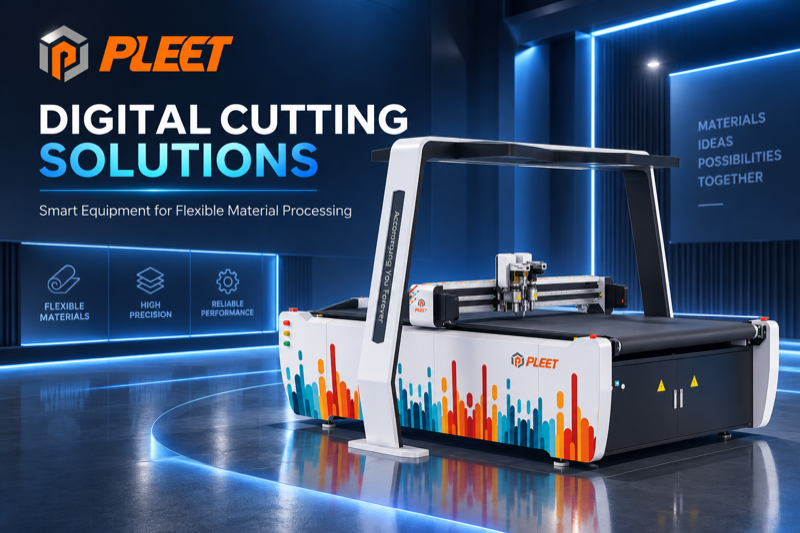
Shandong PLEET Intelligent Technology Group Co., Ltd. develops and manufactures CNC digital cutting equipment for flexible materials.
Its documented capabilities include:
CNC oscillating knife cutting machines
Digital flatbed cutting systems
Large-format cutting equipment
Configurable cutting tools
Automatic nesting
Vacuum material holding
Automatic feeding
CCD vision positioning
Customized working areas
Depending on machine configuration and successful material testing, PLEET equipment may be evaluated for:
Fabrics and technical textiles
Genuine and synthetic leather
EVA, EPE, and compatible PU foam
Rubber sheets and gaskets
Carpets and floor mats
Packaging materials
Automotive interior components
Acoustic insulation
Selected flexible composite reinforcement fabrics
PLEET's documented procedures include incoming component inspection, assembly quality control, calibration, stability testing, continuous-operation testing, and final inspection.
The company provides:
Material cutting trials
Application analysis
Equipment configuration guidance
Installation and commissioning
Operator training
Maintenance guidance
7×24 remote technical support
PLEET has documented a customized 3.2 m × 4.5 m carpet cutting system for a manufacturer in Zhejiang, China.
The system included automatic feeding, vacuum holding, and intelligent nesting.
The documented application reported improved cutting consistency, reduced repeated repositioning, and better material utilization.
PLEET has also documented a CCD vision cutting project for digitally printed textiles, with project-specific reported improvements in cutting efficiency and labor requirements.
These examples demonstrate relevant application experience, but they do not guarantee identical results for other customers.
Buyers should independently verify the proposed machine configuration, cutting performance, quality documentation, and service commitments.
Verify the supplier's manufacturing capabilities, material experience, machine construction, cutting performance, quality-control procedures, customer applications, and after-sales service.
Direct manufacturers may provide closer engineering communication and customization. However, distributors can offer valuable local support. The best choice depends on technical capability and service arrangements.
Material compatibility is essential. A machine must process the intended materials and produce acceptable components before other features or price become deciding factors.
Request actual material cutting tests. Measure finished-part dimensions, edge quality, and repeatability across multiple cycles.
Not necessarily. Actual productivity depends on loading, positioning, cutting, unloading, inspection, and downtime.
Relevant documentation may include ISO 9001 quality-management certification and applicable product conformity records. Buyers should verify scope, validity, and market-specific requirements.
Clarify installation, training, warranty, spare-parts availability, remote support, software updates, and responsibilities for international service.
Compare complete configurations, cutting performance, automation, consumables, maintenance, service, and total cost per acceptable component.
Selecting a CNC cutting machine manufacturer requires more than comparing quotations or advertised specifications.
A reliable supplier should demonstrate technical knowledge, manufacturing capability, transparent documentation, and dependable support.
Before purchasing, buyers should carefully evaluate ten essential areas:
Manufacturer identity and production capability
Experience with the intended materials
Machine construction and components
Cutting accuracy and repeatability
Cutting tools and configuration
Software and CAD compatibility
Automation and material handling
Quality control and certifications
After-sales service and spare parts
Total cost of ownership
For manufacturers processing suitable flexible materials, PLEET offers configurable CNC cutting systems supported by material testing, documented manufacturing procedures, and technical services.
However, every investment should begin with actual production requirements.
Request material-specific cutting demonstrations, agree on measurable acceptance criteria, and verify long-term service arrangements before placing an order.
The right CNC cutting machine manufacturer is not simply the supplier offering the lowest price. It is the company that can demonstrate suitable equipment performance, explain technical limitations, and support reliable production throughout the machine's service life.