
400-867-1999
Carpet manufacturing is changing. Alongside traditional large-volume production, manufacturers are receiving more orders for customized rugs, irregularly shaped carpets, branded entrance mats, hotel flooring, and made-to-measure interior products.
These orders create a challenge for conventional cutting methods.
A customer may request a round rug today, an irregularly shaped hotel carpet tomorrow, and a small batch of printed floor mats next week. Each order can involve different dimensions, materials, backing structures, and edge-finishing requirements.
For manufacturers relying on manual cutting or dedicated cutting dies, frequent design changes can increase preparation time, labor requirements, and material waste.
A digital carpet cutter for custom and small-batch production offers a more flexible approach.
Using CNC-controlled knife cutting, digital pattern files, automatic nesting, and suitable material-holding systems, manufacturers can produce complex carpet shapes without manufacturing a separate cutting die for every design.
For compatible roll-fed carpets, automatic feeding can further reduce repetitive handling. For oversized products, large-format cutting tables can accommodate components that would otherwise require multiple positioning operations.
However, not every carpet material behaves the same way. Tufted carpets, woven rugs, printed carpets, rubber-backed mats, and thick commercial flooring products have different cutting requirements.
This guide explains how digital carpet cutting works, where it offers the greatest advantages, and how manufacturers can select a system for customized and small-batch carpet production.
Traditional carpet production often focuses on repeated designs and standardized dimensions.
Customized production is different.
Manufacturers may receive orders for:
One-off residential rugs
Custom hotel carpets
Irregular commercial floor coverings
Branded entrance mats
Automotive floor mats
Decorative printed carpets
Small batches of promotional floor mats
Replacement carpet components
These products may require frequent pattern changes and relatively low quantities per design.
Manual cutting can be effective for simple shapes and occasional orders.
However, it becomes more demanding when production involves complex contours, repeated dimensions, and frequent changes.
Common difficulties include:
Time-consuming pattern preparation
Inconsistent curved edges
Repeated measuring and marking
Material handling errors
High dependence on operator experience
Difficulty repeating previously completed designs
Die cutting can be economical when thousands of identical components are required.
For a customized order of only a few pieces, the cost and preparation time of dedicated tooling may be difficult to justify.
A digital carpet cutting machine follows programmed contours directly from CAD files.
Changing the product design generally means changing the cutting file rather than manufacturing new tooling.
For high-mix, low-volume carpet manufacturing, production flexibility can be more valuable than the highest possible cutting speed.
A digital carpet cutting machine is a computer-controlled system designed to cut compatible carpet materials into specified shapes.
Many systems use oscillating knife technology.
An oscillating knife contains a rapidly reciprocating blade that follows a programmed cutting path.
The blade mechanically separates the carpet material without intentionally applying concentrated heat.
A typical CNC carpet cutting system may include:
Flatbed cutting table
Oscillating knife cutting head
Servo motion-control system
Digital cutting software
Automatic nesting functions
Vacuum material holding
Optional conveyor feeding
Optional CCD vision positioning
Configurable cutting tools
The exact configuration depends on the carpet structure and production requirements.
Customer Dimensions → Digital Pattern → Automatic Nesting → Carpet Loading → CNC Cutting → Edge Finishing → Final Inspection
For customized production, approved cutting patterns can be stored and reused.
This helps manufacturers reproduce previous designs without repeating the entire manual pattern-making process.
Carpets are multilayer products.
Their cutting behavior depends on surface fibers, backing construction, adhesives, thickness, and density.
| Carpet Material | Typical Application | Main Cutting Challenge |
|---|---|---|
| Tufted carpet | Residential and commercial rugs | Pile and backing separation |
| Woven carpet | Decorative and premium rugs | Yarn movement and fraying |
| Printed carpet | Promotional and decorative products | Print-to-cut alignment |
| PVC-backed carpet | Entrance mats and floor coverings | Dense backing resistance |
| Rubber-backed carpet | Commercial mats | Elasticity and blade wear |
| Polyester carpet | Customized rugs | Fiber structure and edge quality |
| Nylon carpet | Commercial flooring | Dense fibers and backing |
| Needle-punched carpet | Exhibition and industrial flooring | Fiber movement |
| Artificial turf | Landscaping and decorative applications | Pile and backing construction |
| Foam-backed carpet | Automotive and cushioning applications | Compression and multilayer cutting |
These are potential applications rather than guarantees that every machine can process every material.
For example, a cutter suitable for lightweight needle-punched carpet may require a different blade to process thick rubber-backed entrance mats.
The complete carpet structure should be tested before equipment selection.
Oscillating knife cutting offers several advantages for compatible carpet materials.
Manufacturers can change cutting patterns through software.
This is useful for one-off products and short production runs.
The machine can follow suitable curves, corners, internal openings, and irregular outlines.
Mechanical cutting avoids the concentrated thermal energy associated with laser cutting.
This can be useful for carpets containing heat-sensitive fibers or backing materials.
Previously approved cutting files can be stored and used for repeat orders.
Software can arrange carpet patterns to reduce unused material while respecting direction and other restrictions.
Mechanical cutting can still cause:
Pile disturbance
Yarn pulling
Backing damage
Frayed edges
Blade deflection
Incomplete cutting
The correct blade and cutting parameters must be matched to the carpet construction.
One of the strongest applications of digital carpet cutting is producing nonstandard shapes.
Customers increasingly request rugs designed around furniture, interior layouts, and architectural features.
Examples include:
Circular rugs
Oval rugs
Curved rugs
Asymmetric decorative rugs
Rugs with internal cutouts
Custom-shaped commercial carpets
Straight cuts can often be measured and marked relatively easily.
Complex curves require more careful pattern preparation.
Small errors may become visible after edge finishing.
The designer creates the required contour in CAD software.
The cutting machine follows that contour.
If the customer changes the dimensions, the digital file can be modified.
The cutting pattern should account for the intended edge-finishing method.
For example, a rug that will receive binding or overlocking may require allowances determined by the finishing process.
Produce a representative sample and check the finished dimensions after edge finishing.
The cut carpet shape and the final finished rug are not necessarily identical in size.
Hotels, offices, exhibition spaces, and commercial interiors frequently require carpets with nonstandard dimensions.
Some installations involve:
Curved walls
Columns
Recesses
Irregular room layouts
Decorative flooring zones
Customized carpet inserts
Large carpet components can be difficult to position repeatedly.
A sufficiently large cutting table may allow suitable components to be cut with fewer repositioning operations.
Dimensions from approved drawings or templates can be converted into digital cutting patterns.
However, site measurements must be verified.
A perfectly cut carpet will still fit poorly if the original dimensions are incorrect.
Manufacturers should consider:
Installation method
Edge finishing
Seams
Material movement
Site tolerances
Required trimming allowances
Digital cutting improves pattern execution, but it does not replace accurate measurement and installation planning.
Printed carpets are used for branded entrance mats, promotional flooring, exhibition displays, and decorative products.
These applications often require cutting contours to align with printed graphics.
During printing and handling, carpet materials may shift, rotate, stretch, or shrink.
If the cutting machine follows only the original digital coordinates, the finished outline may not match the printed design.
A suitable camera registration system recognizes printed registration marks or supported visual features.
The software calculates positional differences and adjusts the cutting path.
Digital Artwork → Carpet Printing → Camera Registration → Contour Cutting → Edge Finishing
A manufacturer produces custom-shaped promotional mats featuring company logos.
The printed design includes an irregular border.
Camera registration can help align the cutting contour with the printed artwork, reducing visible border inconsistencies.
CCD vision cannot physically remove wrinkles or correct every form of local material distortion.
The carpet must remain stable during recognition and cutting.
Rubber-backed and PVC-backed carpets are common in commercial entrance mats and floor coverings.
Their backing layers can improve grip, durability, or dimensional stability, depending on product construction.
However, they also affect cutting resistance.
Dense backing material
Blade friction
Elastic recovery
Layer separation
Rough lower edges
Increased blade wear
A carpet may contain:
Surface Pile + Primary Backing + Adhesive Layer + Rubber or PVC Backing
A blade must separate all relevant layers.
A clean-looking upper surface does not guarantee complete cutting through the backing.
Inspect:
Upper carpet surface
Lower backing surface
Cutting completeness
Edge quality
Dimensional consistency
Blade wear
PVC-backed carpets should also be evaluated carefully when comparing cutting technologies.
Mechanical knife cutting avoids intentional thermal decomposition, whereas inappropriate laser processing of PVC-containing materials can generate hazardous and corrosive emissions.
Small-batch production often involves multiple customer designs sharing the same carpet material.
Automatic nesting software can arrange different patterns within the available sheet or roll width.
For example, a manufacturer may receive orders for:
Two oval rugs
Four rectangular entrance mats
Three irregular decorative rugs
Several small promotional mats
If the products use compatible materials, their patterns may be combined into a single cutting layout.
This can reduce unused material and unnecessary changeovers.
Nesting must respect:
Carpet pile direction
Printed graphics
Material grain or orientation
Backing structure
Cutting margins
Product quality requirements
Suppose a workshop needs finished carpet components occupying 360 m².
At 72% utilization, it requires:
360 ÷ 0.72 = 500 m² of material
If an improved layout raises utilization to 78%:
360 ÷ 0.78 ≈ 461.5 m²
The potential reduction is approximately 38.5 m².
This is an illustrative calculation, not a guaranteed saving.
Actual results depend on pattern shapes, carpet width, directional restrictions, and current nesting performance.
Rotating a carpet pattern may improve theoretical material utilization but create visible differences in surface appearance.
For directional carpet products, acceptable visual consistency must take priority over unrestricted nesting.
Many carpet materials are supplied in rolls.
For compatible products, conveyor feeding can reduce repetitive manual repositioning.
Roll Loading → Controlled Feeding → Carpet Positioning → Vacuum Holding → CNC Cutting → Component Collection
Less repetitive manual handling
More consistent processing of long rolls
Reduced repositioning time
Improved production continuity
Carpet rolls can be heavy.
Some materials are relatively stiff, while others stretch or curl.
Important factors include:
Roll support
Feeding tension
Lateral alignment
Wrinkle prevention
Material flatness
Conveyor synchronization
A small workshop producing occasional irregular rugs from individual sheets may find manual flatbed loading sufficient.
Automation should be justified by actual handling time and production volume.
Working area is especially important in carpet manufacturing.
Unlike small textile components, rugs and floor coverings can occupy substantial space.
What is the widest carpet roll used?
What is the largest finished rug?
Can large components be cut without repositioning?
Is automatic feeding required?
How much loading and collection space is available?
A large working area can reduce repositioning for suitable oversized products.
However, it also requires sufficient factory space and material-handling arrangements.
Shandong PLEET Intelligent Technology Group Co., Ltd. has documented a customized carpet cutting project for a manufacturer in Zhejiang, China.
The customer processed tufted carpets, printed carpets, and PVC mats.
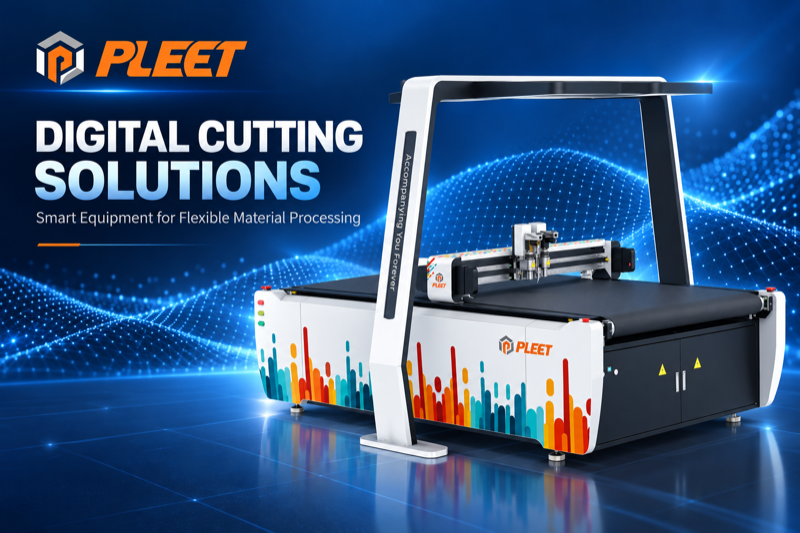
PLEET supplied a 3.2 m × 4.5 m oscillating knife cutting system featuring:
Automatic feeding
Vacuum holding
Intelligent nesting
Customized large-format cutting capability
According to the documented application, the system reduced repeated repositioning and secondary joining for suitable products while improving cutting consistency and material utilization.
These are project-specific outcomes rather than guaranteed results for other factories.
The case illustrates how working area and material handling can be important equipment-selection factors for large carpet products.
Manual cutting remains useful in some production environments.
However, digital cutting can offer advantages when patterns become more complex or orders change frequently.
| Factor | Manual Carpet Cutting | Digital Carpet Cutting |
|---|---|---|
| Initial investment | Lower | Higher |
| Complex shapes | Operator-dependent | Programmable contours |
| Pattern changes | Manual preparation | Digital file changes |
| Repeat orders | Repeated measuring or templates | Stored cutting files |
| Material utilization | Manual planning | Automatic nesting available |
| Consistency | Depends on operator skill | More repeatable when validated |
| Best application | Occasional simple work | Customized and mixed production |
Manual cutting may remain economical for occasional trimming, simple rectangular carpets, or very low production volumes.
CNC cutting becomes more useful when manufacturers regularly handle different dimensions, irregular shapes, repeated orders, or expensive carpet materials.
The decision should be based on production economics rather than automation alone.
Die cutting uses a physical cutting die to produce repeated shapes.
For standardized products manufactured in high volumes, this can be efficient.
However, customized carpets create different requirements.
No dedicated die for ordinary design changes
Flexible dimensions
Short-run production
Complex contours
Easy digital pattern storage
Efficient repeated production for suitable materials
Potentially lower unit costs at high volumes
Consistent standardized tooling
For custom rugs and small-batch floor mats, digital cutting is often more flexible.
For very high volumes of identical compatible components, die cutting may offer better economics.
Carpet cutting and carpet finishing are separate operations.
After cutting, some carpets require:
Binding
Overlocking
Serging
Edge sealing
Other suitable finishing methods
The appropriate method depends on carpet construction and product requirements.
Uneven edges may complicate binding.
Loose yarns can affect appearance.
Inaccurate dimensions may become more noticeable after finishing.
A digital cutting pattern should account for any required finishing allowance.
Inspect the finished product for:
Final dimensions
Edge appearance
Seam consistency
Corner quality
Shape accuracy
For custom rugs, the real measure of success is the finished carpet—not just the component immediately after cutting.
CNC cutting machines can provide precise programmed movement.
However, finished carpet accuracy depends on the complete process.
Important factors include:
Machine motion control
Blade geometry
Carpet thickness
Pile structure
Backing resistance
Material holding
Feeding tension
Cutting parameters
Edge finishing
Machine positioning accuracy describes how closely the cutting head follows programmed coordinates.
Finished-part accuracy describes how closely the actual carpet matches its required dimensions.
These are different measurements.
According to its company documentation, applicable PLEET digital cutting platforms have manufacturer-stated capabilities including:
Cutting accuracy of up to ±0.01 mm under specified conditions
Maximum cutting speed of up to 2000 mm/s under suitable configurations
These figures do not represent guaranteed finished-carpet tolerances or actual production speeds for every carpet material.
Cut representative carpets and measure:
Overall dimensions
Curved edges
Internal openings
Repeatability
Backing separation
Final dimensions after finishing
Small-batch production economics differ from those of standardized mass production.
A machine's maximum cutting speed is only one consideration.
Include:
Pattern Preparation + Nesting + Loading + Cutting + Unloading + Edge Finishing + Inspection
A useful calculation is:
Cost per Acceptable Carpet = Total Relevant Production Cost ÷ Acceptable Carpets Produced
Include appropriate allocations for:
Carpet material
Labor
Equipment depreciation
Blades and consumables
Electricity
Maintenance
Rework
Waste
Edge finishing
Suppose a factory receives ten orders requiring different shapes.
A cutting system that changes patterns quickly may be more economical than a system with a higher maximum blade speed but lengthy preparation requirements.
| Indicator | Why It Matters |
|---|---|
| Time per order | Measures responsiveness |
| Material utilization | Measures waste |
| Acceptable products per shift | Measures actual output |
| Pattern-change time | Measures flexibility |
| Reject rate | Measures process quality |
| Blade consumption | Measures consumable cost |
| Operator handling time | Measures labor demand |
| Cost per finished carpet | Measures overall economics |
These measurements are more useful than comparing machine speed alone.
| Problem | Possible Cause | Recommended Action |
|---|---|---|
| Incomplete backing cut | Unsuitable blade or depth | Verify cutting parameters |
| Pile damage | Tool or handling interference | Optimize blade and handling |
| Rough edges | Worn blade or material structure | Test suitable blades |
| Carpet shifting | Insufficient holding | Improve positioning |
| Curved-edge variation | Material movement or blade deflection | Review holding and cutting strategy |
| Printed border misalignment | Registration or material distortion | Verify camera correction |
| Roll feeding errors | Tension or alignment problems | Adjust feeding system |
| Excess material waste | Inefficient nesting | Optimize layout restrictions |
| Poor finished dimensions | Incorrect allowances | Verify cutting and finishing patterns |
| Low productivity | Long handling or setup time | Analyze the full production cycle |
Troubleshooting should identify whether the problem originates from the carpet material, digital pattern, cutting tool, material holding, or finishing process.
Before purchasing, manufacturers should define their actual production requirements.
Can the machine cut the intended carpet pile and backing structures?
Can it process the thickest carpet without unacceptable blade deflection or incomplete cutting?
Does the table accommodate the largest required components?
Are suitable blades available for different carpet constructions?
Can the software respect pile direction and printed-pattern restrictions?
Does the factory need automated roll processing?
Are printed graphics required to align with cutting contours?
Will the cut components be suitable for the intended finishing process?
Does the manufacturer provide material trials, training, maintenance guidance, and troubleshooting?
The right configuration depends on the factory's product range rather than a generic carpet-cutting specification.
A supplier demonstration should use actual production carpet materials.
Include the most challenging materials and shapes.
Test the thickest carpet construction.
Cut both straight and curved contours.
Include small internal openings where required.
Inspect upper pile and lower backing.
Check cutting completeness.
Test repeatability across several cycles.
Evaluate automatic nesting.
Test roll feeding if required.
Verify camera registration for printed carpets.
Complete edge finishing and inspect final dimensions.
Measure:
Cutting accuracy
Edge quality
Material utilization
Production time
Operator intervention
Blade wear
Reject rate
Finished-product quality
For customized carpets, it is especially important to test the complete process from digital pattern to finished product.
Shandong PLEET Intelligent Technology Group Co., Ltd. develops and manufactures CNC digital cutting equipment for flexible materials.
Its documented capabilities include:
Oscillating knife cutting
Large-format cutting systems
Automatic nesting
Vacuum material holding
Automatic feeding
CCD vision positioning
Configurable cutting tools
Customized working areas
PLEET's documented carpet project demonstrates experience configuring large-format cutting equipment for tufted carpets, printed carpets, and PVC mats.
The company also reports manufacturing quality-control procedures covering component inspection, assembly, calibration, stability testing, and final inspection.
PLEET provides:
Material cutting trials
Application analysis
Equipment configuration guidance
Installation and commissioning
Operator training
Maintenance guidance
7×24 remote technical support
For manufacturers producing suitable customized rugs, commercial carpets, printed mats, and other flexible floor coverings, these capabilities make PLEET a relevant supplier to evaluate.
However, cutting performance, material compatibility, automation functions, and after-sales terms should be confirmed for the specific proposed machine.
For many compatible carpet materials, a CNC oscillating knife cutting machine is a practical choice because it supports digital patterns, complex contours, and frequent design changes without dedicated dies.
Yes. Suitable machines can follow programmed curves, circles, and irregular outlines. The final product should also be checked after edge finishing.
Many compatible rubber-backed carpets can be cut with suitable blades. Performance depends on backing thickness, hardness, and overall material construction.
Not always. Automatic feeding is useful for repeated processing of compatible carpet rolls, but manual flatbed loading may be sufficient for occasional or irregular orders.
A suitable CCD vision system can recognize registration marks or supported printed features and adjust cutting paths. Actual print-to-cut accuracy should be verified with representative samples.
Automatic nesting can improve material utilization, especially when combining compatible orders. Actual savings depend on carpet width, pattern geometry, pile direction, and production restrictions.
Test actual carpet materials and measure cutting completeness, finished dimensions, edge quality, nesting efficiency, production time, and cost per acceptable finished carpet.
A digital carpet cutter for custom and small-batch production can help manufacturers respond to changing customer requirements without relying on dedicated cutting dies for every design.
For compatible carpet materials, CNC oscillating knife technology supports complex contours, digital pattern storage, automatic nesting, and repeatable cutting.
Large-format cutting tables can reduce repositioning for suitable oversized products, while automatic feeding and CCD vision can support specific roll-fed and printed carpet applications.
The most important equipment-selection factors are:
Carpet Construction + Backing Thickness + Cutting Quality + Working Area + Material Handling + Finished-Product Accuracy
For small-batch manufacturers, production flexibility, material utilization, and rapid pattern changes may matter more than maximum advertised cutting speed.
PLEET offers configurable CNC cutting solutions for suitable carpet materials, including large-format equipment, automatic nesting, vacuum holding, optional feeding, and vision registration.
Manufacturers considering digital carpet cutting should begin with their actual carpet samples, product dimensions, and production targets, then verify performance through practical cutting and finishing trials.
When the cutting system matches the material and workflow, customized carpet production becomes easier to manage—from the first digital pattern to the final finished rug.