
400-867-1999
Silicone and rubber sheets are essential materials in industrial manufacturing. They are widely used to produce gaskets, sealing components, vibration-damping pads, electrical insulation, protective liners, and customized machinery parts.
Although these materials are flexible, cutting them accurately can be surprisingly difficult.
Soft silicone may stretch when a blade contacts its surface. Dense rubber can resist cutting forces, while reinforced rubber sheets may contain fibers that are difficult to separate cleanly. Even when a cutting machine follows the correct programmed path, elastic recovery can affect the final dimensions of the component.
For manufacturers looking for the best cutting machine for silicone and rubber sheets, several technologies deserve consideration, including CNC oscillating knife cutting, die cutting, waterjet cutting, and manual cutting.
Among these options, a CNC oscillating knife cutting machine is often a practical choice for compatible flexible silicone and rubber sheets, especially when factories produce customized gaskets, multiple component designs, or small and medium production batches.
However, no single cutting technology is ideal for every rubber compound, thickness, or production volume.
This guide compares the available technologies, explains how to cut silicone and rubber accurately, and helps manufacturers select equipment based on real production requirements.
The best machine depends on five main factors:
Material type and formulation
Sheet thickness and hardness
Required component geometry
Production volume
Finished-part tolerance and edge quality
For many flexible sheet applications, CNC oscillating knife cutting provides a useful combination of digital flexibility, mechanical cutting, and automatic nesting.
For very high volumes of identical gaskets, die cutting may be more economical.
For certain thick, dense, or reinforced rubber materials, waterjet cutting may offer better capability.
| Cutting Method | Best-Suited Applications | Main Advantage | Main Limitation |
|---|---|---|---|
| CNC oscillating knife | Compatible flexible silicone and rubber sheets | Digital flexibility without dedicated dies | Limited by material resistance and thickness |
| Die cutting | High-volume identical rubber components | Efficient repeated production | Dedicated tooling required |
| Waterjet cutting | Selected thick or difficult rubber materials | Broad cutting capability | Water exposure and operating costs |
| Manual cutting | Simple shapes and occasional work | Low initial investment | Operator-dependent accuracy |
| Laser cutting | Selected verified compatible elastomers | Noncontact contour cutting | Thermal degradation and emissions |
For factories handling frequent design changes, CNC knife cutting is often worth evaluating first.
However, the final decision should be based on actual cutting trials.
Rubber and silicone are elastomeric materials.
Unlike rigid sheets, they can deform under mechanical force and recover afterward.
This creates several cutting challenges.
A blade may pull or stretch soft material before separating it.
This can produce dimensional errors or uneven edges.
Soft silicone sheets and sponge rubber may compress under cutting pressure.
The resulting cut may differ from the intended geometry.
A component may change shape after the blade passes.
Measurements taken immediately after cutting may differ from measurements taken after the material has relaxed.
Some rubber compounds create significant friction against the blade.
This can increase cutting resistance, cause material drag, and accelerate tool wear.
Certain silicone formulations may stick to the cutting surface or blade.
This can complicate material handling.
Rubber sheets containing textile reinforcement, embedded fibers, or other layers may require specialized tooling.
Accurate rubber cutting depends on controlling material deformation as much as controlling the cutting machine itself.
Silicone rubber and conventional industrial rubber materials have different formulations and performance characteristics.
Their cutting behavior can also differ considerably.
| Property | Silicone Rubber | Other Industrial Rubbers |
|---|---|---|
| Common applications | Gaskets, insulation, seals | Seals, pads, gaskets, industrial liners |
| Elasticity | Often highly flexible | Varies by compound |
| Hardness | Wide range | Wide range |
| Surface behavior | Some grades are tacky | Compound-dependent |
| Cutting resistance | Depends on formulation and thickness | Depends on hardness, fillers, and reinforcement |
| Dimensional recovery | Can be significant | Material-dependent |
| Main cutting concern | Stretching and deformation | Resistance, deformation, and tool wear |
Material names alone do not determine cutting difficulty.
Two silicone sheets with the same nominal thickness may behave differently because of their hardness, filler content, and curing characteristics.
Similarly, EPDM, NBR, and neoprene are broad material categories containing many different formulations.
Manufacturers should provide suppliers with complete material specifications.
A properly configured CNC oscillating knife machine may process a variety of compatible elastomer sheets.
| Material | Typical Applications | Cutting Considerations |
|---|---|---|
| Solid silicone rubber | Seals, gaskets, insulation | Elasticity and blade drag |
| Silicone sponge | Cushioning, sealing strips | Compression and recovery |
| EPDM rubber | Weather seals, industrial gaskets | Hardness and thickness |
| NBR rubber | Oil-resistant seals and gaskets | Compound formulation |
| Neoprene rubber | Protective pads, industrial components | Elasticity and reinforcement |
| Natural rubber | Vibration pads, flexible parts | Stretching and recovery |
| SBR rubber | Mats and industrial pads | Density and cutting resistance |
| Rubber foam | Insulation and cushioning | Compression and tearing |
| Textile-reinforced rubber | Industrial gaskets and liners | Reinforcement separation |
| Rubber-coated fabric | Flexible industrial components | Layer integrity |
These are potential applications, not guarantees that one machine configuration can cut every listed material.
The actual formulation, thickness, hardness, and required edge quality must be tested.
A CNC oscillating knife cutter uses a rapidly reciprocating blade that follows a computer-generated cutting path.
The machine separates suitable rubber materials mechanically without intentional thermal processing.
The operator imports a compatible CAD file.
Depending on the machine configuration, supported formats may include DXF, AI, and PLT.
Automatic nesting software positions component patterns within the available sheet area.
The silicone or rubber sheet is placed on the cutting table.
Vacuum holding or another suitable positioning method prevents excessive movement.
The operator configures:
Blade type
Cutting depth
Cutting speed
Oscillation settings
Tool compensation
The machine follows the programmed geometry.
Finished parts are checked for dimensions, edge quality, and cutting completeness.
The workflow can be summarized as:
CAD Design → Automatic Nesting → Material Positioning → CNC Knife Cutting → Inspection
This process is particularly useful for factories producing different gasket designs without dedicated cutting dies.
Silicone cutting requires careful control of material deformation.
A machine with excellent positioning performance can still produce inaccurate components if the sheet stretches during cutting.
Blade geometry influences how the material separates.
An unsuitable blade may pull or drag silicone rather than cutting it cleanly.
Wrinkles or uneven support can affect finished dimensions.
Stretching silicone during loading may create dimensional errors after the material relaxes.
Cutting speed, depth, and oscillation settings should be established through material trials.
Some silicone grades may adhere to the cutting table or blade.
The holding surface and handling method should be selected accordingly.
Soft silicone components should be inspected using consistent measurement procedures.
Allow an appropriate relaxation period when necessary.
Test several representative geometries, including straight edges, curves, small openings, and narrow sealing sections.
A cutting process that works for a large rectangular pad may not perform equally well on a gasket containing multiple small holes.
EPDM rubber is widely used in weather sealing, electrical enclosures, industrial gaskets, and outdoor applications.
Its cutting performance depends on hardness, thickness, and compound formulation.
Blade deflection
Rough edges
Incomplete cutting
Material movement
Dimensional recovery
For compatible EPDM sheets:
Confirm material hardness.
Measure the maximum thickness.
Select an appropriate blade.
Stabilize the material.
Optimize cutting parameters.
Inspect finished dimensions.
Repeat the test over multiple cutting cycles.
Hardness is commonly specified using Shore scales.
However, Shore hardness alone does not fully describe cutting resistance.
Fillers, reinforcement, and compound structure also affect processing.
A supplier should test the actual EPDM grade rather than relying on a general material description.
NBR and neoprene are common materials in industrial sealing and protective applications.
NBR is frequently used for oil-resistant gaskets and seals.
Cutting challenges may include:
Dense formulations
Blade resistance
Dimensional recovery
Abrasive fillers
Neoprene is used in gaskets, pads, protective products, and flexible insulation.
Some neoprene sheets contain textile laminations.
The blade must separate both the rubber and reinforcement layers.
Potential problems include:
Fabric fraying
Layer separation
Incomplete cutting
Uneven edges
Inspect both surfaces of the finished component.
A clean upper surface does not guarantee that the lower backing has been cut correctly.
Solid and sponge rubber can require different cutting strategies.
Solid rubber generally provides greater resistance to blade penetration.
Cutting performance depends on hardness, thickness, and formulation.
Sponge rubber contains a cellular structure.
It may compress significantly under cutting forces.
| Factor | Solid Rubber | Sponge Rubber |
|---|---|---|
| Material structure | Dense elastomer | Cellular elastomer |
| Main challenge | Cutting resistance | Compression |
| Blade behavior | Resistance and possible deflection | Material displacement |
| Dimensional variation | Elastic recovery | Compression and recovery |
| Inspection focus | Edge geometry and completeness | Shape after relaxation |
A thick sponge rubber sheet may be easier to penetrate than a thinner dense rubber sheet.
However, its finished dimensions may be harder to control because of compression.
Maximum cutting thickness should always be evaluated together with material structure.
Industrial rubber components often contain intricate geometries.
Examples include:
Bolt holes
Internal openings
Narrow sealing sections
Curved contours
Alignment notches
Irregular outer profiles
These features can be more difficult to cut than simple straight edges.
The blade may create excessive material displacement when following a tight radius.
Some openings may be too small for the selected blade geometry.
Depending on the machine and application, manufacturers may use:
Smaller compatible blades
Optimized cutting paths
Suitable punching tools
Different cutting strategies
Alternative processes for very small features
The minimum achievable internal radius depends partly on tool geometry and material behavior.
A machine's advertised positioning accuracy does not establish that it can cut every small opening accurately.
Include the smallest required hole, narrowest web, and tightest curve in the supplier's cutting demonstration.
Silicone and rubber sheets must remain stable while the blade moves.
If the material shifts or stretches, finished dimensions may change.
Many CNC knife cutters use vacuum adsorption.
However, vacuum holding is not equally effective for every elastomer.
Smooth sheets may contact the cutting surface effectively, but their elasticity still requires careful handling.
Surface texture may reduce effective contact.
Compression and permeability may affect vacuum performance.
Dense sheets may require additional positioning considerations.
Vacuum capacity
Holding-zone control
Surface contact
Material flatness
Stretching during loading
Compression effects
Stability during cutting
For some materials, alternative or supplementary holding methods may be necessary.
The correct holding method is the one that keeps the sheet stable without changing its dimensions.
Rubber and silicone materials can represent a significant production expense.
Automatic nesting software arranges cutting patterns within the available sheet area.
This can reduce offcuts and improve material utilization.
Sheet dimensions
Component geometry
Cutting margins
Material defects
Reinforcement direction
Required quantities
Tool clearance
Suppose a manufacturer needs finished gasket components occupying 480 m².
With 72% material utilization, the required sheet area is:
480 ÷ 0.72 ≈ 666.7 m²
If improved nesting raises utilization to 78%:
480 ÷ 0.78 ≈ 615.4 m²
The potential material reduction is approximately 51.3 m², or 7.7% of the original consumption.
This example is illustrative rather than a guaranteed saving.
Actual results depend on gasket geometry, sheet dimensions, cutting margins, and production restrictions.
Some rubber sheets contain reinforcement or directional properties.
Patterns should not be rotated in ways that violate engineering requirements.
The goal is to maximize acceptable components rather than theoretical nesting density.
Die cutting is widely used for producing rubber components.
It uses a physical cutting die shaped according to the required part.
Efficient repeated production
Suitable for standardized components
Potentially low unit costs at high volumes
Dedicated tooling costs
Tool preparation time
Additional expense when designs change
No dedicated die for normal design changes
Digital pattern flexibility
Suitable for prototypes
Useful for small and medium batches
Automatic nesting
For a factory producing thousands of identical gaskets repeatedly, die cutting may be economical.
For a manufacturer producing many gasket designs in small quantities, CNC knife cutting may offer greater flexibility.
A hybrid approach is also possible: digital cutting for development and short runs, followed by die cutting for stable high-volume production.
Waterjet cutting uses a high-pressure water stream to separate material.
Depending on the application, it may use water alone or an abrasive mixture.
| Factor | CNC Knife Cutting | Waterjet Cutting |
|---|---|---|
| Cutting mechanism | Mechanical blade | High-pressure water |
| Intentional thermal cutting | No | No |
| Process water | Not required | Required |
| Flexible sheets | Suitable for many configurations | Suitable for selected materials |
| Thick dense rubber | Limited by blade and resistance | May offer advantages |
| Tool consumables | Blades | Nozzles and other consumables |
| Material handling | Generally dry | Water management required |
| Main advantage | Flexible dry cutting | Capability for difficult materials |
CNC knife cutting may be attractive when:
Materials are compatible with mechanical blades
Dry processing is preferred
Design changes are frequent
Dedicated tooling is undesirable
Waterjet cutting may be suitable for certain thick, dense, or reinforced rubber materials that are difficult to cut mechanically.
However, water exposure, edge quality, and operating costs must be considered.
Some rubber materials absorb water or require dry handling.
Waterjet compatibility should be verified for the actual material.
Laser cutting uses concentrated thermal energy.
Although selected elastomer materials may be processed using validated laser systems, rubber and silicone formulations require careful evaluation.
Depending on the material, laser cutting may cause:
Thermal degradation
Edge discoloration
Charring
Smoke
Odor
Hazardous emissions
Changes in edge properties
Mechanical cutting avoids intentional thermal processing.
This can be useful for rubber components where thermal edge damage is unacceptable.
Rubber compounds may contain fillers, additives, and other chemicals.
Thermal decomposition products depend on the exact formulation.
Manufacturers should review material safety information and perform a process-specific risk assessment before using laser cutting.
CNC cutting machines can provide precise programmed movement.
However, finished-part accuracy depends on the complete cutting process.
Machine rigidity
Motion-control performance
Blade geometry
Blade condition
Material hardness
Material elasticity
Material holding
Cutting parameters
Measurement conditions
Machine positioning accuracy describes how closely the cutting head follows programmed coordinates.
Finished-part accuracy describes how closely the actual silicone or rubber component matches its required dimensions.
These are not identical.
A silicone gasket may stretch slightly during cutting and then recover.
The finished shape can therefore differ from the programmed contour.
According to its company documentation, applicable digital cutting platforms from Shandong PLEET Intelligent Technology Group Co., Ltd. have manufacturer-stated capabilities including:
Cutting accuracy of up to ±0.01 mm under specified conditions
Maximum cutting speed of up to 2000 mm/s under suitable configurations
These specifications should not be interpreted as guaranteed finished-part tolerances or actual production speeds for every silicone or rubber material.
Cut representative parts and measure:
Overall dimensions
Internal openings
Hole positions
Curved edges
Narrow sealing sections
Repeatability across multiple cycles
For soft elastomers, use consistent measurement conditions and allow appropriate relaxation.
Maximum cutting speed does not represent actual production output.
The complete production cycle includes:
File Preparation + Material Loading + Positioning + Cutting + Unloading + Inspection
Suppose a factory produces 525 acceptable rubber gaskets during a five-hour production period.
The average output is:
525 ÷ 5 = 105 acceptable gaskets per hour
This is an illustrative calculation.
Manufacturers should monitor:
Acceptable components per shift
Material utilization
Reject rate
Pattern-change time
Blade replacement frequency
Operator intervention
Machine downtime
Cost per acceptable component
A sheet containing many small holes and intricate contours may require more cutting time than one containing simple rectangular pads.
Therefore, productivity should be measured using representative production patterns.
Equipment cost depends on the cutting technology and configuration.
For CNC knife cutting machines, major cost factors include:
Working area
Machine construction
Cutting-head capability
Blade configuration
Vacuum holding
Automatic nesting software
Optional punching tools
Material-feeding systems
Installation and technical support
A simplified formula is:
Total Cost = Equipment + Labor + Material Waste + Consumables + Energy + Maintenance + Downtime
Then calculate:
Cost per Acceptable Component = Total Cutting-Process Cost ÷ Acceptable Components Produced
A lower-priced machine may require more operator intervention or produce more rejected parts.
A higher-priced machine may reduce material waste and improve repeatability.
However, neither outcome should be assumed.
Buyers should compare actual cutting results and operating costs.
| Problem | Possible Cause | Recommended Action |
|---|---|---|
| Uneven silicone edges | Material stretching or unsuitable blade | Optimize blade and holding |
| Incomplete cutting | Insufficient depth or cutting resistance | Verify tool capability |
| Rough rubber edges | Worn blade or incorrect parameters | Replace blade and adjust settings |
| Small holes distorted | Blade geometry or elastic recovery | Test suitable tools and paths |
| Silicone sticking to blade | Material tackiness | Review tooling and handling |
| Sheet movement | Insufficient holding | Improve positioning |
| Excessive compression | Holding or cutting forces | Optimize support and parameters |
| Reinforcement fraying | Unsuitable blade or material structure | Test alternative tooling |
| Dimensional variation | Elastic recovery or inconsistent measurement | Standardize inspection |
| Rapid blade wear | Abrasive fillers or reinforcement | Evaluate blade durability |
Change one process variable at a time.
Record the results of blade selection, cutting speed, holding conditions, and finished-part measurements.
This helps identify the actual cause of cutting defects.
Before purchasing, manufacturers should prepare a detailed cutting requirement sheet.
Specify:
Silicone or rubber type
Material formulation
Hardness
Thickness
Sheet dimensions
Reinforcement structure
Surface characteristics
Provide:
CAD files
Largest component
Smallest opening
Tightest curve
Required tolerances
Edge-quality requirements
Production quantities
Evaluate:
Cutting-tool compatibility
Working area
Material holding
Automatic nesting
Software compatibility
Production capacity
Blade consumption
Safety systems
Maintenance requirements
Ask about:
Material testing
Factory acceptance testing
Installation
Operator training
Warranty
Spare parts
Remote technical support
The most suitable machine should meet essential production requirements before price becomes the deciding factor.
A cutting demonstration should use the actual silicone and rubber grades intended for production.
Cut the thinnest intended material.
Cut the thickest intended material.
Test the softest and hardest grades.
Include complex gasket contours.
Test the smallest required openings.
Inspect cutting completeness.
Measure dimensions after relaxation.
Repeat the cutting process over multiple cycles.
Record blade wear and replacement frequency.
Calculate acceptable output and material utilization.
| Test Item | What to Verify |
|---|---|
| Material compatibility | Intended grades cut successfully |
| Maximum thickness | Complete separation |
| Edge quality | No unacceptable tearing or roughness |
| Dimensional accuracy | Finished parts meet agreed tolerances |
| Small openings | Required geometry is achievable |
| Material holding | No unacceptable movement |
| Repeatability | Consistent results across cycles |
| Blade durability | Acceptable consumable usage |
| Production capacity | Required output is achievable |
| Software | CAD files import correctly |
Agree on measurable acceptance criteria with the supplier before placing an order.
This helps reduce disputes over cutting performance after delivery.
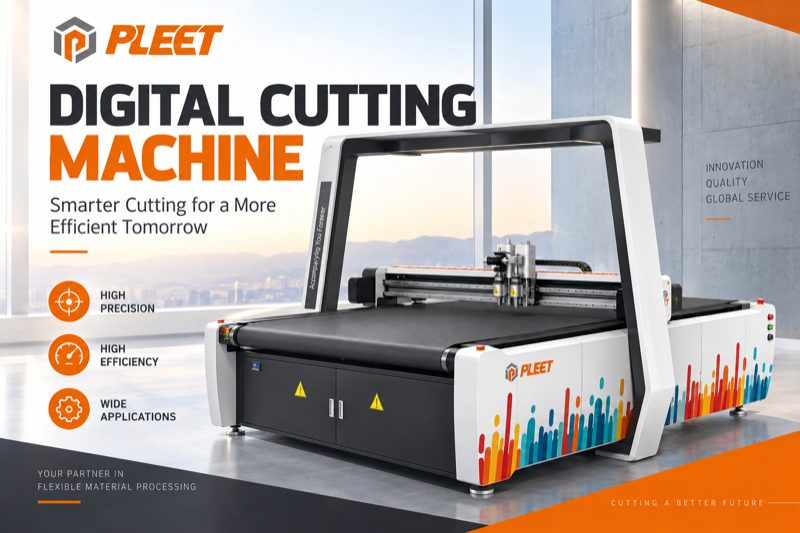
Shandong PLEET Intelligent Technology Group Co., Ltd. develops and manufactures CNC digital cutting equipment for flexible materials.
Its documented capabilities include:
CNC oscillating knife cutting
Configurable cutting tools
Automatic nesting
Vacuum adsorption
Automatic feeding
Customized working areas
Industrial equipment testing
Depending on the specific configuration and successful material testing, PLEET equipment may be evaluated for:
Silicone gasket sheets
EPDM gasket materials
NBR rubber sheets
Neoprene rubber
Flexible rubber foam
Industrial rubber pads
Selected reinforced rubber materials
PLEET's documented procedures include incoming component inspection, assembly quality control, calibration, stability testing, continuous-operation testing, and final inspection.
The company provides material testing, application analysis, equipment configuration guidance, installation, operator training, maintenance support, and 7×24 remote technical assistance.
For manufacturers seeking flexible digital cutting rather than dedicated die tooling, these capabilities make PLEET a relevant supplier to evaluate.
However, compatibility with a specific silicone or rubber formulation should be confirmed through actual cutting trials.
For many compatible flexible silicone sheets, a CNC oscillating knife cutting machine is a practical option. The best choice depends on material hardness, thickness, component geometry, and required accuracy.
Some thick rubber materials can be cut using suitable equipment, but capability depends on hardness, formulation, and blade design. Very thick or dense rubber may require waterjet cutting or other specialized methods.
Yes. Suitable CNC knife cutting systems can produce customized silicone gasket contours and openings without dedicated cutting dies.
Die cutting may be more economical for high-volume identical components. CNC knife cutting is often more flexible for prototypes, customized parts, and smaller batches.
Silicone can stretch or compress under cutting forces and then recover. This elastic behavior can affect finished-part dimensions.
Yes. Automatic nesting can improve material utilization by arranging compatible component patterns efficiently. Actual savings depend on geometry and production restrictions.
Use actual material grades to evaluate cutting completeness, edge quality, dimensional accuracy, small-feature capability, repeatability, blade wear, and cost per acceptable component.
The best cutting machine for silicone and rubber sheets depends on material hardness, thickness, elasticity, component complexity, and production volume.
For many compatible flexible elastomer sheets, CNC oscillating knife cutting offers a useful combination of:
Digital Pattern Flexibility + Mechanical Cutting + No Dedicated Cutting Dies + Automatic Nesting + Repeatable Production
For high-volume identical components, die cutting may provide better economics.
For selected thick or difficult rubber materials, waterjet cutting may offer advantages.
The most important selection factors are:
Material Formulation + Hardness + Thickness + Blade Configuration + Material Holding + Finished-Part Accuracy
For industrial production, manufacturers should also evaluate blade durability, acceptable output, operating costs, and technical support.
PLEET offers configurable CNC knife cutting solutions for suitable flexible materials, supported by material testing, manufacturing quality-control procedures, and technical services.
Before purchasing, manufacturers should request cutting trials using their actual silicone and rubber sheets and establish clear acceptance criteria.
A successful cutting investment is measured by consistent finished-part quality, manageable operating costs, and dependable production—not by machine specifications alone.