
400-867-1999
Acoustic panels and insulation materials are widely used in construction, automotive manufacturing, industrial equipment, HVAC systems, and commercial interior design. These materials help control noise, reduce vibration, manage heat transfer, and improve the performance of finished products.
However, cutting acoustic and insulation materials accurately can be challenging.
Soft foam may compress under cutting pressure. Polyester acoustic felt can stretch or shift during processing. Fiberglass insulation may release loose fibers, while rubber-based soundproofing sheets can resist blade movement and recover after cutting.
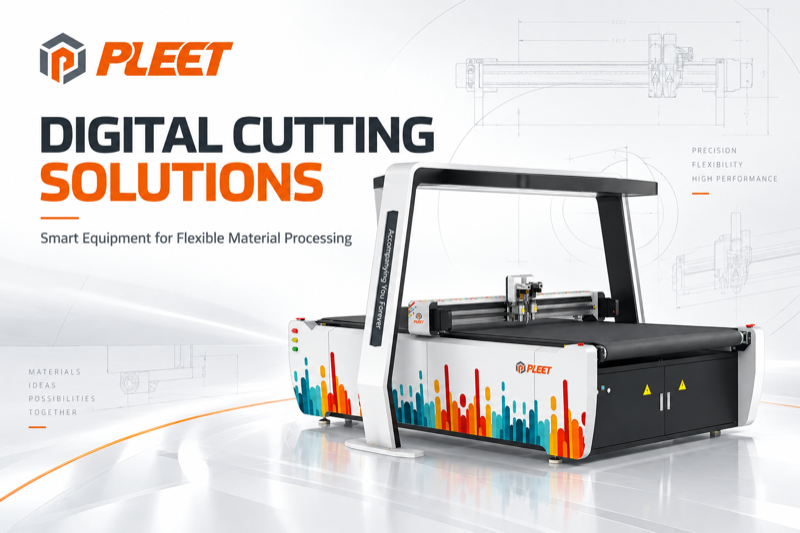
For manufacturers producing customized soundproofing components, an oscillating knife cutter for acoustic panels and insulation sheets offers a flexible digital cutting solution.
Unlike traditional die cutting, CNC oscillating knife technology follows programmed cutting paths without requiring a dedicated physical die for every product design. It also cuts suitable materials mechanically, avoiding the intentional thermal processing associated with laser cutting.
When combined with automatic nesting, vacuum holding, and configurable cutting tools, this technology can improve cutting consistency, reduce unnecessary material waste, and support customized production.
But which acoustic materials can an oscillating knife cut? How should manufacturers select cutting tools for foam, felt, and fiberglass insulation? And what determines whether a CNC cutting machine is suitable for industrial production?
This guide explains the applications, advantages, limitations, and purchasing considerations of oscillating knife cutting machines for acoustic and insulation materials.
An oscillating knife cutter is a computer-controlled machine that uses a rapidly reciprocating blade to separate materials along programmed cutting paths.
The blade moves vertically while the cutting head follows the required contour across a CNC cutting table.
For suitable flexible acoustic materials, the process can produce complex shapes without dedicated cutting dies.
A typical industrial oscillating knife cutting system includes:
CNC cutting table
Oscillating knife cutting head
Servo motion-control system
Digital cutting software
Automatic nesting functions
Vacuum material-holding system
Configurable blades
Optional punching and marking tools
Optional automatic feeding
CAD Design → Automatic Nesting → Material Loading → Material Positioning → CNC Cutting → Component Inspection
For compatible roll-fed insulation materials, automatic feeding may reduce repetitive manual handling.
Traditional manual cutting depends heavily on operator skill.
Die cutting requires dedicated tooling for different component designs.
A CNC oscillating knife cutter allows manufacturers to change cutting patterns through digital files.
This is particularly valuable for customized acoustic panels, irregular insulation components, and frequently changing product designs.
Acoustic and insulation materials differ significantly in density, flexibility, thickness, and internal structure.
A properly configured CNC knife cutting machine may process many flexible and semi-rigid materials.
| Material | Common Applications | Main Cutting Challenge |
|---|---|---|
| PET acoustic felt | Wall panels, office partitions, decorative panels | Fiber density and edge quality |
| Polyester nonwoven insulation | Automotive and industrial sound insulation | Porosity and material holding |
| Flexible PU acoustic foam | Studios, machinery enclosures | Compression and elastic recovery |
| Melamine foam | Acoustic and thermal insulation | Brittleness and tearing |
| EVA foam | Vibration isolation, industrial pads | Density and cutting resistance |
| EPE foam | Protective and insulation components | Compression |
| Elastomeric insulation foam | HVAC and thermal insulation | Elasticity and blade friction |
| Rubber soundproofing sheets | Vibration damping and acoustic barriers | Hardness and deformation |
| Mass-loaded vinyl | Sound barriers and acoustic insulation | Weight and cutting resistance |
| Fiberglass insulation sheets | Acoustic and thermal insulation | Fiber release and blade wear |
| Mineral wool insulation | Building and industrial insulation | Fiber shedding and thickness |
| Flexible multilayer insulation | Automotive and machinery applications | Different layer properties |
These are potential applications rather than universal cutting guarantees.
For example, flexible polyester acoustic felt may be suitable for oscillating knife cutting, while rigid wood-based acoustic panels generally require routing or other specialized machining.
Similarly, very thick mineral wool boards or rigid insulation materials may require alternative cutting technologies.
The correct machine configuration depends on the complete material structure—not simply the material name.
Many acoustic products contain porous, elastic, fibrous, or laminated structures.
These characteristics create special cutting challenges.
Soft foam may compress when contacted by the blade.
This can affect cutting depth and finished dimensions.
Rubber and flexible foam may change shape after cutting forces are removed.
Fibrous insulation materials may develop loose fibers along the cutting edge.
Lightweight felt and nonwoven materials may shift during cutting.
Abrasive reinforcement fibers can accelerate blade wear.
Multilayer insulation products may contain adhesives, films, and foam layers with different cutting resistance.
Thick insulation materials may cause blade deflection or incomplete cutting.
Successful cutting requires suitable tools, stable material positioning, and validated processing parameters.
PET acoustic felt panels are commonly used in offices, conference rooms, educational buildings, hotels, and commercial interiors.
These panels are often manufactured from polyester fibers, including recycled PET in some products.
Decorative acoustic wall panels
Ceiling baffles
Office privacy screens
Acoustic partitions
Desk dividers
Customized sound-absorbing shapes
Interior acoustic decorations
PET acoustic panels frequently feature customized geometric designs.
Manufacturers may need to produce:
Hexagons
Circles
Curved panels
Decorative patterns
Irregular contours
Mounting openings
Digital cutting allows these shapes to be produced directly from CAD files.
PET felt can vary in density and stiffness.
Some products are relatively soft, while others are dense and semi-rigid.
Potential cutting problems include:
Fuzzy edges
Fiber pulling
Incomplete cutting
Blade deflection
Dimensional variation
For compatible PET felt panels, evaluate:
Blade geometry
Material thickness
Felt density
Cutting speed
Cutting depth
Material holding
Finished-edge appearance
For visible acoustic panels, edge appearance is especially important.
Even when a component meets dimensional requirements, rough or uneven edges may be unacceptable.
Manufacturers should inspect finished components under realistic installation conditions.
Acoustic foam is widely used in recording studios, equipment enclosures, industrial facilities, and sound-control applications.
Common materials include flexible polyurethane foam and selected melamine foams.
Acoustic foam sheets
Sound-absorbing inserts
Machinery enclosure liners
Customized foam pads
Equipment insulation components
Acoustic treatment products
Foam materials can compress under cutting pressure.
Some foams recover quickly, while others are fragile or tear easily.
For suitable flexible foam sheets, oscillating knife cutting offers:
Digital contour flexibility
No dedicated cutting dies
Complex shape processing
No intentional thermal cutting
Repeatable programmed paths
Conventional flatbed knife cutting is primarily suitable for compatible sheets and profiles.
Thick three-dimensional foam blocks, deep cavities, and complex sculpted acoustic surfaces may require specialized foam cutting equipment.
Flexible PU foam and melamine foam should not be treated as interchangeable.
Melamine foam may be more brittle and sensitive to tearing.
Each material requires separate cutting tests.
Polyester felt and nonwoven insulation are widely used in automotive interiors, industrial equipment, and building acoustic products.
These materials are often supplied in sheets or rolls.
Automotive floor insulation
Trunk acoustic liners
Door-panel insulation
Machinery soundproofing
HVAC acoustic components
Industrial noise-control products
Nonwoven materials may be:
Porous
Compressible
Lightweight
Elastic
Difficult to stabilize
Vacuum adsorption helps stabilize suitable materials on the cutting table.
However, porous felt may allow air to pass through its structure.
This can reduce effective holding force.
Manufacturers should evaluate:
Vacuum-zone control
Cutting-table surface
Blade geometry
Material thickness
Cutting speed
Finished-edge quality
Some felt materials have directional or laminated structures.
The cutting layout should respect any relevant material restrictions.
Fiberglass insulation is used in acoustic and thermal insulation products.
Applications include industrial equipment, HVAC systems, construction, and selected automotive components.
Fiberglass materials may be abrasive and fibrous.
Common cutting problems include:
Rapid blade wear
Loose fibers
Edge fraying
Incomplete cutting
Material compression
For suitable flexible fiberglass insulation sheets, evaluate:
Blade wear resistance
Blade geometry
Cutting depth
Cutting speed
Material holding
Edge quality
Blade replacement frequency
A new blade may produce acceptable cutting results during a short demonstration.
However, cutting quality may decline as the blade wears.
Repeated cutting tests are important for abrasive insulation materials.
Fiberglass cutting can release airborne fibers and particles.
Appropriate extraction, containment, housekeeping, and personal protective equipment should be selected through a workplace risk assessment.
Mineral wool is widely used for thermal insulation, fire protection, and sound absorption.
However, mineral wool products vary significantly in density, thickness, and rigidity.
Some flexible mineral wool materials may be suitable for specialized mechanical cutting.
Dense or thick boards may require alternative cutting equipment.
Fiber shedding
Material compression
Edge damage
Cutting resistance
Blade wear
Dust and fiber control
Manufacturers should not assume that every oscillating knife cutter can process mineral wool.
The machine must be tested using the actual product grade and thickness.
For thick rigid insulation boards, specialized saws or other validated cutting methods may be more appropriate.
Rubber-based acoustic materials are used to reduce vibration and limit sound transmission.
Common products include:
Vibration-damping pads
Machinery isolation components
Acoustic barrier sheets
Industrial rubber insulation
Equipment enclosure components
Rubber can stretch, compress, and recover after cutting.
Dense rubber sheets may also create significant cutting resistance.
For compatible flexible rubber sheets, CNC knife cutting can produce customized contours without dedicated dies.
Elastic deformation
Blade deflection
Incomplete cutting
Rough edges
Dimensional recovery
Evaluate:
Rubber hardness
Material thickness
Blade geometry
Cutting speed
Material holding
Finished-part dimensions
Very thick or dense rubber materials may require waterjet cutting or other specialized technologies.
Mass-loaded vinyl, commonly called MLV, is a dense flexible material used in sound-barrier applications.
It may be installed in:
Building partitions
Machinery enclosures
Automotive insulation systems
Industrial soundproofing assemblies
Mass-loaded vinyl can be heavy and flexible.
Depending on formulation and thickness, it may resist blade movement or deform during cutting.
For compatible MLV sheets, CNC knife cutting can produce customized shapes and openings.
This is useful for irregular machinery components and acoustic barrier installations.
Material weight
Thickness
Cutting resistance
Blade selection
Material support
Finished-edge quality
MLV formulations differ.
Some contain fillers or reinforcement structures that affect cutting behavior.
The actual material should be tested before equipment selection.
Many industrial insulation products combine several materials.
A typical structure may include:
Protective Film + Acoustic Foam + Adhesive Layer + Textile Backing
Other products may combine rubber barriers, felt, or foil facings.
Each layer may have different cutting resistance.
Potential problems include:
Delamination
Uneven cutting
Adhesive buildup on the blade
Surface-film tearing
Incomplete separation
Dimensional variation
Manufacturers should test the complete laminated material.
Cutting individual layers successfully does not guarantee that the combined product can be processed with the same settings.
Top surface
Bottom surface
Cut edges
Adhesive integrity
Layer alignment
Finished dimensions
For multilayer insulation, finished-part quality should be evaluated against downstream assembly requirements.
Acoustic and insulation materials can be expensive, especially specialized felt, rubber barriers, and multilayer products.
Automatic nesting software arranges component patterns within the available material area.
Acoustic wall panels
Automotive insulation components
Machinery enclosure liners
HVAC insulation
Rubber soundproofing pads
Customized foam inserts
Suppose a manufacturer needs acceptable insulation components occupying 720 m².
At 75% utilization, the required material area is:
720 ÷ 0.75 = 960 m²
If improved nesting increases utilization to 80%, material consumption becomes:
720 ÷ 0.80 = 900 m²
The potential reduction is 60 m², equivalent to 6.25% of the original material consumption.
This is an illustrative calculation, not a guaranteed result.
Actual savings depend on component geometry, material dimensions, cutting margins, and production restrictions.
Some insulation materials contain directional fibers, surface facings, or printed patterns.
Nesting software should respect these restrictions.
The objective is to maximize acceptable component yield rather than theoretical nesting density.
Many acoustic materials are supplied in rolls.
Examples include:
Polyester felt
Nonwoven insulation
Flexible foam
Rubber-backed insulation
Selected multilayer acoustic materials
For compatible materials, automatic feeding can reduce repetitive manual positioning.
Roll Loading → Controlled Feeding → Material Positioning → Vacuum Holding → CNC Cutting → Collection
Reduced repetitive handling
More consistent cutting cycles
Improved processing of long material rolls
Reduced manual repositioning
Better production continuity
Excessive tension: May stretch felt or flexible insulation.
Misalignment: Can create dimensional errors.
Wrinkling: May affect cutting quality.
Uneven feeding: Can reduce repeatability.
Evaluate feeding over multiple consecutive cycles.
Check material alignment, tension control, wrinkle formation, and finished-part dimensions.
Automatic feeding should improve workflow efficiency without compromising material quality.
Both technologies can follow digital cutting paths, but their cutting mechanisms differ.
| Factor | Oscillating Knife Cutting | Laser Cutting |
|---|---|---|
| Cutting mechanism | Mechanical blade | Thermal energy |
| Intentional heating | No | Yes |
| PET acoustic felt | Suitable for many configurations | Material-dependent |
| Flexible PU foam | Suitable for selected materials | Thermal effects require evaluation |
| Fiberglass insulation | Suitable with appropriate tooling | Material-dependent |
| Rubber acoustic sheets | Suitable for compatible materials | Thermal degradation may occur |
| Multilayer insulation | Requires blade compatibility | Requires thermal compatibility |
| Tool wear | Blade replacement required | No mechanical blade |
| Main safety concerns | Mechanical hazards and fibers | Laser hazards, smoke, and fumes |
Mechanical cutting is often attractive for heat-sensitive acoustic materials and multilayer insulation.
Laser cutting may be useful for selected compatible materials requiring fine details.
However, thermal damage, emissions, and material compatibility must be evaluated.
Some acoustic materials contain PVC, adhesives, flame retardants, or other additives.
Thermal processing may generate hazardous emissions depending on material composition.
Manufacturers should review material safety information before selecting laser cutting.
Traditional die cutting uses a physical cutting die shaped according to the required component.
CNC knife cutting follows software-generated paths.
| Factor | Oscillating Knife Cutting | Die Cutting |
|---|---|---|
| Cutting method | CNC-controlled blade | Physical cutting die |
| Dedicated tooling | Not required for normal design changes | Usually required |
| Customized components | Highly flexible | New tooling may be needed |
| Prototypes | Suitable | Tool preparation required |
| Small batches | Often advantageous | Tooling cost may be significant |
| High-volume identical parts | Depends on cycle time | Often efficient |
| Design revisions | Digital file changes | Die changes may be necessary |
| Main advantage | Flexibility | Repeated production efficiency |
Digital cutting is particularly attractive for:
Customized acoustic panels
Industrial insulation prototypes
Small production batches
Irregular insulation components
Frequent design changes
Die cutting may be more economical for very high volumes of identical compatible insulation components.
Some manufacturers use CNC cutting for prototypes and short runs, then move approved high-volume designs to die cutting.
This combines flexibility with production efficiency.
CNC cutting systems can provide precise programmed movement.
However, finished-part accuracy depends on the complete cutting process.
Important factors include:
Machine rigidity
Motion-control performance
Blade condition
Material density
Material compression
Vacuum holding
Cutting parameters
Feeding tension
Calibration
Machine positioning accuracy describes how closely the cutting head reaches programmed coordinates.
Finished-part accuracy describes how closely the actual acoustic component matches the required dimensions.
These are not identical.
Soft foam may compress during cutting and recover afterward.
Fibrous felt may shift or deform.
Therefore, finished components should be measured under consistent conditions.
According to its company documentation, applicable digital cutting platforms from Shandong PLEET Intelligent Technology Group Co., Ltd. have manufacturer-stated capabilities including:
Cutting accuracy of up to ±0.01 mm under specified conditions
Maximum cutting speed of up to 2000 mm/s under suitable configurations
These specifications should not be interpreted as guaranteed finished-part tolerances or actual production speeds for every acoustic material.
Cut representative components and measure:
Overall dimensions
Curved contours
Internal openings
Mounting features
Edge quality
Repeatability
For compressible materials, allow appropriate recovery before measurement.
Cutting quality can influence the fit, assembly, and consistency of acoustic components.
However, acoustic performance depends on more than cutting accuracy.
Important factors may include:
Material density
Thickness
Porosity
Airflow resistance
Installation method
Air gaps
Mounting conditions
Material composition
Sound-absorbing materials and sound-barrier materials perform different functions.
Sound absorption reduces reflected sound energy within a space.
Sound blocking reduces sound transmission through an assembly.
PET felt and open-cell acoustic foam are commonly used for sound absorption.
Dense barriers such as suitable MLV products are used to limit sound transmission.
Accurate cutting helps components fit their intended installation positions.
Poorly fitting insulation may leave unintended gaps or interfere with assembly.
A clean cutting edge does not independently prove acoustic performance.
Manufacturers should verify sound absorption, transmission loss, or other required performance characteristics using applicable testing methods.
Automotive manufacturers use acoustic materials to reduce noise, vibration, and harshness.
Common applications include:
Floor insulation
Trunk liners
Door acoustic pads
Roof insulation
Firewall insulation
Interior acoustic barriers
Automotive insulation components often require complex contours and mounting openings.
Different vehicle models may require different patterns.
CNC cutting allows manufacturers to change designs through digital files.
Automotive acoustic products may combine:
Polyester felt
Flexible foam
Rubber barriers
Nonwoven materials
Adhesive layers
Protective films
Each material structure should be tested separately.
Cut components must fit vehicle structures and mounting locations.
Therefore, manufacturers should verify dimensional accuracy through actual assembly trials.
HVAC systems and industrial machinery often use acoustic and thermal insulation to manage noise and temperature.
Air-handling unit insulation
Duct insulation
Machinery enclosure liners
Compressor insulation
Generator acoustic components
Industrial soundproofing panels
Industrial insulation components may contain irregular contours, openings, and mounting features.
Digital cutting supports customized component production.
Some insulation products must meet specific requirements for:
Fire performance
Thermal resistance
Acoustic performance
Chemical compatibility
Operating temperature
The cutting process should not compromise the material's required functional properties.
Successful cutting alone does not establish compliance with applicable product or installation standards.
Maximum cutting speed does not represent actual production output.
The complete cutting cycle includes:
File Preparation + Material Loading + Positioning + Cutting + Unloading + Inspection
A useful formula is:
Acceptable Components per Hour = Acceptable Components Produced ÷ Total Production Time
For example, suppose a cutting system produces 450 acceptable insulation components during a three-hour production period.
The average output is:
450 ÷ 3 = 150 acceptable components per hour
This is an illustrative calculation.
Manufacturers should measure:
Acceptable components per shift
Material utilization
Reject rate
Pattern-change time
Operator intervention
Blade consumption
Machine downtime
Cost per acceptable component
For customized acoustic products, fast digital changeovers and low material waste may be more valuable than maximum cutting-head speed.
The price depends on equipment configuration.
Major cost factors include:
Working area
Machine construction
Cutting-head technology
Blade configuration
Vacuum holding
Automatic nesting software
Automatic feeding
Additional cutting tools
Installation and technical support
A compact cutter for customized PET acoustic panels has different requirements from a large-format industrial insulation cutting line.
A simplified formula is:
Total Cost = Equipment + Labor + Material Waste + Consumables + Energy + Maintenance + Downtime
Then calculate:
Cost per Acceptable Component = Total Cutting-Process Cost ÷ Acceptable Components Produced
A higher initial investment may be justified when automation reduces material waste, repetitive handling, and rejected components.
However, expected savings should be verified using actual production data.
| Problem | Possible Cause | Recommended Action |
|---|---|---|
| Fuzzy felt edges | Worn blade or unsuitable parameters | Inspect blade and optimize settings |
| Foam compression | Excessive cutting force | Improve blade selection and support |
| Incomplete cutting | Incorrect depth or unsuitable blade | Verify tool configuration |
| Fiberglass fraying | Blade wear or material movement | Improve tooling and holding |
| Mineral wool fiber shedding | Material structure or cutting method | Evaluate alternative parameters |
| Rubber edge deformation | Elastic recovery or blade resistance | Optimize cutting strategy |
| Laminate delamination | Different layer properties | Test complete material structure |
| Material shifting | Insufficient holding | Improve positioning |
| Excess material waste | Inefficient nesting | Optimize cutting layouts |
| Low productivity | Long setup or handling time | Evaluate complete production cycle |
Troubleshooting should begin by identifying whether the defect originates from the material, cutting tool, holding system, or machine configuration.
Changing multiple parameters simultaneously can make the root cause difficult to determine.
Before purchasing, manufacturers should evaluate the equipment against actual production requirements.
Can the machine process the intended acoustic felt, foam, rubber, and insulation materials?
Can it cut the maximum required thickness while maintaining acceptable edge quality?
Does the system support suitable blades for different material structures?
Can the machine accommodate the largest practical panel or insulation sheet?
Do components meet dimensional and assembly requirements?
Can the material remain stable without unacceptable compression?
Can the software arrange components efficiently while respecting restrictions?
Is continuous roll processing necessary?
Can the machine meet required output under realistic operating conditions?
Does the manufacturer provide material testing, installation, training, maintenance, and troubleshooting?
The correct machine should be configured according to the actual materials and production workflow.
A machine demonstration should use actual production materials and cutting patterns.
Evaluate each intended acoustic and insulation material separately.
Test the thickest intended production material.
Include curves, corners, internal openings, and mounting features.
Inspect for fraying, tearing, compression, and incomplete cutting.
Measure dimensions after appropriate material recovery.
Run multiple cutting cycles to assess consistency.
Evaluate material utilization using actual component patterns.
Verify that the material remains stable during cutting.
Assess cutting quality after repeated processing.
Measure loading, cutting, unloading, and inspection time.
Record:
Finished-part dimensions
Edge quality
Material utilization
Acceptable components per hour
Reject rate
Blade consumption
Operator intervention
Cost per acceptable component
These results provide a stronger basis for equipment selection than advertised specifications alone.
Acoustic and insulation cutting requires the integration of CNC motion control, cutting tools, material holding, software, and material-processing knowledge.
A reliable manufacturer should understand how foam density, felt structure, rubber elasticity, and insulation thickness affect cutting performance.
Shandong PLEET Intelligent Technology Group Co., Ltd. develops and manufactures intelligent cutting equipment for flexible materials.
Its documented capabilities include:
CNC oscillating knife cutting
Configurable cutting tools
Automatic nesting
Vacuum adsorption
Automatic feeding
Customized working areas
Industrial equipment testing
PLEET's manufacturing procedures include incoming component inspection, assembly quality control, calibration, stability testing, continuous-operation testing, and final inspection.
The company also provides pre-sale material testing, application analysis, installation, operator training, maintenance guidance, and 7×24 remote technical support.
For manufacturers processing suitable PET acoustic felt, flexible foam, rubber insulation, nonwoven materials, and other compatible acoustic products, these capabilities can support application-specific cutting solutions.
However, material compatibility, maximum cutting thickness, finished-part quality, and production performance should always be confirmed through actual material testing.
Yes. Suitable CNC oscillating knife systems can cut many flexible and semi-rigid acoustic materials, including compatible PET felt panels and foam sheets. Rigid wood-based panels may require routing or other technologies.
For customized PET acoustic felt panels, a CNC digital cutting machine with suitable oscillating knife tools is often a practical choice. The correct configuration depends on panel density, thickness, and edge-quality requirements.
Yes. Many flexible acoustic foam sheets can be processed using suitable oscillating knife systems. Thick blocks and complex three-dimensional foam structures may require specialized equipment.
Suitable systems can process selected flexible fiberglass insulation materials. Blade wear, fiber shedding, material holding, and workplace safety must be considered.
Yes. Many compatible flexible rubber sheets can be processed mechanically. Cutting capability depends on rubber hardness, thickness, and formulation.
Automatic nesting can improve material utilization by arranging components efficiently. Actual savings depend on component geometry, cutting margins, and material restrictions.
Use actual production materials to test cutting completeness, edge quality, finished-part accuracy, repeatability, blade wear, material utilization, and cost per acceptable component.
An oscillating knife cutter for acoustic panels and insulation sheets provides a flexible digital manufacturing solution for many compatible soundproofing and thermal insulation materials.
Its main advantages include:
Digital Pattern Flexibility + Mechanical Cutting + No Dedicated Cutting Dies + Automatic Nesting + Repeatable Production
For customized PET acoustic panels, foam insulation, rubber barriers, and industrial soundproofing components, digital knife cutting can reduce tooling preparation and support frequent design changes.
However, acoustic materials differ significantly in density, thickness, porosity, elasticity, and internal structure.
The most important selection factors are:
Material Structure + Density + Thickness + Blade Configuration + Material Holding + Finished-Part Accuracy
For industrial production, additional priorities include:
Edge Quality + Material Utilization + Production Reliability + Process Safety + Technical Support
PLEET's configurable intelligent cutting systems combine oscillating knife technology, automatic nesting, vacuum holding, and optional automation for suitable flexible acoustic and insulation applications.
Before investing, manufacturers should evaluate actual material samples and verify cutting quality, dimensional accuracy, and production performance under realistic operating conditions.
The best acoustic panel cutting machine is not simply the equipment with the highest advertised speed. It is the system that consistently produces acceptable insulation components, preserves material integrity, reduces unnecessary waste, and supports reliable long-term manufacturing.