
400-867-1999
Accurate cutting is a critical step in composite manufacturing. Whether producing carbon fiber components, fiberglass reinforcement, automotive structures, aerospace parts, or industrial composite products, cutting quality directly affects material utilization, layup efficiency, and finished-component consistency.
Unlike ordinary textiles, prepreg and composite fabrics require careful control of fiber orientation, material deformation, cutting-tool performance, and handling conditions.
A small cutting error may create problems during layup. Distorted reinforcement fibers can affect the intended laminate structure, while poorly cut edges may increase handling time and the risk of defects.
Prepreg materials introduce additional challenges because they contain uncured resin. Depending on the formulation, the material may be tacky, temperature-sensitive, or supplied with protective backing films.
For manufacturers processing suitable flexible reinforcement materials, a CNC oscillating knife cutting machine can provide an effective digital solution.
By combining programmable cutting paths, appropriate blades, automatic nesting, stable material holding, and controlled feeding, CNC cutting systems can improve consistency while reducing dependence on manual cutting and dedicated dies.
However, not every composite material is suitable for knife cutting.
Dry reinforcement fabrics, uncured prepreg, and fully cured composite laminates require different cutting approaches.
This guide explains how to cut prepreg and composite fabrics accurately, which cutting technologies are suitable, and how to avoid common manufacturing problems.
Before choosing a cutting method, manufacturers must identify the material's physical condition and construction.
Composite reinforcement materials can be divided into several categories.
Dry carbon fiber fabric contains reinforcement fibers without a fully impregnated resin matrix.
It may be woven, stitched, or otherwise arranged into flexible textile structures.
Typical applications include:
Automotive composite reinforcement
Aerospace composite layups
Marine components
Sporting goods
Industrial lightweight structures
Suitable CNC knife cutting systems can process many dry carbon fiber fabrics.
Fiberglass reinforcement is used in industrial composites, marine manufacturing, insulation, and construction-related products.
It can be abrasive and may accelerate blade wear.
Aramid reinforcement is used in selected protective products and composite applications.
Its tough fibers can be difficult to separate cleanly.
Prepreg contains reinforcement fibers pre-impregnated with a controlled amount of resin.
Common reinforcement types include carbon fiber and fiberglass.
Prepreg may be supplied with:
Release paper
Protective plastic film
Other backing materials
Its cutting behavior depends on resin formulation, tackiness, thickness, and handling conditions.
After curing, the reinforcement fibers are embedded in a hardened resin matrix.
The material becomes rigid.
Conventional oscillating knife cutting is generally unsuitable for rigid cured composite panels.
These materials typically require specialized machining methods such as CNC routing or abrasive waterjet cutting.
| Material | Physical Condition | Typical Cutting Approach |
|---|---|---|
| Dry carbon fiber fabric | Flexible reinforcement | CNC knife cutting |
| Dry fiberglass fabric | Flexible reinforcement | CNC knife cutting with suitable tooling |
| Dry aramid fabric | Flexible, tough reinforcement | Specialized knife cutting or other validated methods |
| Carbon fiber prepreg | Flexible, resin-impregnated | Specialized digital knife cutting for compatible formulations |
| Fiberglass prepreg | Flexible, resin-impregnated | Material-specific cutting process |
| Cured carbon fiber laminate | Rigid composite | CNC routing or abrasive waterjet |
| Cured fiberglass laminate | Rigid composite | Specialized machining |
The first rule of accurate composite cutting is to match the cutting technology to the material's actual condition—not simply its fiber type.
Composite reinforcement materials have properties that make cutting more demanding than ordinary fabric processing.
Dry reinforcement fibers may separate or loosen near the cutting edge.
This can create handling problems during layup.
Loosely woven fabrics may shift when contacted by the blade.
The finished ply may no longer maintain its intended fiber arrangement.
Flexible reinforcement can stretch or deform during loading and cutting.
Carbon fiber and fiberglass can be abrasive.
Worn blades may produce rough edges or incomplete cuts.
Prepreg resin may adhere to the blade or cutting surface.
This can affect cutting consistency.
Prepreg may contain protective films or release paper.
Incorrect cutting depth can damage the backing or leave reinforcement incompletely separated.
Some prepreg formulations require controlled storage and handling temperatures.
Composite plies often require specific fiber directions.
Incorrect orientation can affect the intended structural performance of the finished laminate.
Accurate cutting therefore requires control of both component geometry and material integrity.
An oscillating knife cutting machine uses a rapidly reciprocating blade controlled by a CNC motion system.
The blade follows programmed contours to mechanically separate suitable flexible materials.
No intentional thermal processing: Mechanical cutting avoids the concentrated heat associated with laser cutting.
Digital pattern flexibility: Different ply shapes can be produced directly from CAD files.
No dedicated cutting dies: Design changes do not require new physical cutting dies.
Complex contour cutting: Suitable curves, notches, and irregular outlines can be processed.
Automatic nesting: Software can arrange plies while respecting fiber-orientation requirements.
Repeatable production: Validated cutting files and parameters can be reused.
Oscillating knife cutting may still cause:
Fiber fraying
Yarn displacement
Blade wear
Material movement
Resin adhesion
Incomplete cutting
The correct blade, cutting parameters, and material-holding method must be selected for each material.
A CNC knife cutter suitable for dry carbon fiber fabric should not automatically be considered suitable for every prepreg formulation.
Prepreg cutting requires additional evaluation of resin behavior, backing materials, contamination, and handling conditions.
Accurate composite cutting begins before the material reaches the cutting table.
The digital ply pattern must correctly represent the intended component geometry.
A composite ply cutting file may include:
Outer contour
Internal openings
Notches
Reference points
Ply identification
Fiber orientation
Material type
Quantity
Layup sequence information
The exact information depends on the manufacturing workflow.
Depending on the cutting system, supported file formats may include:
DXF
AI
PLT
However, buyers should verify file compatibility using actual production files.
Incorrect digital patterns can create defective plies even when the cutting machine operates accurately.
Before production, verify:
Component dimensions
Fiber orientation
Ply identification
Internal features
Material requirements
Cutting allowances
CNC cutting accuracy cannot compensate for incorrect engineering data.
Fiber orientation is one of the most important requirements in composite manufacturing.
Composite reinforcement is often designed to carry loads in specific directions.
Common ply orientations include:
0°
+45°
-45°
90°
A laminate may require several plies arranged in a defined sequence.
The mechanical performance of a composite structure depends partly on how reinforcement fibers are arranged.
Rotating a ply incorrectly can change its intended load-bearing direction.
Automatic nesting software attempts to reduce material waste by arranging patterns efficiently.
However, unrestricted pattern rotation may violate engineering requirements.
Suppose a ply requires fibers aligned at 0° relative to a defined component reference.
Rotating the cutting pattern by 45° merely to improve nesting efficiency may make the resulting ply unsuitable.
Evaluate whether the nesting system supports:
Orientation restrictions
Pattern rotation control
Ply identification
Material assignment
Cutting-layout verification
Treat required fiber orientation as a mandatory engineering constraint.
Material utilization should be optimized only within those restrictions.
Blade selection directly affects cutting quality.
Different reinforcement materials create different cutting resistance and wear characteristics.
Carbon fiber reinforcement can be abrasive.
Blade wear may affect edge quality during repeated cutting.
Fiberglass can also accelerate blade wear.
An unsuitable blade may produce fraying or incomplete separation.
Aramid fibers can be difficult to cut because of their toughness.
Specialized blade geometry may be necessary.
Prepreg cutting may involve resin adhesion and backing-film considerations.
The blade must be compatible with the complete material structure.
Blade geometry
Blade material
Cutting depth
Cutting speed
Oscillation settings
Blade wear rate
Edge quality
A new blade may produce acceptable results during a short demonstration.
However, cutting quality may decline as the blade wears.
For abrasive composite fabrics, repeated cutting tests are essential.
Fraying occurs when reinforcement fibers separate or become displaced near the cutting edge.
It is a common challenge with dry carbon fiber fabrics.
Worn blades may pull fibers rather than separating them cleanly.
Insufficient holding can allow reinforcement yarns to move during cutting.
Excessive speed may increase distortion for some fabrics.
Some reinforcement structures respond differently depending on cutting direction relative to the fibers.
Repeated handling can disturb loosely woven reinforcement.
Check for:
Loose fibers
Yarn displacement
Fraying
Incomplete separation
Dimensional variation
The correct cutting parameters should be established through representative material testing.
Fiberglass fabric is widely used in composite reinforcement and industrial applications.
Its abrasive structure creates particular cutting challenges.
Rapid blade wear
Fiber fraying
Loose fibers
Incomplete cutting
Material movement
For suitable flexible fiberglass fabrics, evaluate:
Blade wear resistance
Blade geometry
Cutting speed
Oscillation settings
Material holding
Edge quality
Blade replacement frequency
A worn blade may increase fiber pulling and reduce cutting consistency.
Manufacturers should establish blade inspection and replacement procedures.
Fiberglass cutting can release airborne fibers and particles.
Suitable extraction, containment, housekeeping, and personal protective equipment should be selected through a workplace risk assessment.
Aramid fabrics are used in selected protective products and composite reinforcement applications.
Their tough fibers can make them difficult to cut.
Fiber pulling
Frayed edges
Incomplete cutting
Blade wear
Material distortion
Manufacturers should evaluate specialized blades and suitable cutting parameters.
Important factors include:
Fabric weight
Fiber structure
Blade geometry
Cutting speed
Material holding
Edge-quality requirements
Not every oscillating knife system can process aramid fabrics effectively.
For safety-critical applications, the cutting process must be validated against applicable manufacturing and product requirements.
Successful cutting does not independently establish that a finished protective product meets a particular safety standard.
Prepreg materials contain uncured resin.
Depending on formulation and temperature, the resin may be tacky.
This can create problems during cutting.
Resin accumulation on the blade
Material sticking to the cutting surface
Backing-film separation
Distorted ply edges
Contamination
Difficult component removal
Some prepreg systems become more tacky as temperature changes.
However, behavior varies by resin formulation.
Manufacturers should follow the material supplier's storage and handling instructions.
Evaluate:
Resin formulation
Material temperature
Tackiness
Blade compatibility
Backing-film structure
Cutting depth
Material removal procedures
A cutting process that works for one prepreg formulation may not work for another.
Material-specific testing is essential.
Many prepreg materials are supplied with protective backing layers.
These may include release paper or plastic film.
The backing helps protect the material during storage and handling.
Some applications require cutting through both the prepreg and backing.
Other applications may require cutting the reinforcement while preserving the backing.
The correct approach depends on the manufacturing process.
If the blade does not penetrate sufficiently, the reinforcement may remain partially connected.
If the blade penetrates too deeply, it may damage the cutting surface or backing material.
Some specialized systems support controlled partial-depth cutting.
However, kiss-cutting capability should not be assumed for every prepreg cutting machine.
Verify:
Cutting completeness
Backing integrity
Ply removal
Resin contamination
Edge quality
Repeatability
The cutting method should match the intended downstream layup process.
Flexible reinforcement fabrics may move during cutting.
Even small movements can affect ply dimensions and fiber orientation.
Vacuum adsorption helps stabilize suitable materials against the cutting table.
However, composite fabrics can present special challenges.
Air may pass through the reinforcement, reducing effective vacuum holding.
Yarns may shift during cutting.
Tacky materials may adhere to the cutting surface.
Lightweight materials may wrinkle or move during handling.
Depending on the application, manufacturers may use:
Controlled vacuum zones
Suitable cutting-table surfaces
Compatible carrier materials
Temporary stabilization methods
Carefully controlled feeding systems
The holding method must not introduce unacceptable contamination or deformation.
Accurate machine movement cannot compensate for reinforcement fabric that shifts during cutting.
Many dry reinforcement fabrics are supplied in rolls.
For compatible materials, automatic feeding can reduce repetitive manual repositioning.
Roll Loading → Controlled Feeding → Material Positioning → Vacuum Holding → CNC Cutting → Ply Collection
Reduced repetitive handling
More consistent cutting cycles
Improved processing of long reinforcement rolls
Reduced manual repositioning
Better production continuity
Composite fabrics may be sensitive to tension.
Excessive feeding force can distort the weave or alter fiber alignment.
Tension control
Alignment consistency
Wrinkle prevention
Fiber stability
Repeatable positioning
Prepreg feeding may require additional control of tackiness, backing materials, and handling conditions.
Not every automatic feeding system suitable for dry fabric is appropriate for prepreg.
Carbon fiber and specialized reinforcement materials can be expensive.
Automatic nesting software can help reduce unused material.
However, nesting must respect engineering restrictions.
Fiber orientation
Material width
Ply geometry
Required quantities
Cutting margins
Material defects
Traceability requirements
Suppose a manufacturer needs acceptable composite plies occupying 700 m².
At 75% utilization, material consumption is:
700 ÷ 0.75 ≈ 933.3 m²
If improved nesting increases utilization to 80%, the required material becomes:
700 ÷ 0.80 = 875 m²
The potential reduction is approximately 58.3 m², or 6.25% of the original material consumption.
This is an illustrative calculation, not a guaranteed result.
Actual savings depend on component geometry, fiber orientation, material width, and production restrictions.
A nesting layout that rotates every pattern freely may produce an attractive utilization percentage.
However, if those rotations violate fiber-orientation requirements, the resulting plies may be unusable.
The correct objective is to maximize acceptable reinforcement yield rather than theoretical nesting density.
Both CNC knife cutting and laser cutting can follow digital contours.
However, their cutting mechanisms differ.
| Factor | CNC Knife Cutting | Laser Cutting |
|---|---|---|
| Cutting mechanism | Mechanical blade | Thermal energy |
| Material contact | Yes | No cutting-tool contact |
| Intentional heating | No | Yes |
| Dry carbon fiber fabric | Suitable for many configurations | Selected validated applications |
| Dry fiberglass fabric | Suitable with appropriate tooling | Thermal compatibility requires evaluation |
| Aramid fabric | Specialized configuration may be needed | Material-dependent |
| Prepreg | Suitable for selected formulations | Resin thermal effects require evaluation |
| Heat-affected zone | No intentional thermal zone | Possible |
| Fiber displacement | Possible | No mechanical blade pulling |
| Tool wear | Blade replacement required | No mechanical cutting blade |
| Main safety concerns | Fibers and mechanical hazards | Laser hazards and thermal emissions |
Mechanical cutting is often attractive for heat-sensitive reinforcement materials and prepregs where thermal damage is unacceptable.
Laser cutting may be useful for selected validated applications requiring fine details or minimal mechanical contact.
However, resin degradation, fiber damage, emissions, and edge quality must be evaluated.
Laser cutting of cured composites is a specialized process and should not be assumed equivalent to cutting dry reinforcement fabrics.
Conventional oscillating knife cutting systems are generally unsuitable for rigid cured composite laminates.
After curing, reinforcement fibers are embedded in a hardened resin matrix.
The resulting material requires different machining methods.
CNC routing
Abrasive waterjet cutting
Specialized composite machining
Selected advanced laser-processing systems
Routing uses rotating cutting tools to machine rigid composites.
It can produce contours, openings, and trimmed edges.
However, routing may generate fine conductive carbon fiber dust.
Suitable extraction and electrical-equipment protection are important.
Abrasive waterjet cutting uses a high-pressure water stream containing abrasive particles.
It can process selected rigid composite materials without concentrated thermal cutting.
However, water exposure, edge quality, and possible delamination must be evaluated.
Do not purchase a conventional oscillating knife cutter expecting it to process thick cured carbon fiber panels.
The cutting technology must match the material's physical condition.
CNC cutting machines can provide precise programmed movement.
However, finished-ply accuracy depends on the complete cutting process.
Important factors include:
Machine rigidity
Motion-control performance
Blade condition
Material stability
Fiber structure
Vacuum holding
Cutting parameters
Feeding tension
Calibration
Machine positioning accuracy describes how closely the cutting head reaches programmed coordinates.
Finished-ply accuracy describes how closely the actual cut reinforcement matches the required geometry.
These measurements are not identical.
According to company documentation, applicable digital cutting platforms from Shandong PLEET Intelligent Technology Group Co., Ltd. have manufacturer-stated capabilities including:
Cutting accuracy of up to ±0.01 mm under specified conditions
Maximum cutting speed of up to 2000 mm/s under suitable configurations
These figures should not be interpreted as guaranteed finished-ply tolerances or actual production speeds for every composite material.
Cut representative plies and measure:
Overall dimensions
Curved contours
Internal openings
Notch positions
Fiber orientation
Repeatability across cutting cycles
For prepreg, measurement and handling procedures should follow applicable material requirements.
Maximum cutting speed does not represent actual production output.
The complete production cycle includes:
File Preparation + Material Loading + Positioning + Cutting + Ply Collection + Inspection
For prepreg, additional handling requirements may affect cycle time.
A useful formula is:
Acceptable Plies per Hour = Acceptable Plies Produced ÷ Total Production Time
For example, suppose a machine produces 360 acceptable composite plies during a three-hour production period.
The average output is:
360 ÷ 3 = 120 acceptable plies per hour
This is an illustrative calculation.
Composite manufacturers should monitor:
Acceptable plies per shift
Material utilization
Reject rate
Pattern-change time
Operator intervention
Blade consumption
Machine downtime
Cost per acceptable ply
For expensive reinforcement materials, material utilization and reject rate may have a greater financial impact than maximum cutting-head speed.
The price depends on equipment configuration.
Major cost factors include:
Working area
Machine construction
Cutting-head technology
Specialized blades
Vacuum holding
Automatic nesting software
Automatic feeding
Material-handling requirements
Installation and technical support
A compact cutter for composite ply samples has different requirements from a large-format industrial reinforcement cutting line.
A simplified formula is:
Total Cost = Equipment + Labor + Material Waste + Consumables + Energy + Maintenance + Downtime
Then calculate:
Cost per Acceptable Ply = Total Cutting-Process Cost ÷ Acceptable Plies Produced
For prepreg applications, material storage and handling costs may also be relevant.
A higher initial investment may be justified when automation reduces material waste, repetitive handling, and rejected plies.
However, expected savings should be verified using actual production data.
| Problem | Possible Cause | Recommended Action |
|---|---|---|
| Fiber fraying | Worn blade or unsuitable parameters | Inspect blade and optimize settings |
| Yarn displacement | Insufficient holding | Improve material stabilization |
| Rapid blade wear | Abrasive reinforcement fibers | Evaluate suitable tooling |
| Incomplete cutting | Incorrect depth or blade selection | Verify tool configuration |
| Resin sticking to blade | Prepreg tackiness | Review blade and handling conditions |
| Backing-film damage | Excessive cutting depth | Adjust depth control |
| Material distortion | Excessive feeding tension | Improve feeding control |
| Incorrect fiber orientation | Nesting or pattern errors | Enforce orientation restrictions |
| Dimensional variation | Material movement | Improve holding and inspection |
| Low productivity | Long setup or handling time | Evaluate complete production cycle |
Troubleshooting should begin by identifying whether the defect originates from the material, cutting tool, holding system, or machine configuration.
Changing multiple parameters simultaneously can make the root cause difficult to determine.
Before purchasing, manufacturers should evaluate the equipment against actual production requirements.
Can the machine process the intended dry reinforcement or prepreg formulation?
Can it cut the required material thickness while maintaining acceptable edge quality?
Does the system support suitable blades for the intended fibers and resin system?
Can the software maintain required engineering directions?
Can the material remain stable without distortion or contamination?
Does the application require through-cutting or controlled partial-depth cutting?
Is continuous roll processing necessary?
Do components meet dimensional and orientation requirements?
Can the machine meet required output under realistic operating conditions?
Does the manufacturer provide material testing, installation, training, maintenance, and troubleshooting?
The correct machine should be selected according to the actual composite material and manufacturing workflow.
A machine demonstration should use actual production materials and ply patterns.
Evaluate each intended reinforcement and prepreg formulation separately.
Test the thickest intended production material.
Include curves, corners, notches, and internal openings.
Inspect for fraying, fiber pulling, resin damage, and incomplete cutting.
Measure dimensions and verify fiber orientation.
Run multiple cycles to assess consistency and blade wear.
Evaluate material utilization while enforcing orientation restrictions.
If applicable, test tension and alignment over consecutive cycles.
Verify backing-film integrity, resin adhesion, and material removal.
Measure loading, cutting, collection, and inspection time.
Record:
Finished-ply dimensions
Edge quality
Fiber orientation
Material utilization
Acceptable plies per hour
Reject rate
Blade consumption
Operator intervention
Cost per acceptable ply
These results provide a stronger basis for equipment selection than advertised specifications alone.
Prepreg and composite fabric cutting requires the integration of CNC motion control, cutting tools, material holding, software, and material-processing knowledge.
A reliable manufacturer should understand the differences between dry reinforcement, uncured prepreg, and cured composite materials.
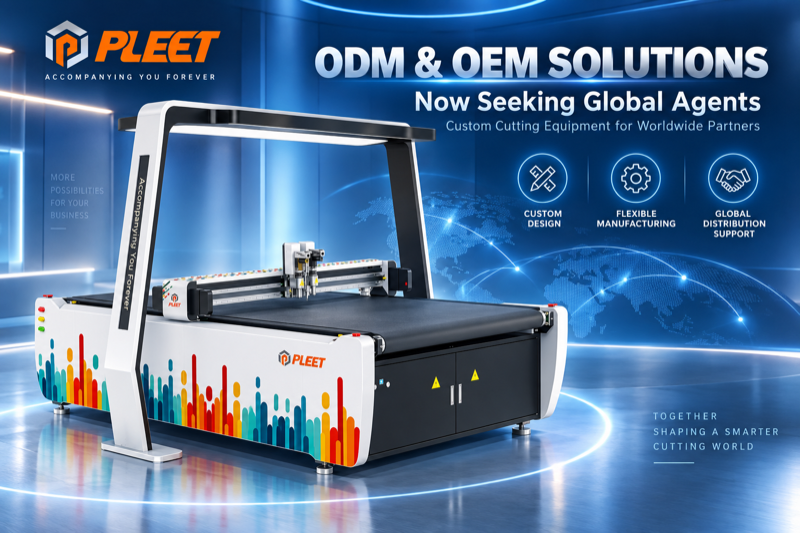
Shandong PLEET Intelligent Technology Group Co., Ltd. develops and manufactures intelligent cutting equipment for flexible materials.
Its documented capabilities include:
CNC oscillating knife cutting
Configurable cutting tools
Automatic nesting
Vacuum adsorption
Automatic feeding
Customized working areas
Industrial equipment testing
PLEET's manufacturing procedures include incoming component inspection, assembly quality control, calibration, stability testing, continuous-operation testing, and final inspection.
The company also provides pre-sale material testing, application analysis, installation, operator training, maintenance guidance, and 7×24 remote technical support.
For manufacturers processing suitable dry carbon fiber fabrics, fiberglass reinforcement, and other flexible composite materials, these capabilities can support application-specific cutting solutions.
However, prepreg compatibility, cutting thickness, finished-ply quality, and production performance should always be confirmed through actual material testing.
For many compatible prepreg materials, a specialized CNC knife cutting machine is a practical option because it avoids intentional thermal processing. The correct configuration depends on resin formulation, backing films, tackiness, and handling requirements.
Some carbon fiber prepreg materials can be processed using appropriately configured oscillating knife systems. Compatibility must be verified through material-specific testing.
Yes. Suitable systems can cut many dry fiberglass fabrics. Blade wear, fiber fraying, and material holding must be controlled.
Fiber orientation influences the intended mechanical performance of composite laminates. Cutting layouts must respect required engineering directions.
Mechanical knife cutting is often preferable for heat-sensitive prepreg because it avoids intentional thermal processing. However, the correct technology depends on the material and manufacturing requirements.
Conventional oscillating knife systems are generally unsuitable for rigid cured carbon fiber panels. CNC routing or abrasive waterjet cutting is usually more appropriate.
Use actual production materials to test edge quality, finished-ply accuracy, fiber orientation, backing-film integrity, repeatability, blade wear, and cost per acceptable ply.
Accurately cutting prepreg and composite fabrics requires more than a precise CNC motion system.
The process must preserve fiber orientation, control material deformation, maintain suitable edge quality, and meet downstream layup requirements.
For many flexible reinforcement materials, CNC oscillating knife cutting offers important advantages:
Mechanical Cutting + Digital Pattern Flexibility + No Dedicated Cutting Dies + Automatic Nesting + Repeatable Production
However, dry carbon fiber, fiberglass, aramid fabrics, and prepreg materials have different cutting characteristics.
The most important selection factors are:
Material Structure + Resin Formulation + Fiber Orientation + Blade Configuration + Material Holding + Finished-Ply Accuracy
For industrial production, additional priorities include:
Material Utilization + Handling Conditions + Process Safety + Production Reliability + Technical Support
PLEET's configurable intelligent cutting systems combine oscillating knife technology, automatic nesting, vacuum holding, and optional feeding for suitable flexible composite reinforcement materials.
Before investing, manufacturers should conduct material-specific cutting tests and compare actual finished-ply quality, acceptable output, and total operating costs.
The best prepreg and composite fabric cutting solution is not simply the machine with the highest advertised speed. It is the system that preserves reinforcement quality, meets engineering requirements, minimizes material waste, and delivers consistent results throughout production.