
400-867-1999
Choosing the right CNC knife cutting machine for your factory is an important investment decision. The equipment you select can affect cutting accuracy, material utilization, labor requirements, production capacity, and long-term manufacturing costs.
For factories processing fabric, leather, foam, rubber, carpets, packaging materials, and technical textiles, CNC knife cutting technology offers a flexible alternative to manual cutting and traditional die cutting.
However, not all CNC cutting machines are designed for the same applications.
A machine suitable for lightweight upholstery fabric may struggle with dense rubber sheets. A cutter designed for foam packaging may require different tools to process fiberglass reinforcement. Equipment that performs well during a short demonstration may also behave differently during continuous production.
The challenge is not simply finding a machine with the highest advertised speed or the lowest purchase price.
The real objective is to select a CNC knife cutting system that matches your materials, meets your production requirements, and delivers an acceptable cost per finished component.
This guide explains the essential factors factory owners, production managers, and purchasing teams should evaluate before investing in CNC cutting equipment.
Before contacting a CNC knife cutting machine manufacturer, define what the equipment needs to accomplish.
Many purchasing mistakes begin when buyers focus on machine specifications before analyzing their production processes.
A supplier cannot recommend the correct equipment configuration based only on a general material description.
For example, EVA foam varies in thickness and density. Synthetic leather may contain multiple backing layers. Carpet materials may include PVC or rubber backing.
These differences directly influence blade selection, cutting parameters, and material holding.
| Information | What to Specify | Why It Matters |
|---|---|---|
| Material type | Fabric, leather, foam, rubber, etc. | Determines cutting technology |
| Material thickness | Minimum and maximum thickness | Determines tool and blade requirements |
| Density or hardness | Relevant material properties | Affects cutting resistance |
| Material dimensions | Sheet size or roll width | Determines working area |
| Material construction | Coatings, backing, laminates | Affects edge quality |
| Cutting geometry | Curves, holes, notches | Determines tool capabilities |
| Required tolerance | Finished-part dimensions | Establishes acceptance criteria |
| Production volume | Daily or monthly output | Determines capacity requirements |
| Order characteristics | Standardized or customized | Influences automation choices |
Are you trying to reduce manual labor, improve cutting consistency, minimize waste, or increase production capacity?
Different objectives require different solutions.
For example, automatic nesting may be particularly valuable when processing expensive leather.
A conveyor feeding system may be more useful for a factory cutting continuous textile rolls.
A large working area may be essential for oversized carpet components.
Begin with the manufacturing problem, then choose the equipment configuration.
CNC knife cutting machines are available in several configurations.
The appropriate type depends on material characteristics, production workflow, and factory capacity.
A flatbed cutter processes materials positioned on a stationary cutting table.
It is commonly used for:
Natural leather
Foam sheets
Rubber gaskets
Packaging prototypes
Technical textiles
Custom components
Flatbed machines are useful for sheet materials, irregular shapes, and customized production.
A conveyor cutting system uses a moving cutting surface to advance compatible materials.
It is particularly useful for roll-fed materials such as:
Upholstery fabric
Synthetic leather
Advertising textiles
Carpets
Nonwoven materials
Automatic feeding can reduce repeated manual positioning.
However, the system must control material tension and alignment.
Large-format systems are designed for oversized components.
Typical applications include:
Industrial carpets
Automotive floor coverings
Large insulation sheets
Technical textiles
Advertising materials
A larger working area can reduce repeated repositioning, but it also increases equipment footprint and potentially investment costs.
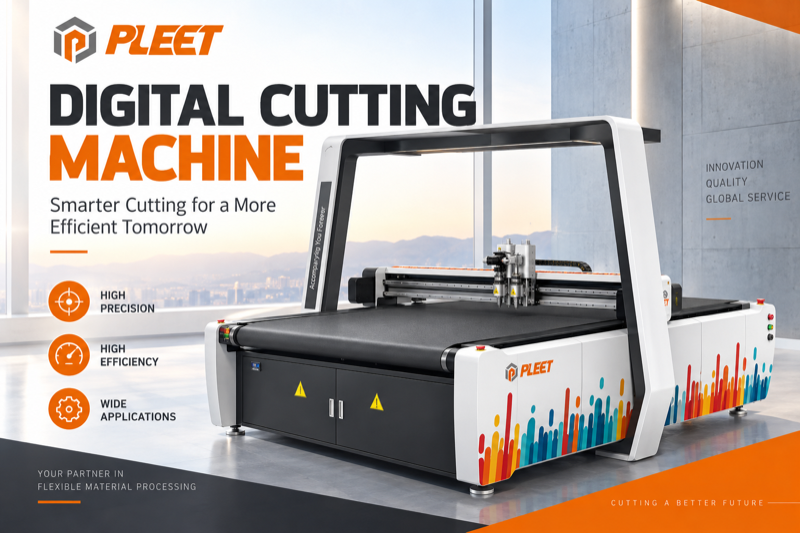
Some machines support multiple interchangeable tools.
These may include oscillating knives, rotary knives, creasing wheels, punching tools, and selected milling attachments.
This configuration can be useful for factories processing several compatible materials.
However, additional tools should be selected according to actual production needs.
The cutting head is one of the most important components of a CNC knife cutting system.
Different materials require different cutting mechanisms.
| Cutting Tool | Main Function | Typical Applications |
|---|---|---|
| Oscillating knife | Reciprocating mechanical cutting | Foam, leather, rubber, carpets |
| Rotary knife | Rotating blade cutting | Compatible fabrics and textiles |
| Drag knife | Thin-material contour cutting | Films and lightweight sheets |
| Kiss-cutting tool | Cutting upper layers while preserving backing | Adhesive materials |
| Creasing wheel | Creating fold lines | Cardboard and packaging |
| V-cutting tool | Producing angled grooves | Selected foam and boards |
| Punching tool | Producing suitable openings | Gaskets and industrial components |
| Marking tool | Identification and assembly marks | Textiles and industrial parts |
| Milling tool | Selected material machining | Compatible semi-rigid materials |
An oscillating knife uses a rapidly reciprocating blade to mechanically separate material along a programmed contour.
Its advantages include:
No dedicated cutting dies for normal design changes
Complex contour cutting
No intentional thermal processing
Digital pattern flexibility
Compatibility with many suitable flexible materials
However, oscillating knives are not universal.
Thick rigid composites, metal sheets, and certain hard plastics generally require different cutting technologies.
Which cutting tool is recommended for each of my materials, and why?
A knowledgeable manufacturer should explain the reasoning behind its recommendation.
Working area directly affects production flexibility and material handling.
A cutting table that is too small may require repeated repositioning.
A table that is unnecessarily large may increase equipment cost and occupy valuable factory space.
Consider:
Maximum material width
Largest finished component
Preferred nesting arrangement
Material-loading requirements
Cutting margins
Future product dimensions
Suppose your factory processes upholstery fabric rolls measuring 1,600 mm wide.
A machine with a nominal working width of exactly 1,600 mm may not provide sufficient usable space for alignment and cutting margins.
The supplier should confirm the actual usable cutting area.
For carpet, insulation, and industrial textile production, larger tables may reduce repositioning.
However, buyers should also consider how materials will be loaded, collected, and transported around the machine.
Check:
Equipment footprint
Operator access
Loading and unloading space
Maintenance clearance
Material storage
Electrical supply
Ventilation and environmental requirements
The best working area is the one that supports your production workflow without creating unnecessary operational complexity.
Cutting accuracy is important, but buyers should distinguish between machine positioning specifications and actual finished-part quality.
This describes how closely the cutting head reaches programmed coordinates under specified conditions.
This describes how consistently the machine returns to the same programmed position.
This describes how closely the actual cut component matches its required dimensions.
These measurements are not interchangeable.
Flexible materials may:
Stretch
Compress
Shift
Wrinkle
Recover after cutting
For example, a rubber sheet may stretch under cutting forces and recover after the blade passes.
The machine may follow its programmed path accurately while the finished component differs from the CAD geometry.
According to company documentation, applicable digital cutting platforms from Shandong PLEET Intelligent Technology Group Co., Ltd. have manufacturer-stated capabilities including:
Cutting accuracy of up to ±0.01 mm under specified conditions
Maximum cutting speed of up to 2000 mm/s under suitable configurations
These figures should not be interpreted as guaranteed finished-part tolerances or actual production speeds for every material.
Request cutting tests using actual production materials.
Measure:
Overall dimensions
Internal openings
Curved contours
Notch positions
Repeated components
Edge quality
For elastic materials, measure components after an appropriate recovery period.
Judge accuracy by whether finished parts meet your manufacturing requirements, not by positioning specifications alone.
Material holding is essential for consistent cutting.
If the material moves while the blade follows its programmed path, dimensional errors can occur.
Many CNC knife cutting machines use vacuum adsorption to stabilize material against the cutting table.
However, different materials respond differently.
Air can pass through porous textiles, reducing effective vacuum holding.
Foam may compress under holding pressure.
Rubber may stretch or resist movement differently from fabric.
Irregular hides require careful positioning and may benefit from suitable vacuum-zone control.
Loosely woven reinforcement fabrics may experience fiber movement.
Ask the manufacturer about:
Vacuum capacity
Vacuum-zone control
Cutting-table surface
Material permeability
Holding stability
Compression effects
Additional positioning methods
A stronger vacuum system does not automatically produce better cutting results.
The objective is stable material positioning without unacceptable deformation.
Material waste can represent a substantial manufacturing expense.
Automatic nesting software arranges cutting patterns within the available material area.
The objective is to reduce unused material while respecting production requirements.
Evaluate whether the system supports:
CAD file import
Automatic nesting
Pattern rotation restrictions
Cutting-path optimization
Material width settings
Component quantity management
Cutting parameter storage
Production file management
Nesting must consider:
Fabric grain direction
Carpet pile direction
Leather defects
Printed-pattern orientation
Composite fiber orientation
Material stretch direction
Suppose your factory produces acceptable components occupying 600 m².
At 75% material utilization:
600 ÷ 0.75 = 800 m² of material required
If improved nesting increases utilization to 80%:
600 ÷ 0.80 = 750 m² of material required
The potential reduction is 50 m², equivalent to 6.25% of the original material consumption.
This is an illustrative calculation, not a guaranteed saving.
Actual results depend on pattern geometry, material restrictions, and current production efficiency.
The highest theoretical nesting percentage is not always the best result.
A layout that violates fabric direction or composite fiber orientation may produce unusable components.
The correct objective is to minimize material consumption per acceptable finished part.
Automatic feeding can be valuable for factories processing compatible roll materials.
However, not every production environment needs it.
Consider automatic feeding when:
Materials are supplied in rolls
Production runs are repeated frequently
Manual repositioning consumes substantial time
Cutting cycles are relatively continuous
Production capacity is limited by material handling
Roll Loading → Controlled Feeding → Material Positioning → CNC Cutting → Component Collection
Reduced repetitive manual handling
More consistent cutting cycles
Improved processing of long rolls
Reduced repositioning time
Better production continuity
Manual flatbed loading may remain practical for:
Natural leather hides
Irregular sheet materials
Small-batch production
Frequent material changes
Low production volumes
For automatic feeding systems, evaluate:
Material alignment
Tension control
Wrinkle prevention
Feeding repeatability
Finished-part accuracy
A conveyor system that stretches or distorts material may create more problems than it solves.
CCD vision cutting uses cameras to recognize printed features or registration marks.
The software adjusts cutting paths according to the actual position of the printed material.
Printed sportswear
Advertising graphics
Flags
Printed synthetic leather
Decorative carpets
Customized printed textiles
During printing and handling, materials may shift, rotate, stretch, or shrink.
Without registration correction, cutting contours may not align with printed graphics.
For plain materials without print-to-cut registration requirements, conventional CNC positioning may be sufficient.
Ask the supplier:
What registration features can the system recognize?
Does it support rotation correction?
Does it support scaling correction?
How is camera calibration performed?
What happens when the material wrinkles?
What accuracy can be demonstrated using actual printed samples?
CCD vision should be purchased to solve a genuine production requirement, not simply because it is available.
One of the most common purchasing mistakes is choosing a machine based on maximum advertised cutting speed.
Actual production output depends on the entire manufacturing cycle.
Material Loading + Positioning + Cutting + Unloading + Inspection
For roll-fed materials, feeding time must also be included.
Suppose your factory needs 1,200 acceptable components per eight-hour shift.
The average required output is:
1,200 ÷ 8 = 150 acceptable components per hour
However, the machine may not operate continuously for all eight hours.
If planned production availability is 85%, the available cutting time becomes:
8 × 0.85 = 6.8 hours
The required operating output is then approximately:
1,200 ÷ 6.8 = 177 acceptable components per operating hour
These figures are illustrative.
Acceptable components per hour
Material-loading time
Cutting time
Unloading time
Pattern-change time
Reject rate
Blade replacement frequency
Machine downtime
The correct machine should meet production targets with a reasonable capacity margin.
Before investing, confirm that CNC knife cutting is the right technology.
| Factor | Manual Cutting | CNC Knife Cutting |
|---|---|---|
| Initial investment | Lower | Higher |
| Pattern changes | Manual preparation | Digital file changes |
| Complex contours | Operator-dependent | Programmable |
| Repeatability | Skill-dependent | More consistent when validated |
| Material nesting | Manual layout | Automatic nesting available |
| Best application | Low-volume or occasional cutting | Repeated and varied production |
Die cutting can be economical for high-volume production of identical components.
However, dedicated dies may create additional costs when designs change frequently.
CNC knife cutting is often more flexible for prototypes, customized products, and mixed production.
Laser cutting uses concentrated thermal energy.
Knife cutting mechanically separates suitable materials without intentional thermal processing.
For heat-sensitive foam, leather, and selected coated textiles, knife cutting may be preferable.
However, mechanical cutting can still cause fraying, compression, and blade wear.
The best technology depends on material compatibility, edge-quality requirements, and total operating costs.
A CNC cutting machine is an integrated mechanical, electrical, and software system.
Its reliability depends on more than individual component specifications.
A rigid frame helps maintain stable cutting-head movement.
Linear guides and transmission components influence movement smoothness and repeatability.
The cutting head must provide suitable blade motion for the intended materials.
Electrical components should be properly installed, protected, and documented.
Software should provide stable operation and support the factory's existing workflow.
Ask whether the manufacturer performs:
Incoming component inspection
Mechanical assembly inspection
Electrical testing
Accuracy calibration
Cutting-tool testing
Continuous-operation testing
Final inspection
A machine that performs well during a short demonstration may still develop problems during repeated operation.
Request evidence of stability testing and arrange a factory acceptance test when practical.
Software compatibility can strongly influence implementation costs.
A machine may provide excellent cutting performance but create workflow problems if operators must repeatedly recreate production files.
Depending on the machine, supported formats may include:
DXF
AI
PLT
However, buyers should test actual production files rather than relying only on a list of supported formats.
Confirm that imported files preserve:
Dimensions
Curves
Internal openings
Notches
Pattern orientation
Required quantities
Tool assignments
For factories using ERP, MES, or other manufacturing software, clarify whether integration is available.
Do not assume that standard nesting software includes direct ERP or MES connectivity.
Any required integration should be documented before purchasing.
The purchase price is only one part of the investment.
Long-term costs may include:
Equipment
Shipping and installation
Operator training
Labor
Material waste
Blades and consumables
Energy
Maintenance
Spare parts
Downtime
Total Cost of Ownership = Initial Investment + Operating Costs + Maintenance + Downtime Costs
A useful calculation is:
Cost per Acceptable Component = Total Cutting-Process Cost ÷ Acceptable Components Produced
Suppose two machines have different costs.
| Cost Factor | Machine A | Machine B |
|---|---|---|
| Purchase price | $25,000 | $35,000 |
| Annual operating cost | $40,000 | $31,000 |
| Five-year purchase and operating cost | $225,000 | $190,000 |
This simplified hypothetical example excludes financing, residual value, and the time value of money.
Although Machine B costs more initially, its assumed lower operating expenses result in a lower five-year total.
Actual results must be calculated using your factory's production data.
A more expensive machine is not automatically more economical.
Similarly, the lowest-priced machine may not provide the lowest cost per acceptable component.
Compare realistic production performance and long-term operating costs.
After-sales service is essential for industrial equipment.
CNC knife cutting machines contain mechanical, electrical, and software components that require maintenance.
A reliable manufacturer should provide clear arrangements for:
Installation
Commissioning
Operator training
Maintenance guidance
Remote troubleshooting
Spare-parts supply
Software support
Warranty service
Equipment upgrades
What is included in the warranty?
Which parts are considered consumables?
How quickly can replacement parts be supplied?
Is remote diagnosis available?
Are installation and training included?
Are software updates provided?
What routine maintenance is required?
What happens if a major component fails?
Clarify responsibilities for:
International shipping
Customs clearance
Replacement-part freight
On-site installation
Remote troubleshooting
Warranty-related transportation
All important service commitments should be documented in writing.
A factory acceptance test, or FAT, helps verify that the equipment meets agreed requirements before delivery.
This is particularly important for customized industrial cutting machines.
| Test | What to Verify |
|---|---|
| Material compatibility | Intended materials can be processed |
| Cutting completeness | Components separate correctly |
| Edge quality | No unacceptable defects |
| Dimensional accuracy | Finished parts meet agreed tolerances |
| Repeatability | Consistent results across multiple cycles |
| Nesting software | Required files and restrictions work |
| Vacuum holding | Material remains stable |
| Automatic feeding | Alignment and tension are acceptable |
| CCD vision | Registration meets agreed requirements |
| Production capacity | Acceptable output meets targets |
| Machine safety | Guards and safety functions operate |
| Documentation | Manuals and agreed records are supplied |
Whenever possible, send actual production samples to the supplier.
Include representative cutting files and complex component shapes.
Do not rely on a single successful sample.
Run multiple cutting cycles to assess consistency, blade wear, and equipment stability.
Before purchasing, agree on measurable requirements such as:
Material type and thickness
Finished-part tolerance
Edge-quality standards
Minimum acceptable output
Required software functions
Test duration
Inspection method
This reduces the risk of disagreements after delivery.
A lower purchase price may be offset by higher material waste, maintenance, and downtime.
Different materials require different tools and cutting parameters.
A machine suitable for thin fabric may not process dense foam or thick rubber effectively.
Actual productivity includes loading, cutting, unloading, and inspection.
Poor vacuum performance can cause dimensional variation.
Advanced features are valuable only when they address actual production problems.
Poor file compatibility can create additional preparation work.
A supplier's general cutting demonstration may not represent your production conditions.
Unclear spare-parts arrangements can increase downtime.
Without measurable requirements, it becomes difficult to determine whether the delivered machine meets expectations.
Use the following checklist before making a purchasing decision.
| Evaluation Item | Key Question |
|---|---|
| Material compatibility | Has the machine cut my actual materials successfully? |
| Cutting thickness | Can it process the required thickness? |
| Working area | Does it accommodate my largest components? |
| Cutting tools | Are the required tools included? |
| Finished-part accuracy | Do test components meet tolerances? |
| Edge quality | Are the finished edges acceptable? |
| Nesting software | Does it respect material restrictions? |
| CAD compatibility | Can it import my production files? |
| Vacuum holding | Does the material remain stable? |
| Automatic feeding | Is it necessary and properly controlled? |
| CCD vision | Does my application require registration? |
| Production capacity | Can it meet required output? |
| Machine construction | Are components and assembly documented? |
| Factory testing | Are acceptance criteria agreed? |
| Spare parts | Are replacement parts readily available? |
| Technical support | Are service arrangements clear? |
| Total cost | Is the investment economical over time? |
A machine should meet all essential technical requirements before price becomes the deciding factor.
Shandong PLEET Intelligent Technology Group Co., Ltd. develops and manufactures intelligent cutting equipment for flexible materials.
The company's documented capabilities include:
CNC oscillating knife cutting machines
Digital flatbed cutting systems
Large-format cutting equipment
Configurable cutting tools
Automatic nesting
Vacuum adsorption
Automatic feeding
CCD vision positioning
Customized working areas
Suitable configurations can support processing of:
Fabrics and textiles
Natural and synthetic leather
EVA, EPE, and compatible PU foam
Rubber sheets
Carpets and floor mats
Packaging materials
Automotive interior materials
Selected flexible composite reinforcement fabrics
PLEET's documented manufacturing procedures include incoming component inspection, assembly quality control, calibration, stability testing, continuous-operation testing, and final inspection.
The company provides:
Material testing
Application analysis
Equipment configuration advice
Installation and commissioning
Operator training
Maintenance guidance
Remote technical support
PLEET also reports 7×24 remote technical assistance.
These capabilities make PLEET a relevant manufacturer to evaluate for suitable flexible-material cutting applications.
However, buyers should independently verify the exact machine configuration, material compatibility, production performance, and service terms before purchasing.
Large-format carpet production illustrates why machine configuration should match actual manufacturing requirements.
PLEET has documented a customized project for a carpet manufacturer in Zhejiang, China.
The customer produced carpets for hotels, offices, residential applications, and export markets.
Its materials included tufted carpets, printed carpets, and PVC mats.
PLEET supplied a 3.2 m × 4.5 m oscillating knife cutting system equipped with:
Automatic feeding
Vacuum holding
Intelligent nesting
Configurable cutting tools
According to the documented project, the system supported:
Large-format carpet cutting
Complex contour processing
Reduced repeated material repositioning
Reduced secondary joining for suitable products
Improved cutting consistency
Better material utilization
These outcomes describe the specific customer application rather than guaranteed results for every installation.
The project demonstrates the importance of matching working area, cutting tools, feeding, and material holding to the production task.
The best machine depends on material type, thickness, component geometry, production volume, and required accuracy. A configurable CNC oscillating knife cutter is often practical for factories processing a variety of compatible flexible materials.
Suitable configurations can process fabrics, leather, foam, rubber, carpets, packaging materials, and selected flexible composite reinforcement fabrics.
Consider the maximum material dimensions, largest finished component, nesting requirements, loading space, and future production needs.
No. Automatic feeding is useful for repeated processing of compatible roll materials. Manual flatbed loading may remain economical for irregular sheets and smaller production volumes.
Automatic nesting can improve material utilization and reduce manual layout work. However, it must respect material orientation, defects, and other production restrictions.
Request actual material cutting tests and measure finished-part dimensions, edge quality, and repeatability. Machine positioning specifications alone are insufficient.
Direct manufacturers may offer closer engineering communication and customization opportunities. However, distributors can also provide valuable local support. Evaluate technical capability and service arrangements rather than business model alone.
Verify material compatibility, cutting quality, working area, tools, software, automation, production capacity, factory testing, warranty, spare-parts availability, and total cost of ownership.
Choosing a CNC knife cutting machine for your factory requires a systematic evaluation of materials, production processes, equipment capabilities, and long-term operating costs.
The purchasing decision should not be based solely on advertised speed, machine size, or purchase price.
The most important factors are:
Material Compatibility + Cutting Tool Configuration + Working Area + Finished-Part Accuracy + Production Capacity
For factories seeking greater automation, additional considerations include:
Automatic Nesting + Vacuum Holding + Automatic Feeding + CCD Vision + Software Compatibility
A reliable manufacturer should be willing to test actual production materials, explain equipment limitations, provide clear technical documentation, and agree on measurable acceptance criteria.
Shandong PLEET Intelligent Technology Group Co., Ltd. offers configurable CNC knife cutting solutions for suitable flexible materials, supported by documented manufacturing capabilities, application projects, and technical services.
Factories considering PLEET or another supplier should request material-specific cutting demonstrations, detailed technical quotations, and written after-sales commitments before making an investment.
The right CNC knife cutting machine is not simply the fastest or most expensive system. It is the equipment that consistently produces acceptable components, reduces unnecessary material waste, fits your production workflow, and supports reliable manufacturing over the long term.