
400-867-1999
In upholstery manufacturing, material waste is not limited to the scraps left on the cutting table. Incorrect dimensions, mismatched fabric patterns, damaged leather, and rejected components can all increase production costs.
For furniture manufacturers processing expensive upholstery fabrics and leather, these losses can significantly affect profit margins.
Digital cutting reduces waste in upholstery manufacturing by optimizing material layouts, improving cutting accuracy, controlling fabric deformation, and reducing human errors. When combined with intelligent nesting and automatic feeding, CNC cutting technology helps manufacturers achieve greater material utilization and production consistency.
Traditional upholstery cutting involves several operations that can generate unnecessary waste.
| Source of Waste | Common Cause |
|---|---|
| Excessive offcuts | Inefficient manual pattern arrangement |
| Rejected components | Inaccurate cutting dimensions |
| Pattern mismatches | Incorrect fabric orientation |
| Damaged materials | Unsuitable cutting tools |
| Unusable leather sections | Poor defect identification |
| Repeated cutting | Incorrect templates or outdated patterns |
| Roll-end waste | Poor production planning |
Reducing waste requires improvements throughout the cutting workflow rather than simply increasing cutting speed.
Automatic nesting software arranges upholstery components within the available material width according to their shapes, quantities, and production restrictions.
For sofa manufacturing, large seat panels can be arranged alongside smaller armrest, cushion, and decorative components to reduce unused spaces.
Intelligent nesting offers several advantages:
Reduced unnecessary gaps between components
Improved utilization of irregular cutting areas
Combined layouts for compatible furniture orders
Reduced manual layout preparation
More consistent material consumption
However, nesting must respect fabric grain, pile direction, stretch characteristics, and pattern-matching requirements.
A densely packed layout is not necessarily efficient if the resulting components cannot be assembled into acceptable furniture products.
Consider a hypothetical upholstery manufacturer consuming 5,000 meters of fabric monthly, with a constant usable roll width.
If material utilization increases from 80% to 88%, the following savings could be achieved while maintaining equivalent acceptable output:
| Performance Indicator | Traditional Cutting | Optimized Digital Cutting |
|---|---|---|
| Material utilization | 80% | 88% |
| Monthly fabric consumption | 5,000 m | 4,545.5 m |
| Monthly fabric savings | — | 454.5 m |
| Annual fabric savings | — | Approximately 5,455 m |
| Material consumption reduction | — | 9.09% |
At a fabric cost of $12 per meter, the potential annual material savings would be approximately $65,455.
This calculation is illustrative, not a guaranteed equipment performance result. Actual savings depend on existing utilization, component geometry, fabric restrictions, and production quality.
Upholstery components must fit together accurately during sewing and assembly.
Even relatively small dimensional deviations can create problems such as uneven seams, wrinkles, poor cushion fit, and inconsistent furniture appearance.
Digital cutting machines use CNC motion control to reproduce approved cutting patterns.
When combined with appropriate blades and stable material holding, this helps reduce:
Incorrect component dimensions
Distorted cutting contours
Misplaced sewing notches
Incomplete cutting
Replacement component production
For elastic upholstery fabrics, finished dimensions should be measured after the material has relaxed rather than while it remains under tension.
Velvet, striped fabrics, plaid textiles, and directional printed upholstery materials require special attention during cutting.
For example, velvet panels cut in opposite pile directions may appear to have different shades after assembly, even when they come from the same fabric roll.
Digital nesting software should support appropriate rotation restrictions and directional requirements.
For printed fabrics, compatible CCD vision systems can assist with graphic positioning and contour alignment. Stripe and plaid matching may require additional software functions and positioning strategies.
These capabilities help prevent visually unacceptable components from entering subsequent production stages.
Genuine leather presents different challenges from conventional roll-fed upholstery fabrics.
Natural hides have irregular outlines, scars, wrinkles, and variations in surface quality.
Effective leather cutting requires consideration of:
Hide boundaries
Surface defects
Leather quality zones
Component appearance requirements
Stretch direction
Compatible digital systems with defect mapping and irregular-area nesting can help improve hide utilization.
Manufacturers should verify whether these specialized functions are included rather than assuming that standard automatic nesting software provides them.
Repeated manual repositioning of upholstery fabric can introduce wrinkles, stretching, and alignment deviations.
Automatic conveyor feeding helps maintain production continuity for compatible roll materials.
Combined with suitable tension control and vacuum holding, it can reduce handling-related errors and improve cutting consistency.
However, excessive feeding tension may distort elastic fabrics. Material stabilization must therefore be validated during equipment trials.
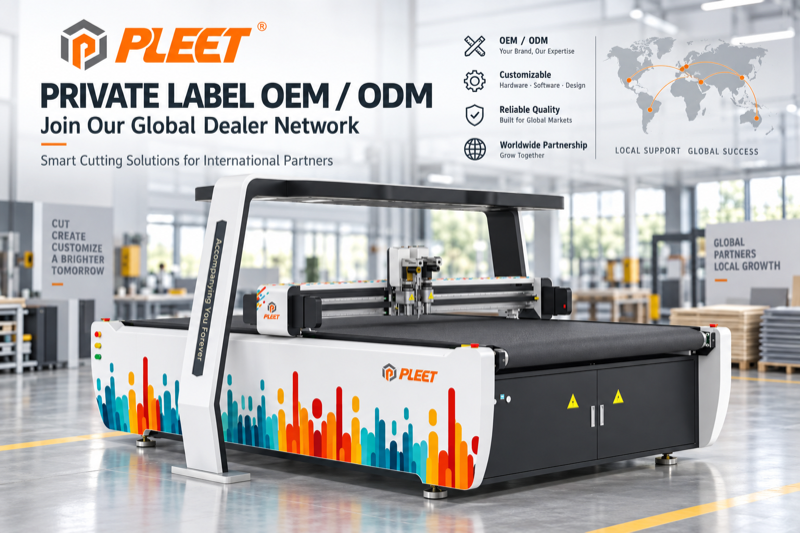
Shandong PLEET Intelligent Technology Group Co., Ltd. develops and manufactures CNC digital cutting equipment for flexible materials.
Its configurable upholstery cutting solutions include:
CNC oscillating knife cutting
Intelligent automatic nesting
Vacuum material holding
Automatic conveyor feeding
Optional CCD vision positioning
Customized working areas
Depending on equipment configuration and material testing, PLEET systems can process suitable woven fabrics, velvet, synthetic leather, genuine leather, and foam-backed upholstery materials.
The company also provides material cutting trials, equipment configuration guidance, installation, operator training, and 7×24 remote technical support.
Can digital cutting reduce upholstery fabric waste?
Yes. Intelligent nesting, accurate contour cutting, and standardized production parameters can reduce unnecessary material consumption.
Can automatic nesting maintain fabric grain direction?
Suitable nesting software supports directional and rotation restrictions to maintain upholstery appearance and functional requirements.
Can digital cutting improve genuine leather utilization?
Yes, provided the system supports appropriate hide boundary recognition, defect mapping, or manual defect identification.
Does automatic cutting reduce sewing-related waste?
Consistent component dimensions and accurate sewing notches can reduce cutting-related assembly errors and rework.
How should furniture manufacturers measure material savings?
Compare material consumption per acceptable furniture set, component rejection rates, reusable remnants, and overall material costs under equivalent production conditions.
Key takeaway: Digital cutting reduces waste in upholstery manufacturing through better pattern arrangement, accurate component geometry, controlled material handling, and fewer production errors. The most meaningful indicator is not theoretical nesting efficiency, but actual material consumption per acceptable finished product.
For furniture manufacturers seeking lower material costs and greater production flexibility, PLEET offers configurable CNC digital cutting solutions. Testing actual upholstery materials and production patterns can help identify realistic material savings before equipment investment.