
400-867-1999
Industrial textiles are widely used in automotive manufacturing, filtration systems, protective equipment, construction, aerospace, and industrial insulation. Unlike ordinary clothing fabrics, these materials often feature reinforced fibers, functional coatings, high-density structures, or multiple bonded layers.
Traditional manual cutting can struggle to maintain dimensional consistency, control material waste, and meet changing production requirements.
A digital cutting machine for industrial textile manufacturing combines CNC cutting technology, configurable cutting tools, intelligent nesting, and automated material handling to improve production efficiency and component consistency.
An industrial textile digital cutting machine uses computer-controlled cutting tools to process technical fabrics according to digital design files.
Depending on material characteristics, the equipment can be configured with oscillating knives, rotary knives, and other compatible cutting tools.
The typical production workflow includes:
CAD Design → Automatic Nesting → Material Feeding → Vacuum Holding → CNC Cutting → Quality Inspection
Digital cutting eliminates the need for dedicated cutting dies for ordinary design changes, making it particularly suitable for customized industrial textile components.
| Material | Typical Industrial Application | Cutting Challenge |
|---|---|---|
| Industrial polyester fabric | Protective covers | Edge fraying |
| Fiberglass fabric | Thermal insulation | Blade wear |
| Carbon fiber fabric | Composite reinforcement | Fiber orientation |
| Aramid fabric | Protective equipment | Fiber toughness |
| PVC-coated fabric | Industrial tarpaulins | Coating resistance |
| Nonwoven fabric | Filtration and insulation | Fiber displacement |
| Industrial felt | Acoustic and thermal insulation | Material density |
| Rubber-coated fabric | Flexible sealing components | Cutting resistance |
| Multilayer technical textiles | Industrial protection | Layer separation |
Material compatibility must be verified according to thickness, density, reinforcement structure, coating composition, and finished-component requirements.
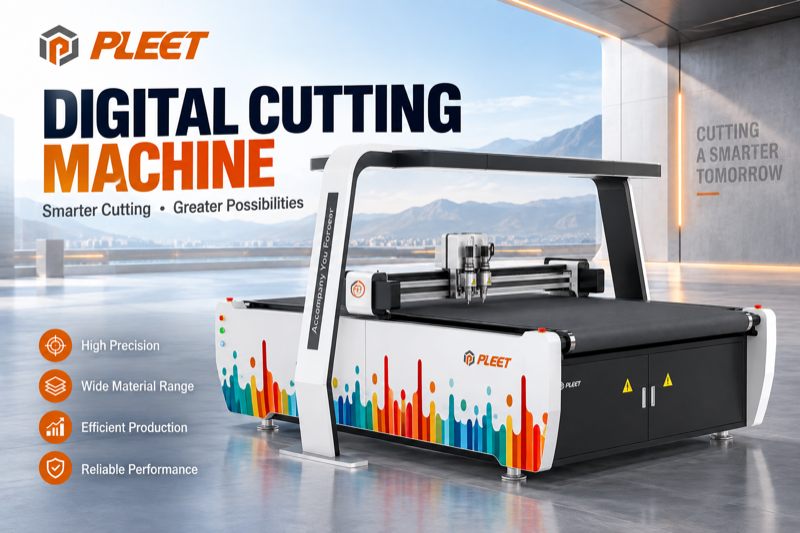
CNC motion control follows approved digital cutting paths, reducing variations associated with manual measuring and cutting.
Consistent component dimensions can simplify subsequent sewing, bonding, welding, and assembly operations.
Intelligent nesting software optimizes component arrangements within available material dimensions.
This is particularly valuable when processing expensive reinforcement fabrics and specialized functional textiles.
Manufacturers can modify component geometries through digital files without producing new cutting dies.
This supports customized orders, product development, and frequent engineering revisions.
Mechanical knife cutting avoids intentional thermal processing, helping protect heat-sensitive coatings, membranes, and reinforcement materials.
Automatic cutting reduces repetitive marking, positioning, template preparation, and hand-cutting operations.
Digital cutting technology supports various industrial manufacturing scenarios.
| Industry | Typical Cutting Applications |
|---|---|
| Automotive | Interior fabrics, insulation, acoustic liners |
| Filtration | Filter fabric blanks and membrane components |
| Construction | Flexible waterproofing and insulation materials |
| Composite manufacturing | Reinforcement plies and flexible prepregs |
| Industrial protection | Equipment covers and protective textile components |
| HVAC | Thermal insulation and flexible duct materials |
| Marine manufacturing | Coated fabrics and reinforcement textiles |
| Industrial packaging | Protective textile and foam components |
Each application requires material-specific cutting validation rather than a universal equipment configuration.
Industrial textiles vary considerably in cutting resistance and structural characteristics.
| Cutting Tool | Suitable Starting Applications |
|---|---|
| Oscillating knife | Dense fabrics, coated textiles, flexible laminates |
| Rotary knife | Compatible woven and lightweight fabrics |
| Drag knife | Selected thin and stable materials |
| Punching tool | Suitable mounting holes and functional openings |
| Marking tool | Component identification and assembly references |
For abrasive fiberglass fabrics or high-toughness aramid materials, manufacturers should pay particular attention to blade geometry, wear resistance, and cutting-edge quality.
The correct cutting tool should separate the material without excessive fiber pulling, coating damage, or dimensional distortion.
Many industrial textiles are supplied in large rolls, making automatic conveyor feeding valuable for continuous production.
Compatible feeding systems can reduce repetitive material handling and improve production continuity.
However, industrial fabrics may have different stiffness, weight, elasticity, and surface friction characteristics.
Manufacturers should verify:
Roll alignment and feeding stability
Material tension control
Vacuum holding effectiveness
Dimensional consistency between feeding cycles
Compatibility with heavy or reinforced textiles
Excessive feeding tension can distort flexible materials and compromise finished-component accuracy.
Maximum cutting speed alone is not sufficient for evaluating industrial production performance.
Equipment acceptance testing should focus on:
Edge quality: Inspect fiber fraying, coating damage, and incomplete cuts.
Dimensional accuracy: Measure components after material relaxation.
Tool durability: Record blade consumption during representative production.
Material utilization: Calculate acceptable component yield.
Production capacity: Measure qualified output per operating hour.
Changeover efficiency: Evaluate material and tool switching times.
Safety controls: Verify appropriate guarding, particle extraction, and contamination management.
These indicators provide a more realistic understanding of long-term manufacturing costs.
Shandong PLEET Intelligent Technology Group Co., Ltd. specializes in developing and manufacturing CNC digital cutting equipment for flexible materials.
Its configurable industrial textile cutting solutions include:
CNC oscillating knife cutting
Multiple cutting-tool configurations
Intelligent automatic nesting
Vacuum material holding
Automatic conveyor feeding
Optional CCD vision positioning
Customized working areas
Depending on material testing and equipment configuration, PLEET systems can process suitable industrial fabrics, coated textiles, nonwoven materials, insulation fabrics, and flexible composite reinforcements.
PLEET also provides material cutting trials, equipment configuration guidance, installation, operator training, and 7×24 remote technical support.
Can a digital cutting machine process reinforced industrial fabrics?
Yes. Suitable cutting tools can process selected reinforced fabrics, subject to material-specific testing.
Can CNC knife cutting replace laser cutting for industrial textiles?
For many heat-sensitive or coated textiles, mechanical knife cutting is a practical alternative. The appropriate technology depends on material composition.
Can automatic nesting reduce technical textile costs?
Yes. Optimized layouts can improve material utilization while respecting mandatory fiber and grain orientations.
Can one machine process multiple industrial textile materials?
Configurable digital cutters can process multiple compatible materials using appropriate tools and validated cutting parameters.
Is digital cutting suitable for continuous industrial production?
Yes. Compatible automatic feeding systems can support continuous production, provided material handling and equipment stability meet production requirements.
Key takeaway: A digital cutting machine for industrial textile manufacturing creates value through improved component consistency, reduced material waste, flexible production, and fewer repetitive manual operations. Successful implementation depends on matching cutting tools, feeding systems, and software capabilities to actual textile characteristics.
For industrial textile manufacturers seeking reliable automated cutting solutions, PLEET offers configurable CNC digital cutting equipment. Material-specific cutting trials can help manufacturers verify processing quality, production capacity, and operating costs before selecting equipment.