
400-867-1999
For manufacturers processing leather, fabrics, foam, rubber, carpets, and composite materials, raw material consumption directly affects production profitability.
Even when a CNC cutting machine operates efficiently, poorly arranged cutting patterns can leave substantial unused areas between components. Over time, these unnecessary offcuts increase purchasing costs and reduce profit margins.
Automatic nesting software helps reduce material waste by intelligently arranging digital cutting patterns within available sheets or rolls. Combined with CNC digital cutting technology, it allows manufacturers to improve material utilization while maintaining production quality and processing efficiency.
Automatic nesting software is a digital tool that calculates efficient arrangements of component patterns within a defined material area.
Instead of manually positioning each pattern, operators import digital files and establish relevant production requirements. The software evaluates different layouts to reduce unused material.
The typical workflow is:
CAD File Import → Material Parameter Settings → Automatic Nesting → Layout Optimization → CNC Cutting
Depending on software capabilities, nesting systems may consider component geometry, material width, rotation restrictions, cutting margins, and required quantities.
Manual nesting relies heavily on operator experience. When processing complex shapes or multiple product designs, finding an efficient arrangement can become difficult.
Common problems include:
Excessive spacing between components
Inefficient use of irregular material areas
Repeated manual layout adjustments
Poor utilization of remaining material
Inconsistent layouts between operators
Difficulty combining different production orders
Automatic nesting can evaluate numerous layout combinations, reducing dependence on manual trial and error.
The software positions compatible shapes closer together while maintaining necessary cutting clearances.
Irregular components can be arranged around one another to reduce unused spaces.
Manufacturers processing different products from the same material can combine compatible patterns into a shared cutting layout.
This is particularly useful for customized furniture, industrial gaskets, automotive interiors, and small-batch manufacturing.
Advanced nesting systems may support remnant management, allowing suitable leftover materials to be recorded and reused for future orders.
This capability should be verified for the specific software configuration.
Automated calculations reduce repetitive pattern arrangement, allowing operators to focus on material preparation and quality inspection.
Material savings depend on component geometry, material dimensions, orientation restrictions, and existing nesting efficiency.
Consider a hypothetical factory consuming 3,000 m² of material monthly at 78% utilization.
If automatic nesting improves utilization to 84%, the comparison would be:
| Performance Indicator | Original Nesting | Optimized Nesting |
|---|---|---|
| Material utilization | 78% | 84% |
| Monthly material consumption | 3,000 m² | 2,785.7 m² |
| Useful component area | 2,340 m² | 2,340 m² |
| Monthly material savings | — | 214.3 m² |
| Annual material savings | — | 2,571.4 m² |
Assuming unchanged acceptable output, material consumption decreases by approximately 7.14%.
This example is illustrative rather than a guaranteed result. Actual savings must be verified through production trials.
Different flexible materials have specific nesting restrictions.
| Material | Important Nesting Requirement |
|---|---|
| Upholstery fabric | Grain and pattern direction |
| Velvet | Consistent pile orientation |
| Genuine leather | Defect avoidance and quality zones |
| Synthetic leather | Texture and stretch direction |
| Carpets | Pile direction and printed patterns |
| Rubber sheets | Cutting clearance and reinforcement direction |
| Foam | Component spacing and cutting stability |
| Carbon fiber fabric | Mandatory fiber orientation |
| Printed textiles | Artwork and contour alignment |
For example, rotating velvet components freely may improve theoretical material utilization but create visible color differences after furniture assembly.
Similarly, changing carbon fiber orientation to save material may violate structural engineering requirements.
The best nesting layout is not necessarily the densest layout. It is the layout that produces the greatest number of acceptable components.
Purchasing advanced nesting software does not automatically eliminate material waste.
Manufacturers should avoid several common mistakes:
Entering incorrect material dimensions
Ignoring grain or fiber orientation
Setting insufficient cutting clearance
Combining incompatible material grades
Using outdated CAD files
Ignoring material defects
Evaluating theoretical utilization without considering rejected components
Nesting parameters should reflect actual cutting capabilities and finished-product requirements.
Manufacturers should establish consistent performance indicators before and after implementing automatic nesting.
A useful measurement is:
Material Utilization = Acceptable Component Area ÷ Total Material Consumed × 100%
Additional indicators include material consumption per order, reusable remnant area, reject rates, layout preparation time, and material cost per acceptable component.
For accurate comparisons, use equivalent product quantities, material grades, and quality requirements.
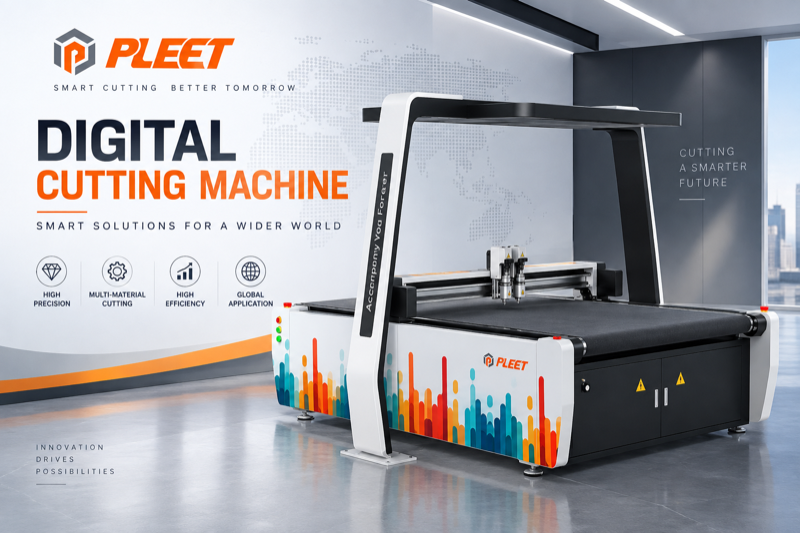
Shandong PLEET Intelligent Technology Group Co., Ltd. develops and manufactures CNC digital cutting equipment for flexible materials.
Its configurable cutting solutions combine:
Intelligent automatic nesting
CNC oscillating knife cutting
Vacuum material holding
Automatic conveyor feeding
Optional CCD vision positioning
Customized working areas
These technologies can support efficient material processing for compatible fabrics, leather, foam, rubber, carpets, packaging, and flexible composite materials.
PLEET also provides material cutting trials, equipment configuration guidance, installation, operator training, and 7×24 remote technical support.
Manufacturers can evaluate nesting performance using actual production patterns and materials before selecting equipment.
Can automatic nesting software reduce material waste?
Yes. It can improve material utilization by optimizing component arrangements within available sheets or rolls.
Does automatic nesting work with irregular shapes?
Yes. Suitable software can arrange complex contours and irregular components according to defined production restrictions.
Can nesting software avoid natural leather defects?
Advanced systems may support defect-aware nesting, but this requires compatible scanning, defect mapping, or manual defect-marking functions.
Does automatic nesting support carbon fiber fabrics?
Suitable software can support composite reinforcement nesting while respecting mandatory fiber orientations.
How can manufacturers verify nesting efficiency?
Compare actual material consumption, acceptable component yield, reject rates, and layout preparation time under equivalent production conditions.
Key takeaway: Automatic nesting software reduces material waste by optimizing cutting layouts, minimizing unnecessary spacing, and improving the utilization of available sheets and rolls. Its effectiveness depends on accurate material information, appropriate nesting restrictions, and reliable CNC cutting performance.
For manufacturers seeking lower material costs and greater production efficiency, PLEET offers configurable digital cutting solutions integrating intelligent nesting and CNC cutting technology. Testing actual production patterns is an effective way to identify potential material savings before investing in automated cutting equipment.