
400-867-1999
Acoustic foam and soundproofing materials are widely used in recording studios, automotive interiors, commercial buildings, industrial equipment, and HVAC systems.
However, cutting these materials accurately can be challenging. Soft foam may compress under cutting pressure, fibrous insulation can develop rough edges, and multilayer soundproofing materials may experience incomplete cutting or delamination.
A digital cutting machine for acoustic foam and soundproofing materials provides a flexible manufacturing solution. By combining CNC oscillating knife technology, intelligent nesting, and stable material holding, manufacturers can produce customized acoustic components without dedicated cutting dies or intentional thermal processing.
Different acoustic materials require different cutting tools and processing parameters.
| Material | Typical Application | Cutting Challenge |
|---|---|---|
| Acoustic PU foam | Recording studios and sound absorption | Compression and recovery |
| PET acoustic felt | Decorative acoustic panels | Fiber density |
| Polyester fiber panels | Interior sound absorption | Edge fraying |
| Rubber foam | HVAC and industrial insulation | Elastic deformation |
| EVA foam | Vibration-damping components | Density and cutting resistance |
| Mass-loaded vinyl | Sound transmission barriers | Material weight and blade resistance |
| Nonwoven insulation | Automotive soundproofing | Fiber movement |
| Multilayer acoustic materials | Industrial noise control | Layer separation |
Material compatibility depends on thickness, density, hardness, and structural composition.
Rigid acoustic boards and thick three-dimensional foam products may require specialized cutting or machining equipment.
An oscillating knife cutter uses a rapidly reciprocating blade to mechanically separate materials along programmed cutting paths.
Its main advantages include:
Reduced thermal damage: Mechanical cutting avoids intentional heating, helping prevent burning, melting, and thermal discoloration.
Complex contour cutting: CNC technology supports customized shapes, mounting openings, curves, and irregular outlines.
No dedicated cutting dies: Manufacturers can modify acoustic component designs directly through digital files.
Improved material utilization: Intelligent nesting helps reduce unnecessary offcuts.
Consistent production: Validated cutting parameters support repeatable component dimensions.
Mechanical cutting may still generate fibers, particles, or frictional heat. Appropriate workplace controls remain necessary.
Acoustic foam is particularly sensitive to mechanical pressure.
When unsuitable blades compress the material before cutting, finished components may develop uneven edges or dimensional errors after recovery.
To improve cutting quality, manufacturers should:
Select blades according to foam density and thickness.
Maintain sharp cutting edges.
Optimize cutting speed and oscillation settings.
Provide stable material support.
Avoid excessive holding pressure.
Measure finished components after appropriate recovery.
Conventional flatbed knife cutters are primarily suitable for compatible foam sheets and flat profiles.
Complex three-dimensional acoustic foam shapes, including certain pyramid and wedge structures, may require specialized foam profiling equipment.
PET acoustic felt is commonly used in offices, conference rooms, schools, commercial interiors, and decorative wall panels.
Manufacturers frequently need to produce geometric patterns, customized contours, and modular acoustic components.
Digital cutting allows designers to transform CAD patterns into physical products without dedicated tooling.
For dense PET felt, blade rigidity, cutting depth, and material holding are particularly important.
Manufacturers should inspect both upper and lower edges to ensure complete cutting without unacceptable fiber pulling.
Automotive and industrial soundproofing products often contain multiple material layers.
Typical applications include:
Automotive floor insulation
Door-panel acoustic liners
Equipment enclosure insulation
HVAC soundproofing components
Industrial vibration-damping pads
Machinery noise-control materials
These products may combine foam, felt, rubber, adhesives, and protective surface layers.
A suitable CNC digital cutter can process compatible flat composite materials into customized shapes.
However, cutting trials must verify complete layer separation, dimensional consistency, and laminate integrity.
Cutting accuracy alone does not establish acoustic performance, which depends on material properties, component design, and installation.
| Factor | Oscillating Knife | Laser Cutting | Saw Cutting |
|---|---|---|---|
| Cutting mechanism | Mechanical blade | Thermal energy | Mechanical teeth |
| Thermal damage | Generally limited | Possible | Friction-related heating possible |
| Particle generation | Material-dependent | Fumes and particles possible | Dust and debris possible |
| Customized contours | Suitable | Material-dependent | Equipment-dependent |
| Flexible foam sheets | Often suitable | Thermal compatibility required | Compression may occur |
| Thick rigid materials | Limited | Material-dependent | Often suitable |
For compatible flexible acoustic materials, oscillating knife cutting is often preferable when clean edges and minimal thermal damage are priorities.
Before purchasing equipment, manufacturers should evaluate:
Material compatibility: Test actual acoustic foam, felt, and laminated materials.
Cutting thickness: Verify performance on the thickest intended material.
Blade configuration: Match cutting tools to density and material structure.
Working area: Accommodate large acoustic panels.
Vacuum holding: Prevent movement without excessive compression.
Automatic nesting: Evaluate material utilization.
Production capacity: Measure acceptable output rather than maximum cutting speed.
Technical support: Confirm training, maintenance, and spare-parts availability.
Request cutting demonstrations using representative production materials and complex patterns.
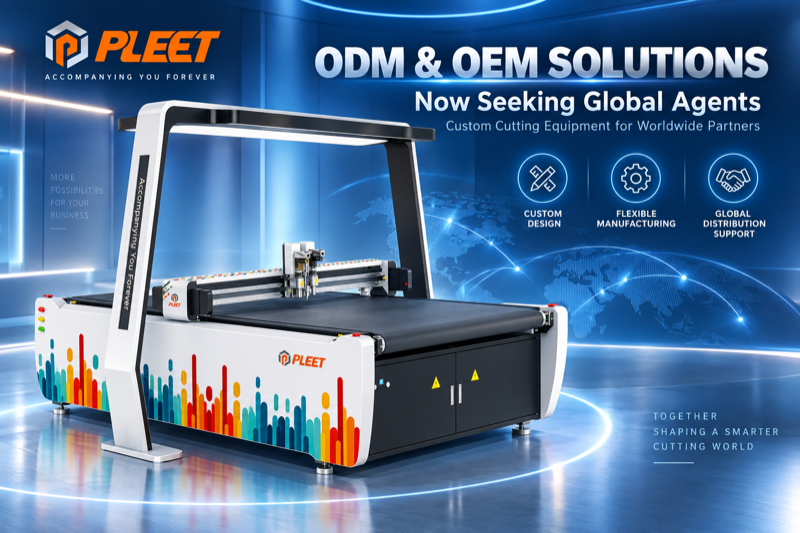
Shandong PLEET Intelligent Technology Group Co., Ltd. develops and manufactures CNC digital cutting equipment for flexible materials.
Its configurable solutions include:
CNC oscillating knife cutting
Intelligent automatic nesting
Vacuum material holding
Automatic conveyor feeding
Multiple cutting-tool configurations
Customized working areas
Depending on equipment configuration and material testing, PLEET systems can support suitable acoustic foam, PET felt, rubber foam, nonwoven insulation, and flexible soundproofing materials.
PLEET also provides material cutting trials, equipment configuration guidance, installation, operator training, and 7×24 remote technical support.
Can an oscillating knife cutter cut acoustic foam?
Yes. Suitable configurations can process many flexible acoustic foam sheets using appropriate blades and cutting parameters.
Can digital cutting machines process PET acoustic panels?
Yes. Compatible PET felt panels can be cut into customized shapes, depending on material thickness and density.
Does knife cutting produce dust or burning?
Mechanical knife cutting avoids intentional thermal processing, but fibers and particles may still be generated.
Can one machine cut different soundproofing materials?
A configurable digital cutter can process multiple compatible materials using suitable tools and validated settings.
Does digital cutting improve acoustic performance?
Not directly. It supports accurate component geometry and consistent manufacturing, while acoustic performance depends on material selection, structural design, and installation.
Key takeaway: A digital cutting machine for acoustic foam and soundproofing materials offers valuable advantages in customized contour cutting, material utilization, edge quality, and flexible production. Successful processing depends on controlling compression, fiber movement, and cutting resistance.
For acoustic panel and soundproofing material manufacturers, PLEET provides configurable CNC digital cutting solutions. Material-specific cutting trials can help determine suitable blade configurations, working areas, and processing parameters before equipment investment.