
400-867-1999
Composite materials are widely used in aerospace, automotive manufacturing, wind energy, marine engineering, and industrial equipment because of their favorable strength-to-weight characteristics and engineering versatility.
However, cutting composite fabrics accurately presents several challenges. Fiber displacement, edge fraying, incorrect reinforcement orientation, and material waste can affect downstream manufacturing quality.
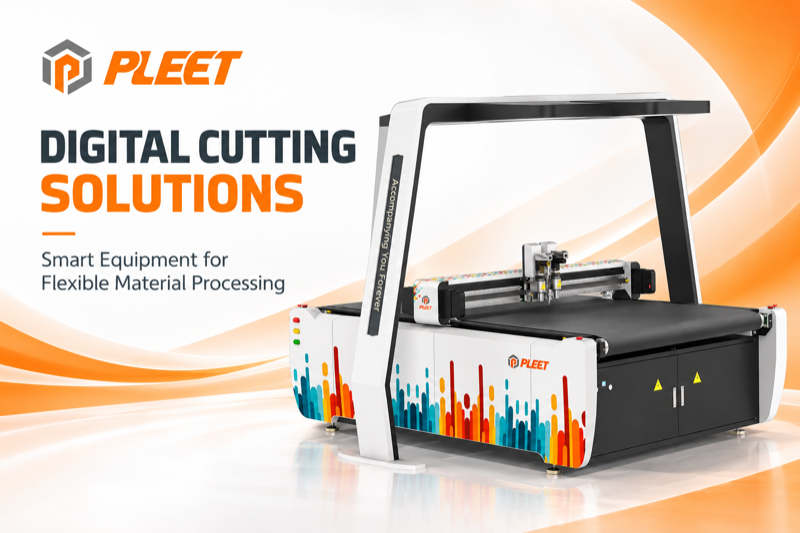
A CNC composite cutting machine equipped with suitable oscillating knife technology offers a practical solution for processing flexible composite reinforcement materials before molding and curing.
By combining digital pattern management, intelligent nesting, precision motion control, and stable material holding, manufacturers can improve cutting consistency and production efficiency.
A CNC composite cutting machine uses computer-controlled cutting tools to produce reinforcement plies and other compatible components according to digital engineering files.
The typical production workflow includes:
CAD Design → Fiber Orientation Planning → Intelligent Nesting → Material Positioning → CNC Cutting → Ply Inspection
Unlike traditional manual cutting, digital cutting allows manufacturers to store, modify, and reproduce approved component patterns without dedicated cutting dies.
However, flexible reinforcement fabrics and rigid cured composites require different processing technologies.
| Composite Material | Typical Application | Cutting Challenge |
|---|---|---|
| Dry carbon fiber fabric | Aerospace and lightweight structures | Fiber displacement |
| Fiberglass fabric | Wind energy and industrial equipment | Abrasiveness and blade wear |
| Aramid fabric | Protective and structural components | High fiber toughness |
| Carbon fiber prepreg | Composite laminate manufacturing | Resin adhesion |
| Glass fiber prepreg | Industrial composite structures | Material handling |
| Multiaxial reinforcement | Structural composite components | Fiber orientation |
| Flexible composite laminates | Industrial insulation and protection | Layer separation |
| Flexible sandwich core materials | Selected lightweight structures | Compression and edge quality |
Material compatibility depends on thickness, reinforcement structure, resin composition, and cutting-tool configuration.
Rigid cured carbon fiber panels generally require specialized routing, waterjet cutting, or other suitable machining processes.
Aerospace composite manufacturing requires strict control over component geometry, reinforcement orientation, material handling, and production traceability.
Typical cutting applications include:
Composite reinforcement plies
Aircraft interior material blanks
Lightweight structural preforms
Flexible insulation components
Selected sandwich core materials
Digital cutting can help reproduce approved ply geometries consistently and reduce manual pattern preparation.
However, aerospace manufacturing requires more than dimensional accuracy. Material handling, contamination control, process qualification, and customer-specific quality requirements must also be satisfied.
A CNC cutting machine alone does not establish aerospace production approval or regulatory compliance.
Accurate complex contours: CNC motion control supports irregular reinforcement shapes, curved edges, and suitable internal openings.
Reduced material waste: Intelligent nesting can improve utilization of expensive carbon fiber and other reinforcement fabrics.
No intentional thermal processing: Mechanical knife cutting helps avoid thermal degradation associated with unsuitable heat-based cutting methods.
Flexible pattern changes: Engineering revisions can be implemented through approved digital cutting files without manufacturing new dies.
Improved repeatability: Validated cutting parameters and stable material holding help maintain consistent ply geometry.
Reduced manual operations: Automated cutting reduces repetitive measuring, marking, and hand-cutting tasks.
Fiber orientation directly influences the mechanical properties of composite structures.
Depending on the engineering design, reinforcement plies may require orientations such as 0°, 45°, −45°, or 90°.
Automatic nesting must respect these requirements rather than freely rotating every component to maximize material utilization.
Incorrect fiber orientation can compromise the intended stiffness, strength, and load distribution of the finished laminate.
For aerospace and structural composite manufacturing, engineering requirements must always take priority over nesting efficiency.
Prepreg materials contain reinforcement fibers impregnated with a resin system.
Their cutting behavior differs from dry composite fabrics because resin tack, backing films, and temperature conditions can affect processing.
Manufacturers should pay particular attention to:
Resin-specific handling requirements
Material temperature and permitted out-time
Blade adhesion and contamination
Backing film integrity
Cutting-edge quality
Ply identification and traceability
Cutting parameters should be validated for each prepreg grade.
Storage conditions, handling procedures, and allowable exposure times must follow the material manufacturer's specifications.
| Factor | CNC Knife Cutting | CNC Routing | Waterjet Cutting |
|---|---|---|---|
| Dry reinforcement fabrics | Often suitable | Generally unsuitable | Generally less practical |
| Flexible prepreg | Material-dependent | Generally unsuitable | Generally less practical |
| Rigid cured composites | Generally unsuitable | Suitable configurations | Suitable configurations |
| Cutting mechanism | Mechanical blade | Rotating tool | High-pressure water |
| Material removal | Minimal | Cutting channel | Cutting channel |
| Main consideration | Blade wear and fiber movement | Dust and machining damage | Water exposure and process costs |
For flexible composite materials before curing, CNC knife cutting is often a practical starting point.
For rigid composite structures after curing, specialized machining technologies are generally more appropriate.
Before purchasing equipment, manufacturers should evaluate:
Material compatibility: Test actual reinforcement fabrics and prepreg grades.
Cutting tools: Verify blade suitability for abrasive or high-toughness fibers.
Nesting software: Confirm support for mandatory fiber orientations.
Material holding: Prevent fiber displacement and unwanted deformation.
Working area: Accommodate large reinforcement plies.
Cutting accuracy: Measure finished-ply dimensions and edge integrity.
Safety controls: Evaluate fiber extraction and contamination management.
Technical support: Confirm training, maintenance, and spare-parts availability.
Acceptance testing should include representative production patterns and repeated cutting cycles.
Shandong PLEET Intelligent Technology Group Co., Ltd. develops and manufactures CNC digital cutting equipment for flexible materials.
Its configurable solutions include oscillating knife cutting, intelligent nesting, vacuum holding, automatic feeding, and customized working areas.
Depending on equipment configuration and material testing, PLEET systems can support suitable carbon fiber fabrics, fiberglass reinforcement, and selected flexible composite materials.
The company also provides material cutting trials, equipment configuration guidance, installation, operator training, and 7×24 remote technical support.
Can a CNC knife cutter cut carbon fiber?
Yes. Suitable configurations can process dry carbon fiber fabrics and selected flexible prepregs. Rigid cured carbon fiber requires different machining technologies.
Can CNC cutting reduce composite material waste?
Intelligent nesting can improve material utilization while respecting mandatory fiber orientations.
Does oscillating knife cutting damage composite fibers?
Suitable blades and validated parameters can reduce fiber disturbance, although fraying and blade-related damage remain possible.
Can CNC knife cutters process aerospace prepreg?
Selected prepreg materials may be compatible, subject to material testing, process qualification, and applicable aerospace manufacturing requirements.
Is composite knife cutting completely dust-free?
No. Mechanical cutting can still release fibers and particles, requiring appropriate workplace controls.
Key takeaway: A CNC composite cutting machine can improve production flexibility, material utilization, and ply consistency when processing suitable flexible reinforcement materials. For aerospace and industrial applications, fiber orientation, material integrity, and process validation are particularly important.
PLEET offers configurable CNC digital cutting solutions for flexible composite materials. Manufacturers can request material-specific cutting trials to evaluate blade configurations, nesting capabilities, and finished-ply quality before selecting equipment.