
400-867-1999
China is an important manufacturing base for CNC digital cutting equipment, offering a wide range of machines for textiles, leather, foam, rubber, carpets, packaging, and technical fabrics.
For international buyers, purchasing a digital cutting machine from China can provide access to competitive pricing, customized configurations, and flexible manufacturing solutions.
However, differences in manufacturing capabilities, equipment quality, software, and after-sales support can make supplier selection challenging.
Buying a digital cutting machine from China successfully requires evaluating the manufacturer's technical capabilities, verifying actual cutting performance, and clarifying international delivery and service arrangements.
Before requesting quotations, prepare a detailed description of your production requirements.
Important information includes:
Material types, thicknesses, densities, and hardness
Maximum component dimensions
Required cutting accuracy
Daily production volume
Existing CAD file formats
Automatic feeding requirements
Printed-pattern recognition requirements
Available factory space
For example, a furniture manufacturer cutting upholstery fabric requires a different configuration from a factory processing dense rubber gaskets or thick foam packaging.
Providing accurate material information helps manufacturers recommend suitable equipment rather than simply offering standard models.
Chinese manufacturers offer various CNC cutting technologies for different industrial applications.
| Cutting Technology | Typical Applications |
|---|---|
| Oscillating knife cutting | Leather, foam, rubber, carpets |
| Rotary knife cutting | Compatible fabrics and textiles |
| CCD vision cutting | Printed fabrics and advertising graphics |
| Automatic feeding cutting | Compatible roll-fed materials |
| Creasing and knife cutting | Cardboard and packaging |
| CNC routing | Rigid boards and hard plastics |
For manufacturers processing flexible materials, a configurable CNC oscillating knife cutter is often a practical starting point.
However, material compatibility should always be confirmed through actual cutting trials.
Not every company selling digital cutting machines operates its own manufacturing facility.
Some companies are manufacturers, while others are trading companies or equipment distributors.
Before purchasing, verify:
Company registration and factory address
Manufacturing and assembly facilities
Engineering capabilities
Quality-control procedures
Equipment customization capabilities
Relevant customer applications
International export experience
Request a factory visit or live video inspection where practical.
Direct manufacturers may offer closer engineering communication and customization, while qualified distributors may provide valuable regional support.
Product demonstration videos cannot fully establish whether a machine is suitable for your production requirements.
Send representative material samples and actual CAD cutting files to the manufacturer.
Request tests covering:
Maximum required material thickness
Complex contours and internal openings
Finished-part dimensional accuracy
Cutting-edge quality
Automatic nesting efficiency
Repeated production stability
Actual processing time
For printed materials, verify CCD registration accuracy. For roll materials, evaluate feeding tension and alignment.
Ask the manufacturer to provide unedited cutting videos, measurement results, and physical samples where practical.
Two digital cutting machines with similar appearances may have significantly different configurations.
| Configuration | What Buyers Should Verify |
|---|---|
| Machine frame | Structural rigidity and stability |
| Servo system | Motion-control performance |
| Cutting head | Material and blade compatibility |
| Working area | Actual usable cutting dimensions |
| Vacuum system | Material-holding effectiveness |
| Nesting software | Functions and licensing |
| Automatic feeding | Included or optional |
| CCD vision | Recognition and correction capabilities |
| Safety systems | Protective functions and documentation |
| Spare parts | Availability and replacement costs |
Compare quotations based on equivalent configurations rather than purchase price alone.
International buyers should clarify which expenses are included in the quotation.
Common Incoterms include:
| Trade Term | General Meaning |
|---|---|
| EXW | Buyer arranges most transportation and export-related operations |
| FOB | Seller delivers equipment on board the vessel at the named shipment port |
| CIF | Seller pays specified freight and insurance to the named destination port |
| DAP | Seller delivers equipment to the named destination, excluding import clearance and duties |
| DDP | Seller generally handles delivery, import clearance, and applicable duties |
FOB and CIF apply to sea and inland waterway transportation. FCA or CIP may be more appropriate for certain containerized or multimodal shipments.
Confirm the applicable Incoterms version, named location, packaging requirements, insurance, unloading responsibilities, and import regulations.
The lowest equipment quotation does not necessarily represent the lowest landed cost.
Before making payments, verify that the contracting company and beneficiary bank account are consistent with the agreed transaction.
The purchase agreement should clearly specify:
Machine model and configuration
Payment schedule
Manufacturing lead time
Factory acceptance criteria
Shipping arrangements
Warranty coverage
Technical support responsibilities
Request factory acceptance testing before shipment and link payment milestones to agreed contractual conditions where possible.
Also verify applicable product conformity documentation for your destination market.
International equipment purchases require dependable technical support.
Ask the manufacturer about installation, commissioning, operator training, remote troubleshooting, spare-parts delivery, software updates, and warranty exclusions.
A machine that remains idle while waiting for technical assistance or replacement components can create substantial production losses.
Written service commitments are more valuable than general promises of excellent support.
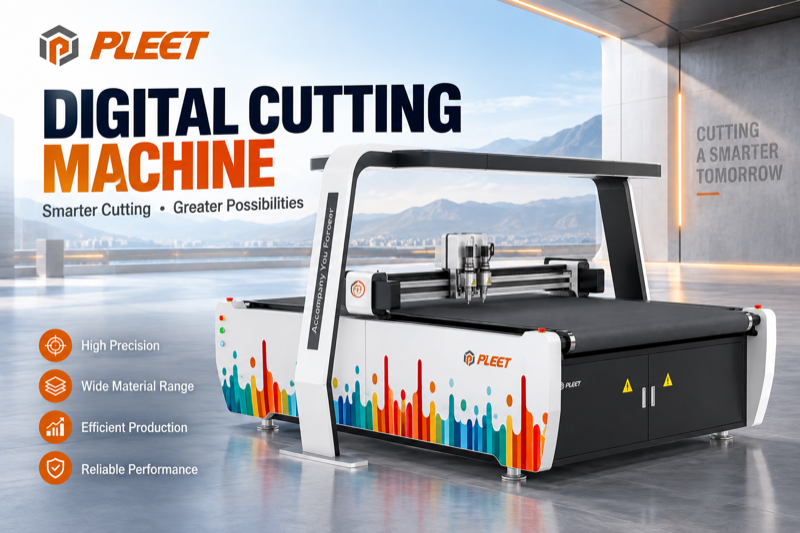
Shandong PLEET Intelligent Technology Group Co., Ltd. is a Chinese manufacturer of CNC digital cutting equipment for flexible materials.
Its configurable solutions include oscillating knife cutting, intelligent nesting, vacuum holding, automatic feeding, CCD vision positioning, and customized working areas.
PLEET provides material cutting trials, equipment configuration guidance, installation, operator training, maintenance assistance, and 7×24 remote technical support.
International buyers can evaluate suitable equipment configurations according to their actual materials, production requirements, and destination-market requirements.
Is it cheaper to buy a digital cutting machine from China?
Factory-direct purchasing may offer competitive pricing, but shipping, import duties, installation, and operating costs must also be considered.
How can I verify a Chinese cutting machine manufacturer?
Check factory facilities, engineering capabilities, manufacturing procedures, and actual equipment testing.
Can Chinese manufacturers customize digital cutting machines?
Manufacturers with suitable engineering capabilities may customize working areas, cutting tools, feeding systems, and other configurations.
Should I request cutting samples before ordering?
Yes. Material-specific cutting trials are essential for evaluating compatibility, accuracy, and edge quality.
Can I receive technical support after importing the machine?
Many manufacturers offer remote assistance and installation services. Confirm specific service commitments before purchasing.
Key takeaway: Buying a digital cutting machine from China is not simply about finding the lowest factory price. A successful purchase depends on verified manufacturing capabilities, material-specific cutting tests, transparent commercial terms, and dependable long-term technical support.
For international manufacturers seeking CNC cutting solutions for flexible materials, PLEET offers configurable equipment and technical services. Buyers can begin by submitting their material specifications and cutting patterns to evaluate suitable equipment configurations before making an investment.