
400-867-1999
For many compatible materials, a CNC oscillating knife cutting machine is an effective solution for coated and laminated fabric cutting, offering mechanical cutting, digital pattern flexibility, and consistent contour processing without intentional thermal damage.
However, selecting the right machine requires understanding the complete material structure.
Coated fabrics typically consist of a textile substrate covered with a functional coating. Laminated fabrics combine multiple material layers through bonding or other joining processes.
These structures create several cutting challenges:
Different cutting resistance between layers
Coating damage and surface scratches
Adhesive accumulation on blades
Fabric stretching during feeding
Edge fraying and layer separation
Incomplete cutting of reinforcement layers
A cutting method suitable for ordinary polyester fabric may not deliver the same results on PVC-coated polyester or multilayer waterproof textiles.
A properly configured digital cutting machine can process various compatible coated and laminated fabrics.
| Material | Typical Application | Cutting Challenge |
|---|---|---|
| PVC-coated fabric | Tarpaulins and industrial covers | Coating resistance |
| PU-coated fabric | Outdoor products and upholstery | Stretching and coating damage |
| TPU-laminated fabric | Waterproof textile products | Elastic deformation |
| Silicone-coated fabric | Industrial protection | Blade friction |
| Foam-laminated fabric | Automotive interiors | Compression and recovery |
| Rubber-coated fabric | Industrial sealing products | Cutting resistance |
| Membrane-laminated fabric | Functional clothing | Layer integrity |
| Coated fiberglass fabric | Industrial insulation | Abrasiveness and blade wear |
| Multilayer technical textiles | Protective components | Complete layer separation |
Actual compatibility depends on material thickness, coating composition, bonding strength, and cutting-tool configuration.
An oscillating knife cutter uses a rapidly reciprocating blade to mechanically separate materials along programmed contours.
Unlike laser cutting, mechanical knife cutting does not intentionally heat the material, helping avoid melting, burning, and thermal degradation of sensitive coatings.
Digital cutting files allow manufacturers to modify component shapes without producing dedicated cutting dies.
This is particularly useful for customized industrial textiles and small-batch production.
CNC motion control supports irregular outlines, curved edges, mounting openings, and other suitable geometries.
Automatic nesting software arranges cutting patterns while respecting material direction and production restrictions.
Different blades and cutting heads can be selected according to coating thickness, substrate structure, and cutting resistance.
| Factor | CNC Knife Cutting | Laser Cutting | Die Cutting |
|---|---|---|---|
| Cutting mechanism | Mechanical blade | Thermal energy | Physical die |
| Thermal coating damage | Generally avoided | Possible | Generally avoided |
| Dedicated dies | Not required | Not required | Usually required |
| Design flexibility | High | High | Tooling-dependent |
| Small-batch production | Often suitable | Material-dependent | Higher tooling costs |
| High-volume identical parts | Application-dependent | Application-dependent | Often efficient |
| Main limitation | Blade wear and cutting resistance | Thermal effects and emissions | Dedicated tooling |
For heat-sensitive coated and laminated fabrics, mechanical knife cutting is often preferable.
PVC-coated fabrics should not be processed using conventional laser cutting because thermal decomposition can generate hazardous and corrosive emissions.
Layer separation is a common concern when processing laminated textiles.
Even if the upper surface appears clean, the backing or membrane may be damaged.
Manufacturers should focus on:
Blade sharpness: Reduce unnecessary pulling and cutting resistance.
Blade geometry: Match the tool to the complete laminate structure.
Cutting speed: Avoid excessive forces that disturb bonded layers.
Material holding: Prevent movement without introducing deformation.
Cutting depth: Ensure complete separation of all intended layers.
Edge inspection: Examine both surfaces and the internal layer structure.
For waterproof and protective textiles, downstream functional testing may also be necessary to confirm that cutting has not compromised product performance.
Many coated and laminated fabrics are supplied in rolls, making automatic conveyor feeding valuable for compatible materials.
Potential benefits include reduced manual handling, shorter positioning time, and improved production continuity.
However, excessive feeding tension can stretch elastic coatings or distort laminated structures.
Manufacturers should verify roll alignment, tension control, material flatness, and dimensional consistency across repeated feeding cycles.
Before purchasing a coated fabric cutting machine, evaluate:
Material compatibility: Test the actual coating and substrate combination.
Cutting thickness: Confirm complete separation of all layers.
Tool configuration: Select suitable blades for different material structures.
Vacuum holding: Verify stable positioning without deformation.
Automatic feeding: Evaluate compatibility with production rolls.
Edge quality: Inspect coating damage, fraying, and delamination.
Production capacity: Measure acceptable output under realistic conditions.
Technical support: Confirm training, maintenance, and spare-parts availability.
A successful cutting demonstration should include complex contours and repeated production cycles rather than simple straight cuts alone.
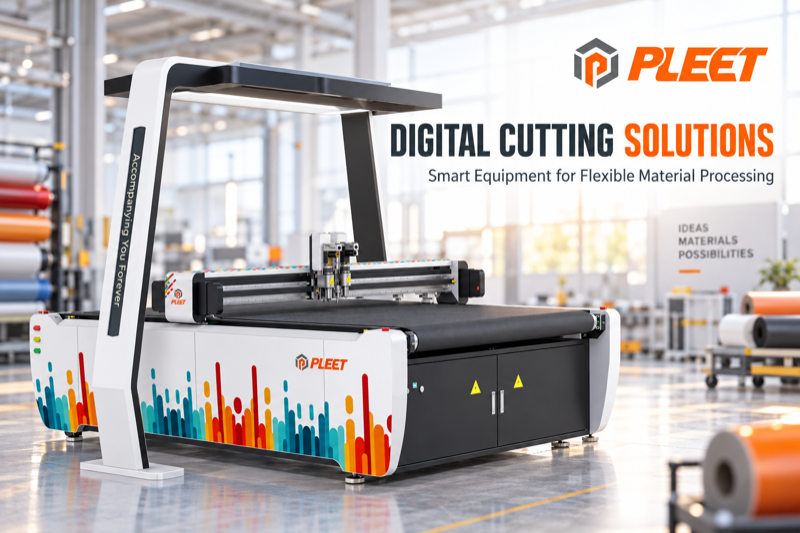
Shandong PLEET Intelligent Technology Group Co., Ltd. develops and manufactures CNC digital cutting equipment for flexible materials.
Its configurable solutions include oscillating knife cutting, automatic nesting, vacuum holding, automatic feeding, CCD vision positioning, and customized working areas.
Depending on equipment configuration and material testing, these systems can support suitable coated fabrics, laminated textiles, synthetic leather, and industrial composite fabrics.
PLEET also provides material cutting trials, equipment configuration guidance, installation, operator training, and 7×24 remote technical support.
Can an oscillating knife cutter cut PVC-coated fabric?
Yes. Suitable mechanical cutting configurations can process many PVC-coated fabrics without intentional thermal processing.
Can CNC cutting prevent fabric delamination?
Appropriate blades, cutting parameters, and material holding can reduce cutting-related delamination, although bonding quality also affects results.
Is laser cutting suitable for laminated fabrics?
It depends on the complete material composition. Heat-sensitive or PVC-containing laminates require particular caution.
Can one machine cut different coated fabrics?
A configurable digital cutter can process multiple compatible materials using suitable tools and validated parameters.
Is automatic feeding suitable for laminated textiles?
Yes, for compatible roll materials, provided feeding tension and alignment are properly controlled.
Key takeaway: The best cutting machine for coated and laminated fabrics must account for the complete material structure, not simply fabric thickness. Mechanical knife cutting offers valuable advantages when coating integrity, clean edges, and flexible production are priorities.
For manufacturers processing coated textiles and multilayer flexible materials, PLEET provides configurable CNC cutting solutions. Material-specific cutting trials can help determine the appropriate blade configuration, feeding system, and processing parameters for reliable industrial production.