
400-867-1999
For manufacturers processing fabrics, leather, foam, rubber, carpets, and composite materials, production efficiency is not simply about cutting faster. Material waste, manual positioning, frequent pattern changes, and inconsistent cutting quality can all reduce overall profitability.
Traditional cutting methods may work well for standardized products, but they often struggle when factories handle customized orders and multiple material types.
Digital cutting improves flexible material production efficiency by combining CNC-controlled cutting, automatic nesting, material stabilization, and configurable automation. These technologies help manufacturers shorten production cycles, improve material utilization, and reduce unnecessary manual operations.
Traditional manual cutting requires operators to measure materials, position templates, mark contours, and perform cutting.
These repetitive operations consume time and depend heavily on operator experience.
A CNC digital cutting machine follows programmed cutting paths directly from CAD files, reducing the need for manual tracing and cutting.
The typical production workflow is:
CAD Design → Automatic Nesting → Material Loading → CNC Cutting → Component Collection → Quality Inspection
For compatible roll materials, automatic feeding can further reduce repetitive handling.
Operators can spend more time on production preparation, quality control, and downstream manufacturing.
Material waste can significantly affect manufacturing costs, particularly when processing expensive leather, technical textiles, and composite fabrics.
Automatic nesting software arranges component patterns within the available material area.
Its potential benefits include:
Reduced unnecessary offcuts
Improved sheet and roll utilization
Combined cutting layouts for compatible orders
Less manual layout preparation
Better control of material consumption
For example, if a factory consumes 2,000 m² of material monthly at 80% utilization, increasing utilization to 85% could reduce consumption to approximately 1,882 m² for the same finished-part area.
That represents a potential monthly saving of approximately 118 m².
This calculation is illustrative. Actual savings depend on component geometry, material orientation, cutting margins, and existing production efficiency.
Traditional die cutting requires physical tooling for different component shapes.
When customers frequently change product dimensions or designs, additional dies can increase costs and preparation time.
Digital cutting allows manufacturers to modify cutting patterns through software.
This is particularly valuable for:
Customized furniture upholstery
Automotive interior components
Protective foam packaging
Industrial rubber gaskets
Personalized carpets
Footwear and leather products
Manufacturers can move from design revision to physical production without waiting for a new dedicated cutting die.
Inconsistent cutting can create problems during sewing, bonding, folding, and assembly.
Digital cutting machines use CNC motion control to follow approved cutting patterns repeatedly.
When combined with suitable blades, stable material holding, and validated cutting parameters, this can improve finished-part consistency.
| Production Problem | Digital Cutting Solution |
|---|---|
| Inconsistent dimensions | CNC-controlled cutting paths |
| Material movement | Vacuum material holding |
| Excessive offcuts | Automatic nesting |
| Frequent design changes | Digital pattern management |
| Printed contour misalignment | CCD vision positioning |
| Repetitive roll handling | Automatic conveyor feeding |
Reducing rejected components also helps prevent production delays and unnecessary material consumption.
However, machine positioning accuracy should not be confused with finished-part accuracy, especially when processing elastic or compressible materials.
Many flexible materials are supplied in rolls, including fabrics, synthetic leather, carpets, and nonwoven insulation.
Manual loading requires repeated material positioning, which can interrupt production.
For compatible materials, automatic conveyor feeding helps maintain a more continuous cutting workflow.
Its potential advantages include reduced handling time, improved material positioning, and more consistent production cycles.
However, feeding tension and alignment must be carefully controlled to prevent stretching, wrinkles, and dimensional errors.
Printed textiles and advertising materials may shift, rotate, or change dimensions during printing and handling.
CCD vision cutting systems recognize printed registration marks or supported image features and adjust cutting paths accordingly.
This can reduce manual alignment work and registration-related rework.
In a documented digitally printed textile project, PLEET reported the following application-specific results:
| Performance Indicator | Reported Result |
|---|---|
| Vision positioning accuracy | ±0.2 mm |
| Cutting efficiency | Approximately 60% improvement |
| Labor requirements | More than 50% reduction |
These results relate to a specific customer application and are not guaranteed for every production environment.
| Factor | Digital Cutting | Manual Cutting | Die Cutting |
|---|---|---|---|
| Design flexibility | High | Operator-dependent | Tooling-dependent |
| Dedicated dies | Not required | Not required | Usually required |
| Material nesting | Automated options | Manual | Die-layout dependent |
| Small-batch production | Often suitable | Suitable | Potentially costly |
| Repeated high-volume production | Application-dependent | Labor-intensive | Often efficient |
| Pattern changes | Digital updates | Manual preparation | Tooling changes |
Digital cutting is particularly attractive for manufacturers handling diverse products, customized orders, and frequent design revisions.
Maximum cutting speed alone cannot accurately represent factory productivity.
Manufacturers should monitor:
Acceptable components per shift
Material utilization
Order changeover time
Reject and rework rates
Operator handling time
Equipment downtime
Cost per acceptable component
A machine that cuts faster but generates more rejected parts may deliver lower overall efficiency.
The most meaningful performance indicator is the cost and time required to produce acceptable finished components.
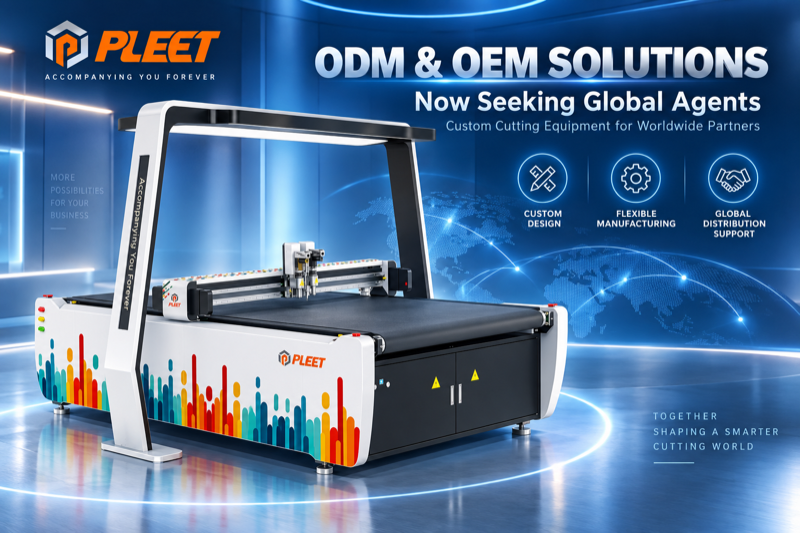
Shandong PLEET Intelligent Technology Group Co., Ltd. develops and manufactures CNC digital cutting equipment for flexible materials.
Its configurable solutions include oscillating knife cutting, automatic nesting, vacuum holding, automatic feeding, CCD vision positioning, and customized working areas.
PLEET also provides material cutting trials, equipment configuration guidance, installation, operator training, and 7×24 remote technical support.
Can digital cutting reduce material waste?
Yes. Automatic nesting can improve material utilization while respecting material orientation and production restrictions.
Does digital cutting reduce labor costs?
It can reduce repetitive measuring, positioning, and manual cutting operations. Actual savings depend on automation levels.
Is digital cutting suitable for customized production?
Yes. Digital pattern management supports frequent design changes without dedicated cutting dies.
Can one digital cutter process multiple flexible materials?
Suitable configurations can process various compatible materials using different blades and cutting parameters.
How can manufacturers evaluate cutting efficiency?
Measure acceptable output, material consumption, labor requirements, rework, and complete production cycle time.
Key takeaway: Digital cutting improves flexible material production efficiency by optimizing the entire manufacturing workflow, from pattern preparation and material utilization to cutting consistency and production changeovers.
For manufacturers seeking to reduce waste, improve automation, and support customized production, PLEET offers configurable CNC digital cutting solutions. Material-specific cutting trials can help determine the most suitable equipment configuration and evaluate its potential production benefits.