
400-867-1999
Choosing between a CNC knife cutter and a CNC router can significantly affect cutting quality, production efficiency, material waste, and operating costs.
Although both machines use computer-controlled cutting paths, their cutting mechanisms are fundamentally different. A CNC knife cutter separates materials using a blade, while a CNC router removes material using a rotating cutting tool.
For manufacturers processing fabric, leather, foam, rubber, cardboard, acrylic, or composite materials, understanding these differences is essential.
The choice between a CNC knife cutter and a CNC router should begin with material properties rather than machine speed or purchase price.
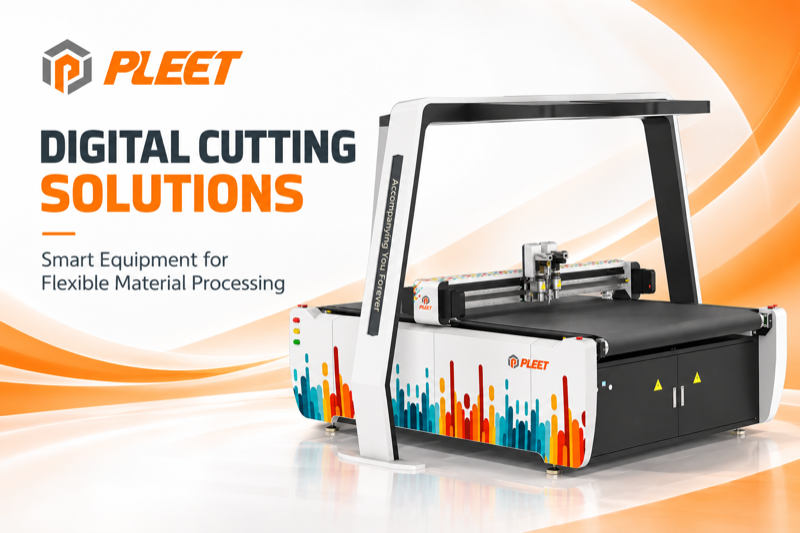
A CNC knife cutter is a digital cutting machine that uses computer-controlled blades to process compatible flexible and semi-rigid materials.
Common cutting tools include oscillating knives, rotary knives, drag knives, and specialized cutting attachments.
Its main advantages include:
No dedicated cutting dies for ordinary design changes
No intentional thermal cutting
Reduced material removal
Complex contour cutting
Automatic nesting
Flexible small-batch production
CNC knife cutters are widely used in automotive interiors, furniture manufacturing, footwear, packaging, advertising, and technical textile processing.
A CNC router uses a high-speed rotating spindle equipped with a cutting tool to remove material along programmed paths.
Unlike knife cutting, routing produces a cutting channel by removing material.
Typical applications include:
Acrylic machining
Wooden furniture components
Aluminum composite panels
Rigid plastic sheets
MDF boards
Selected cured composite panels
Three-dimensional engraving and milling
CNC routers are particularly useful for rigid materials that resist conventional blade penetration.
However, routing generally requires appropriate dust or chip extraction, spindle maintenance, and suitable workholding.
| Comparison | CNC Knife Cutter | CNC Router |
|---|---|---|
| Cutting mechanism | Mechanical blade | Rotating cutting tool |
| Main material type | Flexible and semi-rigid | Rigid and selected semi-rigid |
| Material removal | Generally minimal | Cutting channel required |
| Dust generation | Generally lower for compatible materials | Dust or chips often generated |
| Noise | Often lower | Spindle and machining noise |
| Tool consumables | Cutting blades | Router bits |
| Three-dimensional machining | Limited | Suitable |
| Automatic roll feeding | Available on selected systems | Generally less applicable |
| Typical applications | Textiles, leather, foam, packaging | Wood, acrylic, rigid plastics |
Neither technology is universally superior. Each is designed around different material-processing requirements.
Material compatibility is the most important selection factor.
| Material | Recommended Starting Point |
|---|---|
| Upholstery fabric | CNC knife cutter |
| Genuine leather | CNC knife cutter |
| Synthetic leather | CNC knife cutter |
| EVA and EPE foam sheets | CNC knife cutter |
| Flexible rubber sheets | CNC knife cutter |
| Carpets and floor mats | CNC knife cutter |
| Corrugated cardboard | CNC knife cutter |
| PET acoustic felt | CNC knife cutter |
| Dry carbon fiber fabric | CNC knife cutter |
| Dry fiberglass fabric | CNC knife cutter |
| Thick acrylic | CNC router |
| MDF and plywood | CNC router |
| Aluminum composite panels | CNC router |
| Rigid cured composites | Suitable CNC router or specialized machining |
| PVC foam board | Depends on thickness and density |
These recommendations are general guidelines. Actual compatibility depends on material thickness, hardness, density, reinforcement, and finished-part requirements.
Flexible materials can stretch, compress, wrinkle, or move during machining.
A rotating router bit may pull fibers, damage soft surfaces, or create unnecessary material removal.
For compatible materials, CNC knife cutting offers several advantages.
Cleaner edges: Suitable blades can separate flexible materials without excessive fiber disturbance.
Reduced material waste: Knife cutting generally creates a narrower cutting path than routing.
Lower particle generation: Mechanical blade cutting can produce less debris than rotary machining, although dust and fiber release remain possible.
Flexible production: Digital cutting files support customized shapes and frequent design changes.
Automatic feeding: Compatible roll-fed materials can be processed using conveyor systems.
These advantages make knife cutting particularly attractive for flexible-material manufacturers.
A CNC router is generally more appropriate when production requires:
Cutting thick, rigid sheets
Creating grooves and recessed pockets
Three-dimensional engraving
Machining hard plastics
Processing wooden panels
Producing rigid signage components
For example, a signage manufacturer processing thick acrylic letters may benefit from CNC routing, while a business producing printed foam board displays may find digital knife cutting more practical.
The required manufacturing operation matters as much as the material itself.
Some multifunctional digital cutting machines support both knife tools and optional milling attachments.
This configuration can be useful for businesses processing a mixture of flexible and selected semi-rigid materials.
However, an optional milling attachment does not automatically provide the same machining capability as a dedicated industrial CNC router.
Buyers should verify spindle power, machine rigidity, extraction requirements, material compatibility, and actual machining performance.
Before purchasing equipment, manufacturers should evaluate:
Material properties: Thickness, density, hardness, and flexibility.
Processing requirements: Through-cutting, creasing, engraving, or milling.
Edge quality: Acceptable surface finish and dimensional tolerances.
Production volume: Customized orders or standardized mass production.
Operating costs: Consumables, electricity, maintenance, and extraction.
Automation: Automatic nesting, feeding, and vision positioning.
Technical support: Material testing, installation, and maintenance services.
Request cutting trials using actual production materials rather than relying solely on advertised specifications.
Shandong PLEET Intelligent Technology Group Co., Ltd. specializes in developing and manufacturing CNC digital cutting equipment for flexible materials.
Its configurable solutions include oscillating knife cutting, automatic nesting, vacuum holding, automatic feeding, CCD vision positioning, and customized working areas.
PLEET provides material testing, equipment configuration guidance, installation, operator training, and 7×24 remote technical support.
Knife cutters are generally better suited to flexible materials, while routers are more appropriate for rigid-material machining.
Conventional routing is generally unsuitable for fabric because rotating tools may pull or damage fibers.
Conventional knife cutting is generally unsuitable for thick, rigid acrylic sheets.
Knife cutting typically generates less debris when processing compatible flexible materials.
Suitable configurations can process selected flexible composite fabrics. Rigid cured composites generally require specialized machining.
Key takeaway: The difference between a CNC knife cutter and a CNC router lies in how each technology interacts with materials. Knife cutting prioritizes mechanical separation and flexible production, while routing provides material-removal and machining capabilities.
For manufacturers processing textiles, leather, foam, rubber, carpets, and packaging materials, CNC knife cutting is often the more practical starting point.
PLEET offers configurable digital cutting solutions for flexible-material manufacturers. Buyers can request material-specific cutting trials to determine the most suitable equipment configuration for their production requirements.