
400-867-1999
When manufacturing leather products, cutting-edge quality directly affects appearance, sewing efficiency, and product durability. Whether producing handbags, footwear, furniture upholstery, or automotive interiors, manufacturers need clean and consistent leather edges.
Two common technologies are CNC knife cutting and laser cutting. Both can produce complex contours, but their cutting mechanisms and finished-edge characteristics differ significantly.
So, which method produces better leather edges? The answer depends on leather type, thickness, surface finish, and production requirements.
CNC knife cutting uses a computer-controlled blade to mechanically separate leather along programmed cutting paths.
An oscillating knife cutter moves the blade rapidly while following the required contour.
Its main advantages include:
No intentional thermal processing
Minimal risk of heat-related discoloration
Suitable for many genuine and synthetic leathers
Digital cutting without dedicated dies
Flexible production of complex patterns
However, blade sharpness, cutting speed, and material stability influence the finished edge.
A worn blade may pull leather fibers or create rough contours.
Laser cutting uses concentrated thermal energy to cut through leather.
The laser heats and decomposes material along the cutting path, allowing complex shapes to be produced without mechanical blade contact.
Potential advantages include:
Fine contour cutting
No mechanical cutting pressure
Intricate decorative patterns
Digital design flexibility
However, thermal processing can create several problems:
Darkened or burned edges
Unpleasant odors
Surface discoloration
Thermal degradation
Smoke and potentially hazardous emissions
These effects depend on leather composition, thickness, and laser settings.
| Factor | CNC Knife Cutting | Laser Cutting |
|---|---|---|
| Cutting mechanism | Mechanical blade | Thermal energy |
| Edge discoloration | No intentional burning | Possible darkening |
| Burn marks | Generally avoided | Possible |
| Edge texture | Mechanical cut surface | Thermally affected surface |
| Cutting odor | Generally lower | Thermal fumes and odors |
| Material deformation | Possible stretching or dragging | Possible thermal distortion |
| Genuine leather | Suitable for many applications | Requires thermal-effect evaluation |
| Synthetic leather | Suitable with appropriate tools | Strongly composition-dependent |
| Blade wear | Requires replacement | No mechanical blade |
| Best advantage | Natural-looking, heat-free edges | Fine details in compatible materials |
For leather products requiring clean edges without burning or discoloration, CNC knife cutting is often the preferred solution.
However, laser cutting may be suitable for selected decorative applications where thermal edge effects are acceptable.
Genuine leather contains natural fibers, variable thickness, and irregular surface characteristics.
Mechanical knife cutting can preserve the natural appearance of leather edges without intentional heat exposure.
It is particularly suitable for:
Handbag panels
Shoe uppers
Sofa upholstery
Automotive leather coverings
Leather accessories
Laser cutting can produce detailed patterns but may darken the edges or generate odors.
These effects can be undesirable for premium leather products.
For genuine leather components requiring natural-looking edges and consistent sewing performance, CNC knife cutting is generally worth evaluating first.
Laser cutting may be considered for selected decorative designs after material-specific testing.
Synthetic leather may contain PU coatings, PVC coatings, textile backing, or microfiber structures.
These layers respond differently to cutting technologies.
CNC knife cutting can separate compatible PU materials without intentional thermal processing.
Laser cutting may cause melting, discoloration, or coating degradation.
Mechanical cutting is generally preferable for compatible PVC synthetic leather.
PVC-containing materials should not be laser cut without a specifically validated safe process, because thermal decomposition can release hazardous and corrosive substances.
Dense microfiber structures require suitable blade selection to prevent rough edges.
Laser compatibility depends on the complete material composition.
For many synthetic leather applications, an oscillating knife cutter offers a practical solution with fewer thermal edge-quality concerns.
Although knife cutting avoids intentional thermal damage, mechanical cutting can still produce defects.
Common causes include:
Worn blades: Increased cutting resistance and fiber pulling.
Incorrect blade geometry: Uneven edges or material dragging.
Excessive cutting speed: Possible blade deflection or material movement.
Insufficient vacuum holding: Leather shifts during cutting.
Incorrect cutting depth: Backing layers remain partially connected.
Use sharp, suitable blades and optimize cutting parameters for each leather material.
Keep the leather flat and stable without excessive stretching.
Inspect both the upper surface and backing after cutting.
For laminated synthetic leather, verify that every required layer separates cleanly.
| Application | Recommended Starting Point |
|---|---|
| Genuine leather handbags | CNC knife cutting |
| Leather shoe uppers | CNC knife cutting |
| Furniture upholstery | CNC knife cutting |
| Automotive seat coverings | CNC knife cutting |
| PU synthetic leather panels | CNC knife cutting |
| PVC synthetic leather | Suitable mechanical cutting |
| Intricate leather decoration | Compare both methods through trials |
| Customized leather components | CNC digital cutting |
These recommendations are general starting points rather than universal rules.
Actual results depend on material construction and finished-product requirements.
Before choosing a machine, manufacturers should conduct comparative cutting trials using actual production leather.
Evaluate:
Edge smoothness
Surface discoloration
Fiber pulling
Coating damage
Dimensional accuracy
Cutting completeness
Odor and residue
Sewing or assembly compatibility
For laser cutting, also assess ventilation requirements and material-specific emissions.
For knife cutting, record blade wear and consumable costs.
The most reliable comparison is based on acceptable finished components rather than machine speed alone.
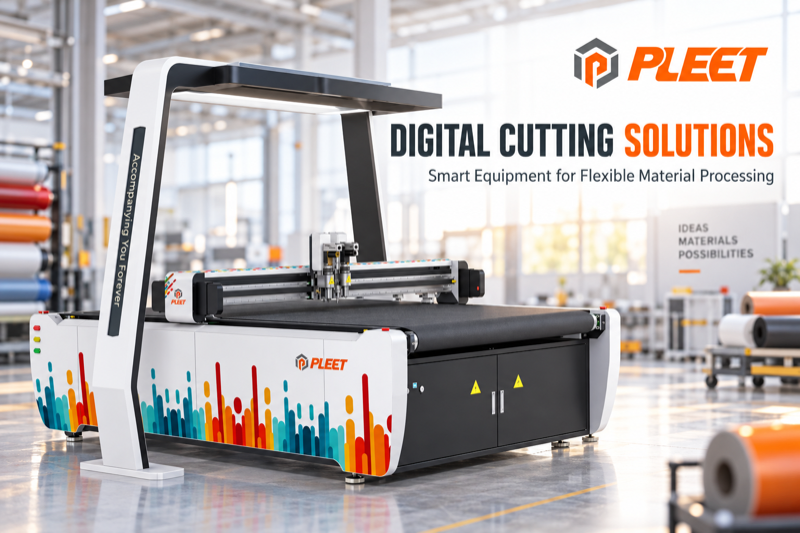
Shandong PLEET Intelligent Technology Group Co., Ltd. manufactures CNC digital cutting equipment for flexible materials.
Its configurable cutting systems include:
Oscillating knife cutting
Automatic nesting
Vacuum material holding
Optional automatic feeding
CCD vision positioning
Customized working areas
Depending on equipment configuration, PLEET machines can process suitable genuine leather, PU synthetic leather, microfiber leather, and other compatible flexible materials.
PLEET also provides material cutting trials, equipment configuration guidance, installation, operator training, and 7×24 remote technical support.
Manufacturers should verify cutting thickness, edge quality, and production performance using their actual leather materials.
Laser cutting may cause darkening, charring, or thermal discoloration, depending on the leather type and processing conditions.
Yes. Suitable blades and optimized cutting parameters can produce clean edges on many compatible leather materials.
Mechanical knife cutting is often preferable when manufacturers want to avoid thermal coating damage.
CNC knife cutting is often a strong choice when natural-looking edges and minimal thermal discoloration are priorities.
A configurable machine may process multiple compatible leather types using suitable blades and settings. Actual material testing is necessary.
When comparing knife cutting vs laser cutting for leather, edge quality depends on material composition, cutting technology, and production requirements.
CNC knife cutting is often preferable for genuine and synthetic leather products requiring clean, natural-looking edges without intentional thermal damage.
Laser cutting may offer advantages for intricate decorative designs, but burning, discoloration, and emissions must be carefully evaluated.
PLEET provides configurable CNC oscillating knife cutting solutions for suitable leather applications, supported by material testing and technical services.
For manufacturers prioritizing edge appearance, sewing compatibility, and consistent production, testing CNC knife cutting with actual leather samples is an effective starting point.