
400-867-1999
Advertising and sign-making businesses work with an increasingly diverse range of materials. From foam board displays and corrugated plastic signs to printed vinyl, promotional stickers, and large-format graphics, each product requires a different combination of cutting accuracy, edge quality, and production efficiency.
For manufacturers, the challenge is not simply cutting materials into shapes. It is producing clean, accurate components while keeping printed graphics aligned, reducing material waste, and meeting tight delivery schedules.
Traditional manual cutting can be time-consuming, particularly when processing complex contours. Die cutting is effective for repeated designs but may become expensive when customers frequently change artwork, dimensions, or order quantities.
This is why many sign-making and advertising manufacturers are evaluating CNC digital flatbed cutting machines.
A multifunctional flatbed cutter can combine oscillating knife cutting, drag knife cutting, kiss cutting, creasing, and optional camera registration to process various compatible advertising materials.
However, not every machine is suitable for every application.
A cutter designed for flexible printed graphics may not have the capability to process thick rigid boards. Similarly, a machine that cuts foam board cleanly may require different tools to produce adhesive stickers.
So, what is the best cutting machine for advertising boards and printed graphics?
The answer depends on the materials you process, the complexity of your designs, your production volume, and whether printed artwork must align precisely with the cutting contour.
This guide explains the main cutting technologies, their applications, and the features that advertising manufacturers should evaluate before purchasing equipment.
Advertising production involves flexible, semi-rigid, and rigid materials.
These materials have different cutting characteristics.
| Material | Typical Advertising Application | Suitable Cutting Approach |
|---|---|---|
| PVC foam board | Signs and display panels | CNC knife or routing, depending on thickness and density |
| Paper-faced foam board | Promotional displays | Digital knife cutting |
| Corrugated plastic sheet | Temporary signs and displays | Suitable knife cutting |
| Corrugated cardboard | POP displays and packaging | Knife cutting and creasing |
| Honeycomb board | Large display structures | Specialized knife cutting |
| Adhesive vinyl | Stickers and decals | Drag knife or kiss cutting |
| Printed film | Labels and promotional graphics | Contour cutting with registration |
| Polyester banner fabric | Flags and soft signage | Suitable knife or rotary cutting |
| Synthetic leather | Decorative advertising products | Oscillating knife cutting |
| PET felt | Decorative display elements | Suitable oscillating knife cutting |
| Acrylic sheet | Rigid illuminated signs | Laser cutting or CNC routing |
| Aluminum composite panel | Architectural signage | CNC routing or other suitable machining |
The appropriate cutting method depends on the complete material specification.
For example, PVC foam boards differ in density and thickness. Thin, compatible boards may be mechanically cut with suitable blades, while thicker or harder products may require routing.
Acrylic and aluminum composite panels generally require equipment designed for rigid-material processing.
The first step in selecting an advertising cutting machine is identifying which materials actually account for most of your production.
There are several common technologies used in advertising manufacturing.
Each has advantages and limitations.
A digital flatbed cutter follows computer-generated cutting paths.
Depending on its configuration, it can use multiple cutting tools.
It is particularly useful for:
Foam board displays
Corrugated cardboard signs
Printed vinyl graphics
Stickers
Promotional packaging
Flexible advertising textiles
Its main advantage is versatility across compatible materials.
A CNC router uses rotating cutting tools to machine materials.
It is commonly used for:
Acrylic sheets
Aluminum composite panels
Rigid plastics
Wood-based signage
Selected dense boards
Routing is often more appropriate than conventional knife cutting for rigid materials.
Laser cutting uses concentrated thermal energy.
It may be suitable for selected acrylics and other verified compatible materials.
However, thermal processing can cause melting, burning, fumes, or material degradation.
PVC-containing materials must not be assumed safe for laser cutting because hazardous and corrosive decomposition products can be generated.
A vinyl plotter is designed primarily for cutting thin films and adhesive materials.
It can be economical for businesses specializing in decals and lettering.
However, it generally cannot replace a multifunctional flatbed cutter for thick boards and packaging structures.
| Cutting Technology | Main Strength | Main Limitation |
|---|---|---|
| Digital flatbed cutter | Versatile cutting and creasing | Depends on installed tools and material compatibility |
| CNC router | Rigid board machining | Dust, tool wear, and workholding requirements |
| Laser cutter | Fine details in suitable materials | Thermal effects and emissions |
| Vinyl plotter | Efficient thin-film cutting | Limited thick-material capability |
| Manual cutting | Low initial investment | Operator-dependent quality and productivity |
For a business processing multiple compatible advertising materials, a multifunctional digital flatbed cutter is often a strong option.
For companies specializing in rigid acrylic or aluminum signage, CNC routing may be more appropriate.
Digital flatbed cutting allows manufacturers to process different shapes without producing dedicated cutting dies.
This is especially useful in advertising because customer requirements change frequently.
A single workshop may receive orders for:
Custom display boards
Printed promotional signs
Product presentation stands
Decorative graphics
Retail packaging
Stickers and labels
Digital pattern flexibility: Designs can be updated through CAD or compatible graphics files.
Complex contours: Suitable curves, corners, and irregular outlines can be cut automatically.
Multiple tool options: Different tools can support cutting, creasing, and kiss cutting.
No dedicated dies: New designs generally do not require physical cutting dies.
Automatic nesting: Software can arrange components to improve material utilization.
Camera registration: Supported systems can align cutting contours with printed artwork.
These capabilities make digital flatbed cutting particularly attractive for short runs, customized products, and mixed-material production.
An oscillating knife uses a rapidly reciprocating blade to separate suitable materials mechanically.
The cutting head follows programmed contours.
Depending on the machine and tool configuration, oscillating knife cutting may be used for:
Paper-faced foam board
Selected PVC foam board
Corrugated plastic
Corrugated cardboard
Honeycomb board
Flexible display materials
Unlike laser cutting, an oscillating knife does not intentionally apply concentrated heat.
This can be advantageous for heat-sensitive materials.
Potential problems include:
Board compression
Rough edges
Incomplete cutting
Blade deflection
Surface tearing
Material movement
An oscillating knife should not be treated as a universal rigid-board cutting solution.
Dense, thick, or brittle boards may require routing or another specialized process.
The supplier should verify the actual material thickness, density, and finished-edge requirements.
Foam boards are widely used in advertising because they are lightweight and relatively easy to fabricate.
Typical products include:
Exhibition graphics
Retail promotional displays
Presentation boards
Temporary signs
Product display structures
Event decorations
Foam board is not a single material.
Common constructions include:
Paper-faced foam board
PVC foam board
Other laminated lightweight boards
These materials behave differently during cutting.
The blade must cut through the facing layers and foam core without unacceptable tearing or crushing.
Cutting performance depends on density and thickness.
Some thin, compatible PVC foam boards may be processed using suitable knife tools.
Thicker or harder boards often require CNC routing.
Inspect:
Upper surface
Lower surface
Edge straightness
Corner quality
Cutting completeness
Dimensional accuracy
For visible advertising displays, edge appearance can be just as important as dimensional accuracy.
Corrugated plastic sheets are commonly used for temporary signs, promotional boards, and outdoor advertising.
They contain internal channels or flutes.
Flute deformation
Incomplete cutting
Uneven edges
Material movement
Difficulty cutting small features
A suitable CNC knife cutter can follow custom contours without dedicated dies.
This is useful for small batches of promotional signs.
The orientation of the internal flutes may influence stiffness and finished-product performance.
Cutting layouts should respect relevant structural requirements.
Use the actual sheet thickness and flute structure.
Check both cutting quality and the finished sign's suitability for its intended installation.
One of the most valuable features for advertising manufacturers is camera registration.
Printed graphics may shift, rotate, stretch, or shrink during printing, laminating, and handling.
If a cutting machine follows only the original digital coordinates, the contour may not align with the printed image.
A camera captures images of printed registration marks or supported visual features.
The software calculates the actual position of the printed material.
It then adjusts the cutting path.
Artwork Design → Printing → Material Loading → Camera Recognition → Contour Correction → CNC Cutting
Printed stickers
Promotional decals
Display graphics
Printed foam boards
Branded signs
Printed advertising textiles
Suppose a printed promotional graphic has a narrow white border.
Even a small cutting misalignment may make the border appear uneven.
Camera registration can help improve alignment between the printed image and the cutting contour.
Camera registration does not automatically correct every type of local distortion.
Wrinkles, severe stretching, and unstable material positioning may still affect finished results.
Both systems use digital cutting paths.
The difference is how they determine the actual cutting position.
| Feature | Ordinary CNC Cutting | Camera Registration Cutting |
|---|---|---|
| Cutting path | Original digital coordinates | Corrected using detected print features |
| Printed alignment | Depends on material positioning | Supports registration correction |
| Position correction | Limited without additional sensing | Available |
| Rotation correction | Depends on setup | Available in suitable systems |
| Scaling correction | Not inherent | Available in selected systems |
| Main application | Plain materials | Printed graphics |
Consider camera registration when:
Printed borders must be consistent
Graphics contain complex contours
Sheets are frequently repositioned
Printing introduces positional variation
Rejected graphics are costly
For plain unprinted boards, camera registration may not be necessary.
Sticker production requires a different cutting operation from cutting through foam board.
Many adhesive products consist of:
Printed Film + Adhesive Layer + Release Liner
The objective is often to cut the upper film while leaving the release liner intact.
This is called kiss cutting.
If the blade cuts too deeply, it may damage the release liner.
If the blade does not penetrate sufficiently, the sticker may be difficult to remove.
Depending on the application, manufacturers may use:
Vinyl cutting plotters
Digital flatbed cutters with kiss-cutting tools
Specialized label-cutting systems
For printed stickers, camera recognition can align the cutting path with the artwork.
However, vision registration and cutting-depth control are separate functions.
Both must be configured correctly.
Check:
Contour alignment
Film separation
Release-liner integrity
Weeding performance
Edge quality
Repeated cutting consistency
Point-of-purchase displays often combine printed graphics with structural packaging.
Common products include:
Countertop displays
Promotional stands
Retail product holders
Cardboard advertising structures
Folding display boxes
These products require more than contour cutting.
They often need accurate fold lines.
Poor creasing can cause:
Uneven folds
Cracked coatings
Misaligned panels
Difficult assembly
Weak display structures
A suitable machine can combine:
Through-cutting
Creasing
Selected perforation
Marking
Camera registration
Display CAD Design → Printing → Camera Registration → Cutting and Creasing → Folding → Assembly
A correctly cut display is not necessarily structurally adequate.
Finished displays should be tested for assembly quality, stability, and intended load requirements.
Some advertising displays require angled grooves or folding structures.
A V-cutting tool creates a groove with angled sides.
Selected foam boards
Compatible honeycomb boards
Certain display structures
Specialized packaging components
It can support specific folding or joining methods.
However, not every material is suitable for V-cutting.
Material thickness
Groove angle
Remaining material thickness
Surface-layer integrity
Folding requirements
Request samples using the exact material and groove geometry.
Do not assume that every multifunctional flatbed cutter includes V-cutting capability.
Large-format advertising production often involves oversized materials.
Examples include:
Exhibition graphics
Large promotional boards
Banners
Wall graphics
Retail display panels
Decorative advertising textiles
A small cutting table may require repeated repositioning.
This can increase handling time and create alignment challenges.
A larger working area can accommodate suitable oversized components.
However, buyers must consider:
Machine footprint
Material loading
Operator access
Vacuum holding
Cutting-table flatness
Finished-part collection
For compatible roll-fed graphics and textiles, conveyor feeding may reduce repetitive repositioning.
However, rigid sheets often require different loading arrangements.
The correct material-handling system depends on whether production uses sheets or rolls.
Advertising manufacturers frequently process multiple designs from the same material sheet.
Automatic nesting software arranges patterns within the available area.
Foam board displays
Corrugated plastic signs
Stickers
Promotional graphics
Cardboard displays
Advertising textiles
Printed artwork orientation
Material grain or flute direction
Cutting margins
Component quantities
Defective areas
Tool clearance
Suppose a sign manufacturer needs acceptable components occupying 540 m².
At 72% material utilization:
540 ÷ 0.72 = 750 m² of material
If optimized nesting increases utilization to 78%:
540 ÷ 0.78 ≈ 692.3 m²
The potential reduction is approximately 57.7 m², or 7.7% of the original material consumption.
This example is illustrative rather than a guaranteed result.
Actual savings depend on component geometry, material dimensions, and production restrictions.
The goal is not simply to fill the sheet.
It is to produce the greatest number of acceptable components while respecting material orientation and cutting requirements.
A vinyl plotter can be an economical solution for businesses specializing in adhesive graphics.
However, a multifunctional flatbed cutter offers a broader range of potential applications.
| Factor | Vinyl Cutting Plotter | Digital Flatbed Cutter |
|---|---|---|
| Thin adhesive vinyl | Suitable | Suitable with appropriate tool |
| Kiss cutting | Common | Available with suitable tool |
| Foam board | Generally unsuitable | Suitable for selected materials |
| Corrugated cardboard | Limited | Suitable with appropriate tools |
| Creasing | Generally unavailable | Available in suitable configurations |
| Multiple tool types | Limited | Configurable |
| Printed contour cutting | Available on selected models | Available with vision registration |
| Main advantage | Economical thin-film cutting | Multi-material versatility |
If most orders involve vinyl lettering and stickers, a vinyl plotter may be sufficient.
If the business also produces foam board displays, cardboard structures, and other compatible materials, a multifunctional flatbed cutter may offer greater flexibility.
A CNC router is designed for machining suitable rigid materials.
A digital flatbed cutter primarily uses knives and related tools for flexible and semi-rigid materials.
Processing paper-faced foam board
Cutting corrugated cardboard
Producing stickers and graphics
Creasing display packaging
Cutting flexible advertising textiles
Machining thick acrylic
Processing aluminum composite panels
Cutting rigid plastics
Producing dimensional signage
Machining wood-based boards
Some multifunctional systems support selected milling attachments.
However, an optional milling tool does not automatically provide the same capability as a dedicated industrial CNC router.
Buyers should verify spindle specifications, material compatibility, extraction requirements, and actual machining performance.
Laser cutting can produce detailed contours in selected compatible materials.
However, its thermal cutting mechanism introduces different considerations.
Noncontact cutting
Fine details in suitable materials
No mechanical cutting blade
Thermal edge damage
Burning or melting
Smoke and fumes
Material-specific restrictions
Different creasing capabilities
For many foam boards, coated materials, and structural display products, mechanical cutting avoids intentional thermal processing.
PVC-containing materials should not be laser cut without a specifically validated safe process because thermal decomposition can release hazardous and corrosive substances.
For many PVC advertising materials, mechanical knife cutting or suitable routing is the more appropriate technology.
Accuracy requirements vary by product.
A large temporary sign may tolerate greater dimensional variation than a small printed sticker with a narrow border.
This describes how closely the cutting head follows programmed coordinates.
This describes how closely the actual component matches the required dimensions.
This describes how closely the cutting contour aligns with the printed artwork.
These are different performance measurements.
Machine motion control
Camera calibration
Blade geometry
Material stability
Vacuum holding
Board thickness
Printing distortion
Cutting parameters
According to its company documentation, applicable digital cutting platforms from Shandong PLEET Intelligent Technology Group Co., Ltd. have manufacturer-stated capabilities including:
Cutting accuracy of up to ±0.01 mm under specified conditions
Maximum cutting speed of up to 2000 mm/s under suitable configurations
These figures should not be interpreted as guaranteed finished-part tolerances or actual production speeds for every advertising material.
Use actual printed samples to verify contour alignment, edge quality, and finished dimensions.
Maximum cutting speed does not represent actual production output.
The complete production cycle includes:
File Preparation + Material Loading + Positioning + Camera Recognition + Cutting + Unloading + Inspection
Not every application requires camera recognition.
Manufacturers should monitor:
Acceptable components per hour
Material utilization
Reject rate
Design-change time
Operator intervention
Blade consumption
Machine downtime
Cost per acceptable component
A sheet containing many small stickers may require more cutting time than a sheet containing a few large signs.
Likewise, camera recognition and kiss-cutting requirements can affect cycle time.
Suppose a workshop produces 300 acceptable display components during a five-hour production period.
Average output is:
300 ÷ 5 = 60 acceptable components per hour
This is an illustrative calculation.
Actual productivity should be measured using representative production jobs.
The price depends on machine configuration.
Major cost factors include:
Working area
Cutting-head technology
Number of tools
Vacuum holding
Automatic nesting software
CCD vision registration
Automatic feeding
Optional milling capability
Installation and technical support
A compact cutter for stickers and small displays has different requirements from a large-format multifunctional cutting system.
A simplified calculation is:
Total Cost = Equipment + Labor + Material Waste + Consumables + Energy + Maintenance + Downtime
Cost per Acceptable Component = Total Cutting-Process Cost ÷ Acceptable Components Produced
A lower-priced machine may be sufficient for simple vinyl cutting.
However, a business producing multiple material types may benefit from additional tools and automation.
The investment should be justified using actual production requirements.
| Problem | Possible Cause | Recommended Action |
|---|---|---|
| Printed contour misalignment | Camera calibration or material movement | Verify registration |
| Foam board edge damage | Unsuitable blade or cutting parameters | Test appropriate tooling |
| Incomplete board cutting | Insufficient cutting capability | Verify material and tool compatibility |
| Sticker liner damage | Excessive kiss-cut depth | Adjust depth control |
| Stickers difficult to weed | Insufficient cutting depth | Optimize blade settings |
| Cracked display folds | Incorrect creasing parameters | Test creasing geometry |
| Corrugated plastic deformation | Excessive cutting pressure | Adjust tool and parameters |
| Rough rigid-board edges | Unsuitable cutting method | Consider routing |
| Excess material waste | Inefficient nesting | Optimize cutting layouts |
| Low productivity | Long setup or handling time | Evaluate complete workflow |
A structured troubleshooting process should distinguish between software, material, cutting-tool, and positioning problems.
Before purchasing, prepare a list of your main products and materials.
Can the machine process the actual foam boards, printed films, cardboard, and other materials?
Can it cut the thickest intended material without unacceptable edge damage?
Does the system support the required operations?
These may include:
Oscillating knife cutting
Drag knife cutting
Kiss cutting
Creasing
V-cutting
Selected milling
Does the application require print-to-cut alignment?
Can the machine accommodate the largest required sheet or graphic?
Can the software arrange mixed cutting patterns efficiently?
Can the machine stabilize thin films, foam boards, and other materials?
Can it meet required output under realistic operating conditions?
Does the supplier provide material testing, installation, training, maintenance, and troubleshooting?
A supplier demonstration should use actual production materials and artwork.
Cut the thickest intended foam board.
Process representative corrugated plastic.
Test complex printed contours.
Verify camera registration.
Test kiss cutting on actual adhesive materials.
Evaluate creasing for display packaging.
Inspect upper and lower cutting edges.
Test repeated production.
Evaluate automatic nesting.
Measure complete cycle time.
| Test Item | What to Verify |
|---|---|
| Material compatibility | Intended materials cut successfully |
| Cutting completeness | Required layers separate |
| Edge quality | No unacceptable tearing or deformation |
| Print registration | Contours align with artwork |
| Kiss cutting | Release liner remains functional |
| Creasing | Displays fold correctly |
| Finished dimensions | Components meet agreed tolerances |
| Repeatability | Consistent results across cycles |
| Production capacity | Required output is achievable |
| Software | Artwork and cutting files import correctly |
Agree on measurable acceptance criteria before purchasing equipment.
A successful short demonstration is useful, but repeated cutting tests provide a stronger basis for evaluating production reliability.
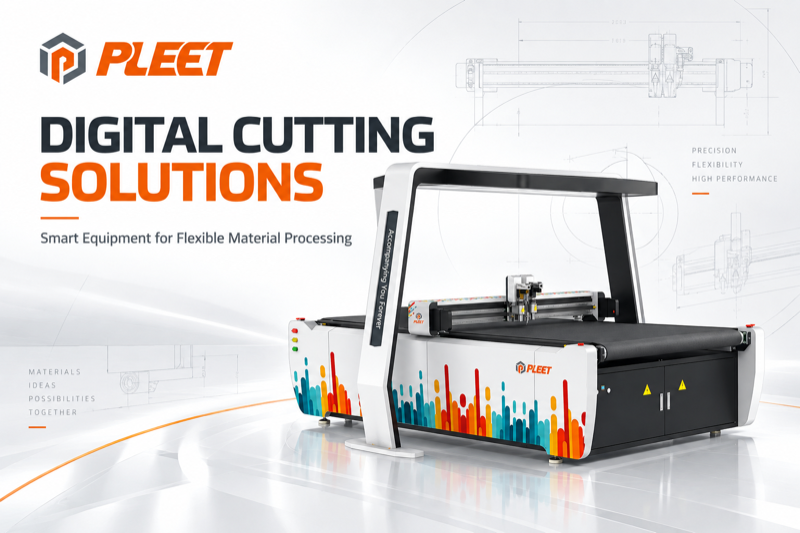
Shandong PLEET Intelligent Technology Group Co., Ltd. develops and manufactures CNC digital cutting equipment for flexible materials.
Its documented capabilities include:
Oscillating knife cutting
Configurable cutting tools
Creasing functions
Kiss-cutting options
V-cutting options
Automatic nesting
Vacuum material holding
Automatic feeding
CCD vision positioning
Customized working areas
Depending on configuration and material testing, these capabilities may support suitable advertising applications such as:
Foam board displays
Corrugated cardboard signs
Printed graphics
Stickers and decals
Promotional packaging
Retail display structures
Advertising textiles
PLEET's documented manufacturing procedures include incoming component inspection, assembly quality control, calibration, stability testing, continuous-operation testing, and final inspection.
The company provides:
Material cutting trials
Application analysis
Equipment configuration guidance
Installation and commissioning
Operator training
Maintenance guidance
7×24 remote technical support
For advertising manufacturers seeking a multifunctional cutting system, PLEET is a relevant supplier to evaluate.
However, the exact cutting tools, material compatibility, registration performance, and production capacity should be confirmed for the proposed machine.
For many compatible foam boards, corrugated cardboard displays, and promotional materials, a multifunctional CNC digital flatbed cutter is a practical choice. Thick rigid boards may require CNC routing.
Yes. Suitable systems can cut printed graphics, and camera registration can help align cutting contours with the artwork.
Some thin, compatible PVC foam boards can be processed using suitable knife tools. Thicker or denser boards may require routing.
A vinyl cutting plotter or digital flatbed cutter with suitable kiss-cutting capability can process many adhesive materials. Camera registration is useful for printed stickers.
CCD vision is useful when printed graphics must align with cutting contours. Plain unprinted materials may not require it.
A multifunctional digital flatbed cutter may process all three using different tools, provided the exact materials are compatible with the selected configuration.
A flatbed knife cutter is often better suited to flexible and selected semi-rigid materials. A CNC router is generally more appropriate for rigid acrylic, aluminum composite panels, and other hard boards.
Test actual materials and artwork to verify edge quality, print registration, cutting completeness, repeatability, material utilization, and cost per acceptable component.
The best cutting machine for advertising boards and printed graphics depends on the materials, product dimensions, cutting complexity, and production requirements.
For businesses processing compatible foam boards, corrugated cardboard, adhesive graphics, promotional displays, and flexible advertising materials, a multifunctional CNC digital flatbed cutter can provide valuable flexibility.
Its main advantages include:
Digital Pattern Flexibility + Multiple Cutting Tools + Camera Registration + Automatic Nesting + No Dedicated Cutting Dies
However, rigid materials such as thick acrylic and aluminum composite panels may require CNC routing or other specialized equipment.
The most important selection factors are:
Material Compatibility + Cutting Tool Configuration + Print Registration + Edge Quality + Working Area + Production Capacity
PLEET offers configurable digital cutting systems with oscillating knife technology, automatic nesting, vacuum holding, optional camera registration, and additional tools for suitable advertising applications.
Manufacturers should request cutting trials using their actual materials and printed artwork before making an investment.
A well-matched cutting system can help advertising businesses handle more varied orders, maintain consistent product quality, reduce unnecessary waste, and respond more efficiently to changing customer designs.