
400-867-1999
In sofa and furniture manufacturing, fabric cutting is one of the most important steps affecting product quality, material costs, and production efficiency. Even a small cutting error can create problems during sewing, upholstery assembly, and final furniture installation.
For manufacturers producing sofas, upholstered chairs, recliners, headboards, and customized furniture, traditional manual cutting often creates challenges. Fabric patterns must be positioned correctly, material waste must be controlled, and different furniture designs require frequent cutting adjustments.
A fabric cutting machine for sofa and furniture manufacturing provides a digital solution for cutting upholstery fabrics into accurate shapes while improving production flexibility.
Modern CNC fabric cutting systems combine computer-controlled cutting tools, automatic nesting software, vacuum holding, and optional automatic feeding. These technologies help furniture manufacturers manage complex patterns, reduce repetitive manual work, and improve cutting consistency.
However, different upholstery materials require different cutting methods. Woven fabric, velvet, synthetic leather, natural leather, and foam-backed textiles do not behave identically during cutting.
Choosing the right machine therefore requires careful consideration of material structure, cutting accuracy, production volume, and downstream sewing requirements.
This guide explains how digital fabric cutting machines work, their applications in furniture manufacturing, and how to select a suitable cutting system.
Furniture manufacturing involves several connected production stages:
Furniture Design → Pattern Development → Fabric Cutting → Sewing → Upholstery Assembly → Final Inspection
Cutting accuracy affects every stage that follows.
For example, if a sofa seat-cover panel is too small, workers may struggle to stretch it over the cushion.
If the panel is too large, the finished upholstery may develop wrinkles or loose areas.
Incorrectly positioned notches can also cause sewing misalignment.
Furniture manufacturers frequently encounter:
Inconsistent cutting dimensions
Excessive material waste
Long pattern preparation times
Fabric stretching during cutting
Difficulty processing complex contours
Frequent manual repositioning
High dependence on experienced cutting operators
Slow changeovers between furniture models
These problems become more significant when manufacturers produce many sofa styles, customized sizes, and different upholstery materials.
Digital cutting can address several of these challenges through programmable cutting paths and suitable material-handling systems.
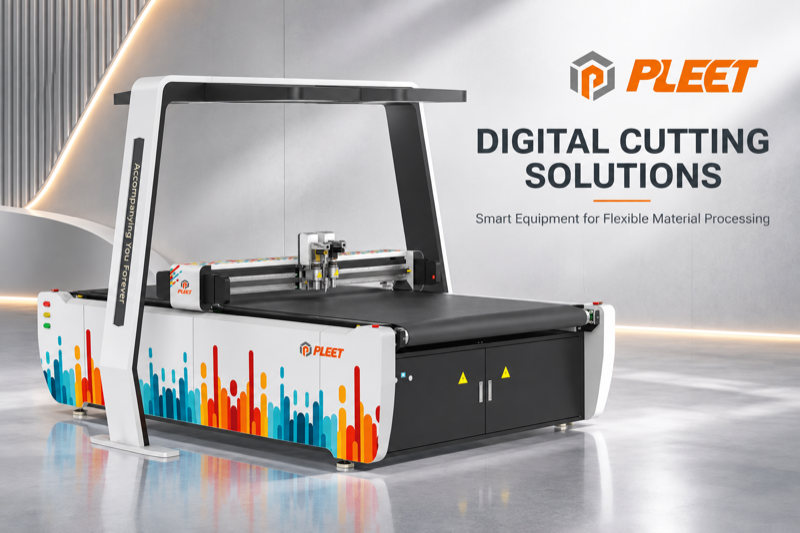
A CNC fabric cutting machine is a computer-controlled system that cuts textile materials according to digital patterns.
For many upholstery applications, a flatbed oscillating knife cutting machine or rotary knife system is a practical choice.
The cutting head follows programmed contours while the material is stabilized on the cutting table.
A typical digital upholstery cutting system may include:
CNC cutting table
Oscillating knife or rotary knife cutting head
Servo motion-control system
Digital cutting software
Automatic nesting functions
Vacuum material holding
Optional conveyor feeding
Optional marking tools
Optional CCD vision positioning
The actual configuration depends on the materials and production requirements.
The operator imports digital cutting patterns into the software.
The software arranges the patterns according to material dimensions and applicable orientation restrictions.
The fabric is then positioned on the cutting table.
The machine follows the programmed cutting paths.
Finished components are collected and transferred to sewing or upholstery assembly.
The workflow can be summarized as:
CAD Pattern → Automatic Nesting → Fabric Loading → CNC Cutting → Component Collection → Sewing
For compatible roll-fed materials, automatic feeding can reduce repeated manual positioning.
The main advantage is that manufacturers can change sofa and furniture cutting patterns through software without producing a dedicated physical cutting die for every design.
Furniture manufacturers use many different materials.
A configurable CNC cutting machine can process a range of compatible fabrics and flexible materials.
| Material | Furniture Application | Main Cutting Challenge |
|---|---|---|
| Woven upholstery fabric | Sofas, chairs, cushions | Fraying and grain direction |
| Polyester fabric | Upholstered furniture | Material movement |
| Linen-blend fabric | Sofas and decorative panels | Fraying and dimensional stability |
| Velvet | Premium sofas and chairs | Pile direction and surface marks |
| Chenille fabric | Sofas and cushions | Yarn movement and fraying |
| Knitted upholstery fabric | Stretch covers | Elasticity and distortion |
| Synthetic leather | Sofas, recliners, chairs | Coatings and backing layers |
| Natural leather | Premium furniture | Hide defects and irregular shapes |
| Microfiber fabric | Sofas and upholstered chairs | Directional appearance |
| Foam-backed fabric | Furniture panels | Compression and layer stability |
| Nonwoven fabric | Furniture backing and internal layers | Fiber movement |
| Flexible PU foam | Cushion and padding components | Compression and recovery |
These are potential applications rather than universal cutting guarantees.
A machine suitable for lightweight polyester upholstery may require different tools to process thick synthetic leather.
Likewise, cutting a foam-backed fabric is not necessarily equivalent to cutting a thick upholstery foam block.
Manufacturers should verify compatibility using actual production materials.
An oscillating knife cutting machine uses a rapidly reciprocating blade to separate material mechanically.
The cutting head follows digital contours generated from CAD files.
For compatible upholstery materials, the technology offers several advantages.
No dedicated cutting dies: Manufacturers can change cutting patterns through software.
Complex contours: The machine can process suitable curves, corners, notches, and irregular shapes.
No intentional thermal cutting: The process avoids the concentrated heat associated with laser cutting.
Automatic nesting: Software can arrange components to improve material utilization.
Repeatable cutting: Validated cutting files can be reused for recurring furniture orders.
Mechanical cutting may still cause:
Fabric fraying
Yarn pulling
Material stretching
Blade-related distortion
Incomplete cutting
Edge irregularities
The correct blade and cutting parameters must be selected according to fabric construction.
Many digital flatbed knife systems are designed primarily for single-ply or limited-layer cutting.
They should not automatically be considered equivalent to specialized high-ply textile cutting machines.
Furniture manufacturers should choose equipment according to actual cutting thickness and production requirements.
Sofa seat covers often contain several fabric components that must fit together during sewing.
Typical components include:
Seat cushion top panels
Cushion bottom panels
Side boxing strips
Front panels
Rear panels
Decorative inserts
Zipper-related components
Incorrect dimensions can affect the final cushion shape.
Misaligned notches can create sewing difficulties.
Inconsistent cutting may also cause visible differences between furniture pieces.
Digital cutting allows manufacturers to store patterns for different sofa models.
When a production order changes, operators can select the appropriate cutting files.
The machine follows the programmed contours.
Finished fabric dimensions should be checked against the sewing and upholstery requirements.
A component may match the CAD pattern but still produce an unsatisfactory fit if the pattern itself is incorrect.
Therefore, manufacturers should validate digital cutting patterns through actual sewing and assembly trials.
Sofa backrests and armrests often require irregular cutting shapes.
Different furniture designs may use curved panels, decorative inserts, and complex seams.
Backrest front panels
Backrest rear coverings
Armrest side panels
Curved upholstery components
Decorative stitching sections
Reinforcement fabric components
CNC cutting can follow complex contours without requiring dedicated dies for each furniture design.
This is especially valuable for manufacturers producing multiple sofa styles.
Accurate curves
Consistent seam allowances
Correct notch positions
Proper fabric orientation
Suitable edge quality
For curved furniture components, even small dimensional differences may become visible during upholstery assembly.
Velvet and other pile fabrics require special attention.
Their surface appearance changes depending on pile direction and viewing angle.
Two components cut from the same fabric roll may appear different if their orientations are inconsistent.
Pile direction influences:
Surface appearance
Light reflection
Color perception
Texture consistency
Finished furniture appearance
Automatic nesting software should respect required pile direction.
For example, rotating a velvet cushion panel by 180° may improve theoretical material utilization.
However, the finished sofa may show visible differences between adjacent panels.
Manufacturers should:
Define the required pile direction.
Apply orientation restrictions in nesting software.
Verify cutting layouts before production.
Inspect component orientation during collection.
Confirm appearance during upholstery assembly.
For directional upholstery fabrics, correct visual consistency is more important than maximum theoretical material utilization.
Many furniture manufacturers use upholstery fabrics with printed or woven patterns.
Examples include:
Stripes
Checks
Floral patterns
Geometric designs
Repeating decorative motifs
Adjacent sofa panels may need to align visually.
A stripe on a seat cushion may need to continue across a backrest or armrest.
If patterns are cut without considering repeat positions, the finished furniture may appear inconsistent.
Manufacturers may need to control:
Pattern repeat length
Pattern orientation
Matching reference points
Cutting margins
Component relationships
For selected printed upholstery fabrics, CCD vision systems can recognize registration features and support cutting-path alignment.
However, conventional camera registration does not automatically solve every upholstery pattern-matching requirement.
The software and production workflow must support the intended matching process.
Use representative patterned fabrics and verify the appearance of assembled upholstery components.
Synthetic leather is widely used in sofas, recliners, office chairs, and commercial furniture.
Many products contain multiple layers.
A typical structure may include:
Surface Coating + Polymer Layer + Textile Backing
These layers influence cutting resistance and dimensional stability.
Coating damage
Material stretching
Backing deformation
Rough edges
Incomplete cutting
Layer separation
For suitable synthetic leather, mechanical cutting provides digital contour flexibility without intentional thermal processing.
Automatic nesting can improve material utilization.
For compatible roll materials, automatic feeding can reduce repeated manual repositioning.
Some synthetic leather products have directional textures or backing characteristics.
The nesting layout must respect these restrictions.
The complete material structure should be tested before purchasing equipment.
Natural leather is used in premium sofas, recliners, chairs, and other upholstered furniture.
Unlike roll-fed synthetic leather, natural hides are irregular.
They may contain:
Scars
Wrinkles
Holes
Surface marks
Thickness variation
Grain differences
Variable stretch characteristics
Visible furniture components may require high-quality hide regions.
Other components may be suitable for less visually critical areas.
Some advanced digital leather cutting systems support hide scanning, defect mapping, and quality-zone planning.
However, these functions are not included in every oscillating knife cutting machine.
Buyers should verify whether the proposed equipment supports the required inspection and nesting workflow.
For suitable natural leather, evaluate:
Appropriate cutting tools
Stable flatbed positioning
Digital pattern management
Nesting software
Hide inspection procedures
Optional defect-mapping capabilities
For premium leather furniture, acceptable hide utilization and surface quality may be more important than maximum cutting speed.
Fabric is a major cost component in upholstered furniture manufacturing.
Inefficient cutting layouts can leave significant unused material between patterns.
Automatic nesting software arranges cutting patterns within the available fabric area.
Fabric grain direction
Pile direction
Printed-pattern orientation
Material stretch direction
Leather defects
Required component quantities
Cutting margins
Suppose a furniture manufacturer needs acceptable upholstery components occupying 900 m².
At 75% material utilization, the required fabric area is:
900 ÷ 0.75 = 1,200 m²
If improved nesting increases utilization to 80%, material consumption becomes:
900 ÷ 0.80 = 1,125 m²
The potential reduction is 75 m², or 6.25% of the original material consumption.
This is an illustrative calculation, not a guaranteed result.
Actual savings depend on component geometry, fabric width, pattern restrictions, and existing cutting efficiency.
A layout that rotates every pattern freely may produce an attractive utilization percentage.
However, it may violate grain direction, pile direction, or pattern-matching requirements.
The correct objective is to minimize fabric consumption per acceptable finished furniture component.
Many upholstery fabrics are supplied in rolls.
For compatible materials, automatic feeding can reduce repetitive manual positioning.
A typical workflow is:
Roll Loading → Automatic Feeding → Material Positioning → Vacuum Holding → CNC Cutting → Collection
Reduced repetitive handling
More consistent cutting cycles
Improved processing of long fabric rolls
Reduced manual repositioning
Better production continuity
Stretching: Excessive tension may distort knitted upholstery fabric.
Misalignment: Lateral movement can shift cutting patterns.
Wrinkling: Thin or soft materials may develop folds.
Uneven feeding: Inconsistent advancement may affect cutting accuracy.
Evaluate feeding over multiple consecutive cycles.
Check:
Material alignment
Tension control
Wrinkle formation
Fabric stability
Finished-part dimensions
Automatic feeding should improve workflow efficiency without compromising cutting quality.
Upholstery fabrics may be porous, elastic, or sensitive to tension.
These characteristics affect cutting accuracy.
Vacuum adsorption helps stabilize suitable materials against the cutting table.
Air may pass through the material, reducing effective holding force.
Excessive tension or unstable positioning may distort the material.
The cutting surface and handling method must avoid unacceptable pile damage.
Material compression may affect cutting dimensions.
Vacuum capacity
Holding-zone control
Material permeability
Surface flatness
Stability during cutting
Repeatability across production cycles
A stronger vacuum system does not automatically guarantee better cutting results.
The objective is stable material positioning without unacceptable deformation.
Manual cutting remains common in small furniture workshops.
However, it can become inefficient as production volume and design complexity increase.
| Factor | Manual Cutting | CNC Digital Cutting |
|---|---|---|
| Cutting method | Operator-controlled | Computer-controlled |
| Pattern changes | Manual preparation | Digital file changes |
| Complex contours | Skill-dependent | Programmable cutting paths |
| Repeatability | Operator-dependent | More consistent when validated |
| Material nesting | Manual layout | Automatic nesting available |
| Labor requirements | Often higher for repetitive tasks | Depends on automation level |
| Initial investment | Lower | Higher |
| Best application | Small-scale or occasional cutting | Repeated and varied production |
Manual cutting may remain economical for:
Very small workshops
Occasional upholstery repairs
Low production volumes
Simple patterns
Digital cutting becomes more valuable when manufacturers handle:
Multiple sofa models
Frequent design changes
Customized orders
Complex patterns
Expensive upholstery fabrics
Repeated production batches
The correct decision should be based on total cost per acceptable component.
Die cutting uses a physical cutting tool shaped according to the required component.
CNC cutting follows software-generated paths.
No dedicated die for normal pattern changes
Flexible design updates
Suitable for prototypes
Suitable for customized production
Automatic nesting
Reduced tooling preparation
High throughput for repeated components
Potentially lower unit costs at high volumes
Suitable for standardized designs
For manufacturers producing many different furniture styles in small or medium quantities, CNC cutting is often more flexible.
For extremely high volumes of identical compatible components, die cutting may remain economical.
The decision should consider tooling costs, order quantities, material utilization, and operating costs.
CNC cutting machines can provide precise programmed movement.
However, finished-part accuracy depends on the complete cutting process.
Important factors include:
Machine rigidity
Motion-control performance
Blade condition
Fabric elasticity
Material compression
Vacuum holding
Cutting parameters
Feeding tension
Calibration
A cutting head may follow its programmed path accurately while the fabric stretches or compresses.
After cutting, the material may recover.
The finished component may therefore differ from the programmed geometry.
According to its company documentation, applicable PLEET digital cutting platforms have manufacturer-stated capabilities including:
Cutting accuracy of up to ±0.01 mm under specified conditions
Maximum cutting speed of up to 2000 mm/s under suitable conditions
These specifications should not be interpreted as guaranteed finished-part tolerances or actual production speeds for every upholstery material.
Cut representative furniture components and measure:
Overall dimensions
Curved-edge consistency
Notch positions
Seam allowances
Pattern orientation
Repeatability across cutting cycles
Where possible, verify components through actual sewing and upholstery assembly trials.
Maximum cutting speed does not represent actual production output.
The complete production cycle includes:
Pattern Preparation + Fabric Loading + Positioning + Cutting + Unloading + Inspection
For roll-fed materials, feeding time must also be included.
A useful formula is:
Acceptable Components per Hour = Acceptable Components Produced ÷ Total Production Time
For example, suppose a machine produces 500 acceptable upholstery components during a five-hour production period.
The average output is:
500 ÷ 5 = 100 acceptable components per hour
This is an illustrative calculation.
Furniture manufacturers should measure:
Acceptable components per shift
Material utilization
Reject rate
Pattern-change time
Operator intervention
Blade consumption
Machine downtime
Cost per acceptable component
For manufacturers handling frequent design changes, fast digital changeovers may be more valuable than maximum cutting-head speed.
The price depends on machine configuration.
Major cost factors include:
Working area
Machine construction
Cutting-head technology
Vacuum holding
Automatic feeding
Nesting software
CCD vision positioning
Additional cutting tools
Installation and technical support
A compact machine for customized upholstery components has different requirements from a large-format industrial fabric cutting line.
A simplified formula is:
Total Cost = Equipment + Labor + Material Waste + Consumables + Energy + Maintenance + Downtime
Then calculate:
Cost per Acceptable Component = Total Cutting-Process Cost ÷ Acceptable Components Produced
A higher initial investment may be justified when automation reduces material waste, repetitive handling, and rejected components.
However, expected savings should be verified using actual production data.
| Problem | Possible Cause | Recommended Action |
|---|---|---|
| Fabric fraying | Worn blade or unsuitable parameters | Inspect blade and optimize settings |
| Velvet appearance mismatch | Incorrect pile direction | Apply orientation restrictions |
| Pattern mismatch | Incorrect cutting layout | Verify pattern registration |
| Fabric stretching | Excessive feeding tension | Improve tension control |
| Dimensional variation | Material movement or recovery | Improve holding and measurement |
| Synthetic leather edge damage | Incorrect blade geometry | Test suitable cutting tools |
| Foam-backed fabric compression | Excessive cutting force | Optimize cutting parameters |
| Roll misalignment | Feeding system problems | Check alignment |
| Excess material waste | Inefficient nesting | Optimize cutting layouts |
| Low productivity | Long setup or handling time | Evaluate complete production cycle |
Troubleshooting should begin by identifying whether the defect originates from the material, cutting tool, holding system, or machine configuration.
Changing multiple parameters simultaneously can make the root cause difficult to determine.
Before purchasing, manufacturers should evaluate the equipment against actual production requirements.
Can the machine process the intended upholstery fabrics, synthetic leather, and other materials?
Can it cut the complete material structure while maintaining acceptable edge quality?
Can the machine accommodate the largest practical furniture component?
Does the system support suitable blades for different upholstery materials?
Do components meet dimensional and sewing requirements?
Can the software respect grain direction, pile direction, and pattern restrictions?
Is continuous roll processing necessary?
Does the application require printed-pattern registration?
Can the machine meet required output under realistic operating conditions?
Does the manufacturer provide material testing, installation, training, maintenance, and troubleshooting?
The correct machine should be configured according to the actual materials and production workflow.
A machine demonstration should use actual production materials and cutting patterns.
Evaluate each intended fabric construction separately.
Test the thickest intended production material.
Include curves, corners, notches, and seam-related features.
Inspect for fraying, tearing, stretching, and incomplete cutting.
Measure dimensions and verify sewing-related features.
Run multiple cutting cycles to assess consistency.
Evaluate material utilization using actual furniture patterns.
If applicable, test alignment and tension over consecutive cycles.
For patterned upholstery, verify visual alignment between components.
Use representative cut components in actual sewing and upholstery assembly trials.
Record:
Finished-part dimensions
Edge quality
Material utilization
Acceptable components per hour
Reject rate
Blade consumption
Operator intervention
Sewing compatibility
Cost per acceptable component
These results provide a stronger basis for equipment selection than advertised specifications alone.
Furniture fabric cutting requires the integration of CNC motion control, cutting tools, material holding, software, and textile-processing knowledge.
A reliable manufacturer should understand how different upholstery materials behave during cutting.
Shandong PLEET Intelligent Technology Group Co., Ltd. develops and manufactures intelligent cutting equipment for flexible materials.
Its documented capabilities include:
CNC oscillating knife cutting
Configurable cutting tools
Automatic nesting
Vacuum adsorption
Automatic feeding
CCD vision positioning
Customized working areas
Industrial equipment testing
PLEET's manufacturing procedures include incoming component inspection, assembly quality control, calibration, stability testing, and continuous-operation testing.
The company also provides pre-sale material testing, application analysis, installation, operator training, maintenance guidance, and 7×24 remote technical support.
For manufacturers processing suitable upholstery fabrics, synthetic leather, natural leather, foam-backed textiles, and other furniture materials, these capabilities can support application-specific cutting solutions.
However, material compatibility, maximum cutting thickness, finished-part quality, and production performance should always be confirmed through actual material testing.
For manufacturers processing different upholstery fabrics and customized furniture patterns, a CNC digital cutting machine with suitable knife tools, automatic nesting, and optional feeding is often a practical choice.
Yes. Suitable oscillating knife systems can cut many woven, synthetic, and foam-backed upholstery materials. Blade selection and material holding must be optimized.
Yes. Suitable systems can process many velvet fabrics. However, pile direction and surface protection must be carefully controlled.
Yes. Many synthetic leather materials can be processed using suitable mechanical cutting tools. The complete coating and backing structure should be tested.
Automatic nesting can improve material utilization by arranging patterns efficiently while respecting grain direction, pile direction, and other production restrictions.
Automatic feeding is useful for repeated processing of compatible roll materials. For occasional cutting or irregular natural leather hides, manual flatbed loading may be more appropriate.
Use actual production materials to test cutting quality, finished-part accuracy, material utilization, repeatability, sewing compatibility, and cost per acceptable component.
A fabric cutting machine for sofa and furniture manufacturing provides a flexible digital solution for many upholstery materials, including woven fabrics, synthetic leather, natural leather, velvet, and selected foam-backed textiles.
Its main advantages include:
Digital Pattern Flexibility + Mechanical Cutting + No Dedicated Cutting Dies + Automatic Nesting + Repeatable Production
For roll-fed upholstery materials, automatic feeding can reduce repetitive handling.
For selected printed fabrics, CCD vision positioning can support contour alignment.
However, furniture materials differ significantly in elasticity, thickness, surface texture, backing structure, and pattern requirements.
The most important selection factors are:
Material Compatibility + Cutting Tool Configuration + Fabric Orientation + Material Holding + Finished-Part Accuracy
For industrial production, additional priorities include:
Material Utilization + Sewing Compatibility + Production Reliability + Technical Support
PLEET's configurable intelligent cutting systems combine oscillating knife technology, automatic nesting, vacuum holding, optional feeding, and CCD vision positioning for suitable furniture upholstery applications.
Before investing, manufacturers should evaluate actual material samples and verify cutting performance through representative production and sewing tests.
The best sofa fabric cutting solution is not simply the machine with the highest advertised speed. It is the system that consistently produces accurate upholstery components, reduces unnecessary fabric waste, supports changing furniture designs, and delivers reliable long-term manufacturing performance.