
400-867-1999
Finding a reliable oscillating knife cutting machine supplier is one of the most important decisions for manufacturers planning to automate flexible-material cutting.
A suitable machine can improve cutting consistency, reduce material waste, support customized production, and minimize dependence on traditional cutting dies. However, choosing the wrong supplier can result in poor cutting quality, frequent downtime, unexpected maintenance costs, and inadequate technical support.
For manufacturers processing fabric, leather, foam, rubber, carpets, packaging, and composite reinforcement materials, the purchasing decision should involve more than comparing equipment prices.
Two machines with similar specifications may perform very differently when processing actual production materials.
A supplier offering an attractive quotation may lack application experience, while another manufacturer may provide stronger engineering support, material testing, and long-term maintenance services.
The most reliable oscillating knife cutting machine supplier is not necessarily the cheapest. It is the company that can demonstrate suitable equipment performance, consistent manufacturing quality, and dependable technical support.
This guide explains how to evaluate suppliers, verify manufacturing capabilities, compare quotations, and reduce purchasing risks before investing.
Before searching for an oscillating knife cutting machine manufacturer, define what the equipment must accomplish.
Many purchasing problems begin when buyers request quotations without providing sufficient technical information.
A supplier cannot recommend an appropriate machine configuration based only on a general material name.
For example, EVA foam varies in density and thickness. Carpet products may contain rubber or PVC backing. Synthetic leather may include multiple coating and reinforcement layers.
These differences directly influence cutting-tool selection and machine performance.
Include the following information:
Material name and composition
Material thickness
Density or hardness, where applicable
Sheet or roll dimensions
Surface coatings and backing layers
Required cutting geometry
Finished-part tolerances
Edge-quality requirements
Expected daily production volume
Current cutting problems
Consider whether the main objective is to:
Reduce manual cutting labor
Improve dimensional consistency
Reduce material waste
Process complex contours
Eliminate dedicated cutting dies
Increase production capacity
Support customized orders
Improve printed-pattern registration
Different objectives may require different equipment configurations.
The clearer your production requirements, the easier it becomes to identify a supplier with suitable technical capabilities.
Oscillating knife cutting machines can process many flexible materials, but their performance depends on the actual material structure.
A reliable supplier should understand the differences between textile, leather, foam, rubber, and composite cutting.
| Material | Typical Applications | Main Cutting Challenge |
|---|---|---|
| Woven fabric | Apparel, upholstery | Fraying and material movement |
| Knitted fabric | Sportswear, garments | Stretching and curling |
| Natural leather | Shoes, bags, furniture | Hide defects and thickness variation |
| Synthetic leather | Automotive interiors, accessories | Coatings and backing layers |
| EVA foam | Protective packaging, footwear | Density and cutting resistance |
| EPE foam | Electronics packaging | Compression and tearing |
| Flexible PU foam | Furniture, insulation | Elastic recovery |
| Rubber sheets | Gaskets and seals | Elasticity and cutting force |
| Carpet | Floor mats and rugs | Pile and backing structure |
| Fiberglass fabric | Composite reinforcement | Abrasiveness and blade wear |
| Dry carbon fiber fabric | Composite manufacturing | Fiber orientation and fraying |
| Cardboard | Packaging prototypes | Cutting and creasing |
A machine suitable for thin fabric may not perform equally well on dense rubber or thick foam.
Similarly, a conventional oscillating knife cutter may process dry carbon fiber fabric but is generally unsuitable for rigid cured carbon fiber panels.
Request examples involving materials similar to yours.
Useful evidence includes:
Actual cutting videos
Finished component photographs
Material testing reports
Customer application descriptions
Equipment configurations
Production workflow demonstrations
A supplier with genuine application experience should explain both the advantages and limitations of its equipment.
Avoid suppliers that claim one machine can cut every material without qualification.
When sourcing industrial cutting equipment, buyers may encounter manufacturers, trading companies, distributors, and equipment integrators.
Each business model can be legitimate.
However, understanding the supplier's role helps clarify who is responsible for engineering, manufacturing, quality control, and after-sales service.
A direct manufacturer may offer:
Factory-level production control
Direct communication with engineers
Customized machine configurations
Equipment testing before shipment
Direct spare-parts support
Technical troubleshooting
These suppliers may provide:
Access to multiple equipment brands
Localized sales support
Export coordination
Consolidated purchasing
Regional installation services
However, some technical questions may need to be referred to the original manufacturer.
Ask for:
Registered company name
Business registration information
Factory address
Production workshop photographs
Mechanical assembly information
Electrical installation procedures
Quality-control documentation
Factory inspection arrangements
Where practical, arrange a factory visit or live video inspection.
A professional website or attractive product catalog does not independently prove manufacturing capability.
An industrial oscillating knife cutting machine is an integrated system.
Its performance depends on mechanical engineering, CNC motion control, cutting-tool technology, software, and material handling.
A reliable manufacturer should understand how these elements work together.
Evaluate the supplier's experience with:
Machine frame construction
Linear guides
Transmission systems
Cutting-head design
Working-area configuration
Conveyor mechanisms
Vacuum tables
Important components include:
Servo motors
Servo drives
CNC controllers
Sensors
Electrical protection systems
Machine safety controls
Different materials require different blade geometries and cutting parameters.
A knowledgeable supplier should explain how blade length, sharpness, cutting force, and oscillation settings affect cutting quality.
Relevant functions may include:
CAD file processing
Automatic nesting
Cutting-path optimization
Cutting parameter management
CCD vision recognition
Production file management
A strong supplier should understand material-specific problems.
For example, porous fabrics may be difficult to stabilize using vacuum holding, while thick foam can create blade deflection.
A reliable supplier should explain why a particular machine configuration is suitable for your application, rather than simply recommending its most expensive model.
Machine construction directly influences stability, cutting consistency, maintenance requirements, and long-term reliability.
Two oscillating knife cutting machines with similar advertised specifications may differ significantly in mechanical quality.
A rigid frame helps maintain stable movement during cutting.
Linear guides and transmission components influence movement smoothness and repeatability.
The cutting head must provide stable blade motion and sufficient capability for the intended material.
Material holding should be matched to the material's permeability, elasticity, and thickness.
Electrical components should be properly installed, protected, and documented.
Which component brands and models are used?
Are replacement parts available?
How is machine accuracy calibrated?
What maintenance is required?
What quality checks are completed during assembly?
How is continuous-operation reliability evaluated?
Recognizable component brands can be useful, but they do not independently guarantee machine quality.
The complete machine must be properly designed, assembled, calibrated, and tested.
Cutting accuracy and speed are important purchasing considerations.
However, these specifications are frequently misunderstood.
Positioning accuracy describes how closely the cutting head reaches programmed coordinates under specified conditions.
Repeatability describes how consistently the machine returns to the same position.
Finished-part accuracy describes how closely the actual cut component matches the required dimensions.
These measurements are not identical.
Flexible materials may:
Stretch
Compress
Shift
Wrinkle
Recover after cutting
For example, a rubber sheet may stretch during cutting and return toward its original dimensions afterward.
The CNC cutting head may follow the programmed path accurately while the finished component differs from the intended dimensions.
Maximum cutting speed does not represent actual production output.
The complete production cycle includes:
Material Loading + Positioning + Cutting + Unloading + Inspection
A machine with a higher advertised speed may produce fewer acceptable components if material handling is inefficient.
Ask the supplier to demonstrate:
Finished-part dimensions
Edge quality
Cutting repeatability
Material utilization
Acceptable components per hour
Continuous cutting performance
The most useful specification is not the highest advertised speed. It is the machine's ability to produce acceptable components consistently under real production conditions.
Oscillating knife cutting machines may support different cutting tools.
However, not every machine includes the same functions.
| Cutting Tool | Main Function | Typical Application |
|---|---|---|
| Oscillating knife | Mechanical contour cutting | Foam, leather, rubber, carpet |
| Rotary knife | Cutting compatible flexible materials | Fabrics and technical textiles |
| Drag knife | Cutting selected thin materials | Films and lightweight sheets |
| Kiss-cutting tool | Cutting upper layers without fully separating backing | Adhesive materials |
| Creasing wheel | Creating fold lines | Packaging and cardboard |
| V-cutting tool | Producing angled grooves | Compatible foam and boards |
| Punching tool | Producing suitable openings | Gaskets and industrial components |
| Marking tool | Adding identification marks | Textiles and industrial parts |
| Milling tool | Machining compatible materials | Selected rigid or semi-rigid products |
A packaging manufacturer may need cutting and creasing.
A carpet manufacturer may prioritize oscillating knife cutting and large working dimensions.
A leather manufacturer may focus on clean edges and nesting efficiency.
A technical textile manufacturer may require specialized blades for abrasive reinforcement fabrics.
More tools do not automatically mean better production performance.
Additional functions can increase purchase price, maintenance requirements, and operator training.
Ask the supplier to identify which tools are necessary for your actual materials.
Software plays an important role in material utilization and production efficiency.
A mechanically capable cutting machine may still create workflow problems if its software cannot process existing production files.
Depending on the system, supported formats may include:
DXF
AI
PLT
However, file compatibility should be verified using actual production files.
Check whether the software preserves:
Dimensions
Contours
Notches
Internal openings
Material orientation
Required quantities
Nesting software arranges components within the available material area.
It can help reduce unused material while respecting production restrictions.
Suppose a manufacturer needs acceptable components occupying 800 m².
At 80% utilization, the required material is:
800 ÷ 0.80 = 1,000 m²
If improved nesting increases utilization to 85%, the required material becomes:
800 ÷ 0.85 ≈ 941.2 m²
The potential reduction is approximately 58.8 m².
This is an illustrative calculation, not a guaranteed result.
Actual savings depend on material restrictions, component geometry, and existing production methods.
Software may need to respect:
Fabric grain direction
Leather defects
Carpet pile direction
Printed-pattern orientation
Composite fiber orientation
Cutting margins
The best nesting layout is not necessarily the one with the highest theoretical utilization.
It is the layout that produces the greatest number of acceptable components from the available material.
Automatic feeding and CCD vision can improve production efficiency for suitable applications.
However, they address different problems.
Automatic feeding is particularly useful for compatible roll materials.
Examples include:
Fabric
Synthetic leather
Carpet
Technical textiles
Advertising textiles
Flexible insulation
A conveyorized system can reduce repeated manual repositioning.
However, feeding tension and alignment must be controlled.
CCD vision uses cameras to recognize printed patterns or registration marks.
The software adjusts cutting paths according to the actual printed material position.
This is useful for:
Printed sportswear
Flags
Advertising graphics
Printed synthetic leather
Decorative carpets
CCD vision is valuable when printed graphics must align accurately with cutting contours.
For plain foam, rubber, or unprinted fabrics, conventional CNC positioning may be sufficient.
Are automatic feeding and CCD vision included or optional?
What materials have been tested?
What correction functions does the vision system support?
How is feeding tension controlled?
Can the system maintain accuracy over repeated cycles?
What additional maintenance is required?
Choose automation based on actual production bottlenecks rather than feature lists alone.
A reliable supplier should be willing to demonstrate machine performance using actual production materials.
This is one of the most effective ways to reduce purchasing risks.
Send materials that reflect normal production conditions.
Include:
Minimum and maximum material thickness
Representative component shapes
Complex curves
Internal openings
Narrow features
Required edge quality
Finished-part tolerances
Inspect:
Cutting completeness
Edge smoothness
Material compression
Fiber fraying
Dimensional accuracy
Repeatability
Blade wear
A single successful sample is not enough.
Ask the supplier to perform multiple cutting cycles.
This helps reveal problems related to blade wear, material movement, and machine stability.
Useful records include:
Cutting videos
Finished component photographs
Measurement results
Cutting parameters
Production-cycle time
Material utilization
Tool consumption
For important purchases, arrange a formal factory acceptance test before shipment.
Actual material testing provides stronger purchasing evidence than product brochures or general performance claims.
A reliable oscillating knife cutting machine manufacturer should have documented quality-control processes.
These may include several stages.
Checking mechanical and electrical components before assembly.
Verifying mechanical alignment, electrical installation, and component integration.
Checking machine positioning and movement performance.
Confirming the operation of cutting tools, software, sensors, and vacuum systems.
Evaluating machine behavior during repeated operation.
Confirming that the completed equipment meets agreed technical requirements.
Ask for relevant inspection records, testing procedures, and acceptance criteria.
For overseas buyers, factory acceptance testing can be especially valuable because resolving problems after international shipment may be expensive.
After-sales service is one of the most important factors in long-term equipment reliability.
Industrial cutting machines contain mechanical, electrical, and software components that require maintenance.
A reliable supplier should provide clear arrangements for:
Installation
Commissioning
Operator training
Maintenance guidance
Remote troubleshooting
Spare-parts supply
Software support
Warranty service
Equipment upgrades
What is the warranty period?
Which components are covered?
Which parts are considered consumables?
How quickly can replacement parts be supplied?
Is remote technical support available?
Are installation and training included?
Are software updates provided?
What maintenance is required?
For overseas purchases, clarify responsibility for:
Shipping replacement parts
International freight
Customs clearance
On-site installation
Remote troubleshooting
Warranty-related transportation
Service commitments should be documented in writing.
A supplier offering strong technical support may provide better long-term value than one offering a lower initial price with unclear service arrangements.
The purchase price is only one part of the investment.
A lower-priced machine may create higher operating costs through material waste, maintenance, labor requirements, and downtime.
| Cost Category | What to Evaluate |
|---|---|
| Equipment | Machine and included functions |
| Shipping | Freight, insurance, customs and delivery |
| Installation | Commissioning and setup |
| Training | Operator and maintenance training |
| Labor | Required operators and material handling |
| Material waste | Scrap and rejected components |
| Consumables | Blades and wear parts |
| Energy | Machine and vacuum-system consumption |
| Maintenance | Routine servicing and repairs |
| Downtime | Production interruptions |
| Software | Licensing and updates, if applicable |
A useful formula is:
Cost per Acceptable Component = Total Cutting-Process Cost ÷ Acceptable Components Produced
Suppose two suppliers offer different machines.
| Factor | Supplier A | Supplier B |
|---|---|---|
| Purchase price | $22,000 | $32,000 |
| Annual operating cost | $38,000 | $29,000 |
| Five-year purchase and operating cost | $212,000 | $177,000 |
This simplified example excludes financing, residual value, and the time value of money.
Although Supplier B requires a higher initial investment, its assumed lower operating costs result in a lower five-year total.
These figures are hypothetical and do not represent actual supplier quotations.
The correct comparison should use real production data.
For international purchases, equipment compliance and export documentation are important.
Requirements vary by destination country.
For machines placed on the European Union market, applicable product legislation and conformity-assessment requirements must be considered.
Buyers should verify the relevant documentation for the exact machine model.
CE marking should not be treated as a universal third-party quality certification.
ISO 9001 relates to quality-management systems.
It does not independently guarantee that a particular cutting machine meets its advertised performance specifications.
Confirm:
Rated voltage
Frequency
Single-phase or three-phase supply
Rated power
Grounding requirements
Electrical protection
Installation conditions
Depending on the transaction, buyers may require:
Commercial invoice
Packing list
Shipping documents
Relevant declarations
Operating manuals
Technical documentation
Applicable certificates
The supplier should clarify which documents will be provided before shipment.
Comparing suppliers using different criteria can lead to poor decisions.
A structured evaluation system makes the process more objective.
| Evaluation Category | Suggested Weight |
|---|---|
| Material compatibility and cutting quality | 25% |
| Engineering and manufacturing capability | 20% |
| Machine construction and reliability | 15% |
| Software and automation | 10% |
| Total cost of ownership | 15% |
| After-sales service | 10% |
| Documentation and compliance | 5% |
| Total | 100% |
These weights are illustrative.
A factory processing expensive carbon fiber reinforcement may assign greater importance to material utilization and fiber-orientation control.
A manufacturer operating continuous production shifts may prioritize reliability and spare-parts availability.
Some requirements should be treated as pass-or-fail conditions.
For example:
Safe processing of the intended material
Required finished-part tolerances
Essential cutting-tool compatibility
Applicable equipment compliance
Acceptable factory testing results
A supplier should not be selected solely because it achieves a high overall score if it fails a critical requirement.
Certain warning signs should prompt further investigation.
The supplier claims one machine can cut every material without limitations.
The supplier refuses to test representative production materials.
Important information such as working area, cutting thickness, and tool configuration is missing.
The supplier cannot provide reasonable evidence of manufacturing capability.
Warranty coverage and responsibilities are not clearly documented.
The supplier cannot explain how replacement components will be supplied.
Different quotations contain unclear or changing equipment configurations.
The supplier promises specific productivity improvements without testing the buyer's actual materials.
The supplier does not agree on measurable performance requirements before shipment.
These warning signs do not automatically prove that a supplier is unreliable.
However, they indicate areas that require additional verification.
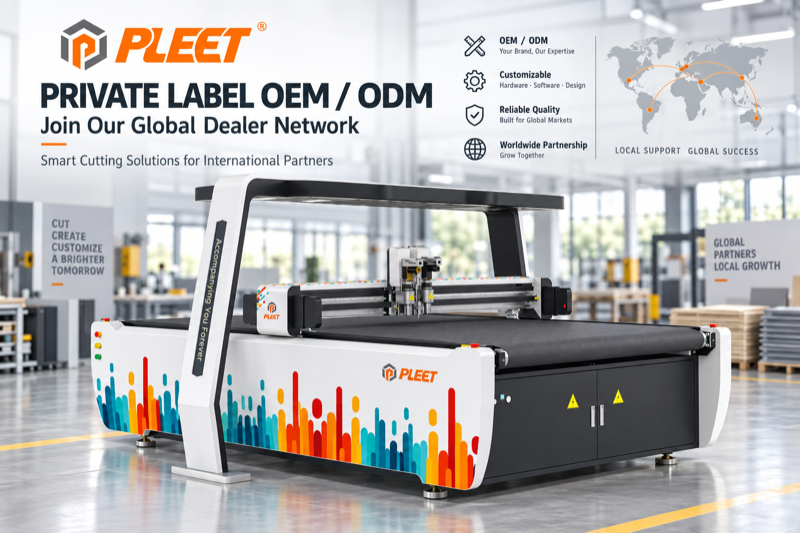
Shandong PLEET Intelligent Technology Group Co., Ltd. develops and manufactures intelligent CNC cutting equipment for flexible materials.
The company combines equipment research and development, manufacturing, quality control, and application-specific machine configuration.
PLEET's cutting solutions include:
CNC oscillating knife cutting machines
Digital flatbed cutting systems
Configurable cutting tools
Automatic nesting
Vacuum adsorption
Automatic feeding
CCD vision positioning
Customized working areas
Suitable configurations can support processing of:
Fabric and textiles
Natural and synthetic leather
EVA, EPE, and compatible PU foam
Rubber sheets
Carpets and floor mats
Packaging materials
Automotive interior materials
Selected flexible composite reinforcement fabrics
PLEET's documented manufacturing procedures include:
Incoming component inspection
Assembly quality control
Equipment calibration
Stability testing
Continuous-operation testing
Final inspection
The company provides:
Material testing
Application analysis
Equipment configuration advice
Installation and commissioning
Operator training
Maintenance guidance
Remote technical support
PLEET also reports 7×24 remote technical assistance.
These capabilities make PLEET a relevant supplier to evaluate for suitable flexible-material cutting applications.
However, buyers should verify the exact machine configuration, material compatibility, service terms, and production performance before purchasing.
Large-format carpet manufacturing requires careful consideration of cutting area, material holding, and feeding.
PLEET has documented a customized cutting project for a carpet manufacturer in Zhejiang, China.
The customer produced carpets for hotels, offices, residential applications, and export markets.
Its materials included tufted carpets, printed carpets, and PVC mats.
PLEET supplied a 3.2 m × 4.5 m oscillating knife cutting system equipped with:
Automatic feeding
Vacuum holding
Intelligent nesting
Configurable cutting tools
According to the documented project, the system supported:
Large-format carpet cutting
Complex contour processing
Reduced repeated material repositioning
Reduced secondary joining for suitable products
Improved cutting consistency
Better material utilization
These outcomes describe the specific customer application rather than guaranteed results for every installation.
The project illustrates why a reliable supplier should configure equipment around the customer's actual material and production requirements.
Before signing a purchase agreement, confirm the following items.
| Checklist Item | What to Verify |
|---|---|
| Material compatibility | Actual production samples tested |
| Cutting quality | Finished edges and dimensions accepted |
| Working area | Suitable for material and component sizes |
| Cutting tools | Required tools included |
| Software | Existing CAD files supported |
| Automatic nesting | Material restrictions respected |
| Vacuum holding | Stable cutting without deformation |
| Automatic feeding | Suitable for intended roll materials |
| CCD vision | Registration performance verified if required |
| Machine construction | Components and assembly documented |
| Factory testing | Acceptance criteria agreed |
| Warranty | Coverage and exclusions documented |
| Spare parts | Supply arrangements confirmed |
| Installation | Responsibilities clarified |
| Technical support | Availability and service terms confirmed |
| Shipping | Delivery terms and packaging agreed |
| Compliance | Applicable documentation verified |
| Total cost | Purchase and operating costs evaluated |
A reliable supplier should be able to address these points clearly and provide supporting documentation where appropriate.
Evaluate material compatibility, engineering capability, manufacturing quality, cutting accuracy, software, factory testing, spare-parts availability, and after-sales support. Request actual material demonstrations before purchasing.
Buying directly from a manufacturer may provide closer engineering communication and customization opportunities. However, distributors can also offer valuable local support. The best choice depends on technical capability and service arrangements.
Suitable configurations can process fabrics, leather, foam, rubber, carpets, packaging materials, and selected flexible composite reinforcement fabrics.
Use actual production materials to test finished-part dimensions, edge quality, repeatability, and cutting consistency. Machine positioning specifications alone are insufficient.
No. Compare total cost of ownership, including material waste, labor, consumables, maintenance, downtime, and technical support.
Automatic feeding is useful for repeated processing of compatible roll materials. For occasional sheet cutting, manual loading may remain economical.
Reliable after-sales support helps manufacturers maintain equipment, resolve technical problems, obtain replacement parts, and reduce production interruptions.
Finding a reliable oscillating knife cutting machine supplier requires a systematic evaluation of material compatibility, engineering expertise, manufacturing quality, and long-term technical support.
The purchasing decision should not be based solely on equipment price or advertised specifications.
The most important factors are:
Material Compatibility + Cutting Quality + Engineering Capability + Machine Reliability + Technical Support
For manufacturers seeking greater automation, additional considerations include:
Automatic Nesting + Vacuum Holding + Automatic Feeding + CCD Vision + Software Compatibility
A trustworthy supplier should be willing to test actual materials, explain equipment limitations, provide clear technical documentation, and agree on measurable acceptance criteria.
Shandong PLEET Intelligent Technology Group Co., Ltd. offers configurable CNC oscillating knife cutting solutions for suitable flexible materials, supported by documented manufacturing capabilities, application projects, and technical services.
Manufacturers considering PLEET or another supplier should request material-specific cutting tests, detailed quotations, and written service commitments before placing an order.
The right supplier is not simply the company that sells you a cutting machine. It is the manufacturing partner that helps you achieve consistent cutting quality, efficient material utilization, and reliable production over the long term.